GALLUP NEWS SERVICE
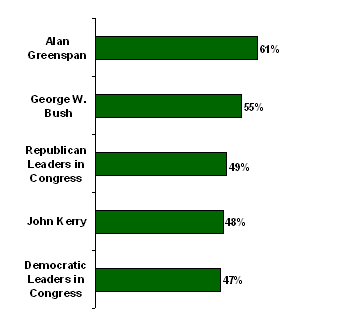
PRINCETON, NJ -- The American public, in a recent Gallup Poll, has more confidence in Federal Reserve Chairman Alan Greenspan than in five other political leaders in the United States to recommend the right thing for the economy. Sixty-one percent of Americans have a "great deal" or "fair amount" of confidence in Greenspan. President George W. Bush trails Greenspan, with 55% saying they are confident in Bush's handling of the economy. Slightly fewer than half of all Americans are confident in the Republican leaders in Congress (49%), Massachusetts Sen. John Kerry (48%), and the Democratic leaders in Congress (47%). The current results show the lowest economic confidence ratings recorded for Bush, Greenspan, and the congressional leadership on this measure over the past four years.
| Confidence in Leaders to Do or Recommend Right Thing for Economy |
 |
| April 5-8, 2004 |
Federal Reserve Chairman Alan Greenspan
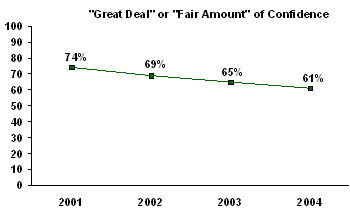
Americans have consistently said they are confident in Greenspan's recommendations for handling the nation's economy. Nearly three in four respondents in 2001 said they had at least a fair amount of confidence in Greenspan. This dropped to 69% in 2002, 65% in 2003, and is 61% in the latest poll.
| Confidence in Alan Greenspan to Do or Recommend Right Thing for Economy |
 |
The current poll shows substantial partisan differences for Greenspan's handling of the economy, with 75% of Republicans, 58% of independents, and just 51% of Democrats saying they are confident in Greenspan. Republicans have had more confidence than Democrats in Greenspan over the last four years, but the difference by partisan identification has grown larger in the latest poll. In 2001, there was only a 9-point difference between Republicans and Democrats (83% and 74%, respectively). This increased to a 17-point difference in 2002 (82% for Republicans and 65% for Democrats), and then a 6-point difference between Republicans and Democrats in 2003 (70% and 64%, respectively).
George W. Bush and John Kerry
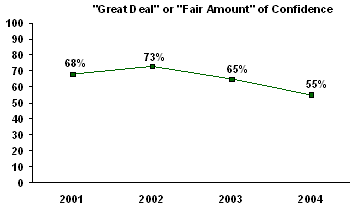
Roughly two-thirds of Americans said they had a great deal or fair amount of confidence in Bush's economic leadership in 2001. This increased to 73% in 2002, but then decreased to 65% in 2003, and further to 55% in the latest poll.
| Confidence in G.W. Bush to Do or Recommend Right Thing for Economy |
 |
While Americans are more likely to express confidence in Greenspan's economic leadership, there has actually been a higher proportion of Americans expressing a "great deal" of confidence in Bush's ability to recommend the right thing for the economy for the past three years. The gap has narrowed in that time, and this year, 24% have a high amount of confidence in Bush and 21% for Greenspan.
|
2004 Apr 5-8 |
|
|
Great deal/ |
|
% |
% |
% |
|
|
President George W. Bush |
24 |
31 |
55 |
|
Federal Reserve Chairman Alan Greenspan |
21 |
40 |
61 |
|
Massachusetts Senator John Kerry |
13 |
35 |
48 |
|
The Republican leaders in Congress |
11 |
38 |
49 |
|
The Democratic leaders in Congress |
7 |
40 |
47 |
This year, Gallup added Kerry, the presumptive Democratic presidential nominee, to the list of economic leaders. The results show that slightly fewer than half of all Americans, 48%, are confident in Kerry in this regard.
An analysis of demographic subgroups between Bush and Kerry shows the following:
- Men have more confidence in Bush than do women, by a 60% to 50% margin. Women are more likely than men to say they are confident in Kerry, by a margin of 52% to 44%.
- Americans aged 30 and older have more confidence in Bush than Kerry to make recommendations for the economy. Fifty-eight percent of 30- to 49-year-olds, 56% of 50- to 64-year-olds, and 51% of people aged 65 and over have confidence in Bush. This compares with 47% of 30- to 49-year-olds, 41% of 50- to 64-year-olds, and 44% of people aged 65 and over who are confident in Kerry. Younger Americans, those aged 18 to 29, are more confident in Kerry than Bush, by a 65% to 50% margin.
- Not surprisingly, Republicans are more likely to have confidence in Bush, while Democrats are more inclined to be confident in Kerry. When asked about their confidence in Bush, 90% of Republicans have at least a fair amount of confidence, compared with 46% among independents, and 27% among Democrats. For Kerry, 29% of Republicans are confident in his abilities to handle the economy, while 46% of independents, and 76% of Democrats say they are confident in Kerry.
The Republican and Democratic Leaders in Congress
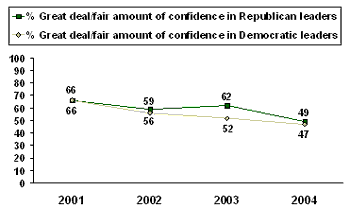
The high point in confidence for the Republican and Democratic leaders came in April 2001, when two-thirds of Americans said they were confident in both the Republicans and Democrats in Congress. These percentages dropped in 2002, with 59% of Americans saying they were confident in the Republican leaders and 56% saying they were confident in the Democratic leaders. In 2003, there was a 10 percentage-point difference in Americans' attitudes toward the Republican and Democratic leaders in Congress, with 62% confident in the Republican leaders and 52% in the Democratic leaders. However, once again, the current poll finds essentially no difference in the public's confidence in the Republican (49%) and Democratic (47%) leaders in Congress.
| Confidence in Republican and Democratic Leaders in Congress to Do or Recommend Right Thing for Economy |
 |
Survey Methods
These results are based on telephone interviews with a randomly selected national sample of 1,014 adults, aged 18 years and older, conducted April 5-8, 2004. For results based on this sample, one can say with 95% confidence that the maximum error attributable to sampling and other random effects is ±3 percentage points. In addition to sampling error, question wording and practical difficulties in conducting surveys can introduce error or bias into the findings of public opinion polls.
16. As I read some names and groups, please tell me how much confidence you have in each to do or to recommend the right thing for the economy -- a great deal, a fair amount, only a little, or almost none. How about… [ITEMS A-B ROTATED, THEN ITEMS C-D ROTATED, then item e read]?
President George W. Bush
|
|
Great |
Fair |
Only |
Almost none |
No |
|
% |
% |
% |
% |
% |
|
|
2004 Apr 5-8 |
24 |
31 |
20 |
24 |
1 |
|
2003 Apr 7-9 |
35 |
30 |
16 |
17 |
2 |
|
2002 Apr 8-11 |
36 |
37 |
15 |
11 |
1 |
|
2001 Apr 6-8 |
29 |
39 |
16 |
15 |
1 |
Federal Reserve Chairman Alan Greenspan
|
|
Great |
Fair |
Only |
Almost none |
No |
|
% |
% |
% |
% |
% |
|
|
2004 Apr 5-8 |
21 |
40 |
23 |
7 |
9 |
|
2003 Apr 7-9 |
24 |
41 |
18 |
7 |
10 |
|
2002 Apr 8-11 |
25 |
44 |
15 |
5 |
11 |
|
2001 Apr 6-8 |
29 |
45 |
11 |
5 |
10 |
The Democratic leaders in Congress
|
|
Great |
Fair |
Only |
Almost none |
No |
|
% |
% |
% |
% |
% |
|
|
2004 Apr 5-8 |
7 |
40 |
34 |
16 |
3 |
|
2003 Apr 7-9 |
11 |
41 |
26 |
19 |
3 |
|
2002 Apr 8-11 |
11 |
45 |
26 |
13 |
5 |
|
2001 Apr 6-8 |
15 |
51 |
18 |
12 |
4 |
The Republican leaders in Congress
|
|
Great |
Fair |
Only |
Almost none |
No |
|
% |
% |
% |
% |
% |
|
|
2004 Apr 5-8 |
11 |
38 |
30 |
18 |
3 |
|
2003 Apr 7-9 |
18 |
44 |
21 |
14 |
3 |
|
2002 Apr 8-11 |
13 |
46 |
23 |
14 |
4 |
|
2001 Apr 6-8 |
15 |
51 |
18 |
12 |
4 |
Massachusetts Senator John Kerry
|
|
Great |
Fair |
Only |
Almost none |
No |
|
2004 Apr 5-8 |
13% |
35 |
25 |
19 |
8 |