GALLUP NEWS SERVICE
PRINCETON, NJ -- About half of America's homeowners tell Gallup that they have taken advantage of the near-record-low long-term interest rates of the past three years to refinance their home mortgages or borrow on the equity in their homes using home equity loans or home equity lines of credit. In fact, one in six homeowners say they have done both.
As has been generally recognized, this easy access to historically low-cost, long-term consumer credit has played a significant role in helping consumers continue their spending even as the economy has experienced a mild recession and a jobless recovery. As a result, a key question for the future involves what will happen to the economy and consumer spending if long-term interest rates continue to increase, as they have over the past several months.
Higher-Income Consumers Made the Most of Refinancing Opportunities
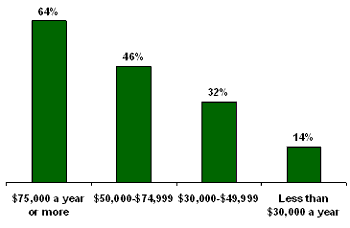
According to a Gallup Poll conducted April 5-8, 69% of Americans own their own homes. Overall, 4 in 10 of these homeowners say they have refinanced their home mortgages over the past three years. But homeowners in all income groups have not taken the same advantage of the opportunity to refinance their mortgage loans.
Nearly two in three homeowners having annual incomes of $75,000 or more say they have refinanced their mortgages over the past three years. This means that these higher-income homeowners are almost 1½ times more likely to have refinanced than are those in the $50,000 to less than $75,000 income range, and twice as likely to have refinanced as are those in the $30,000 to less than $50,000 range. Only 14% of those making less than $30,000 a year say they have refinanced.
| Percentage of Homeowners Who Have Refinanced Their Mortgages in the Last Three Years by income distribution |
 |
| April 5-8, 2004 |
Higher-Income Consumers Also More Likely to Have Borrowed on Home Equity
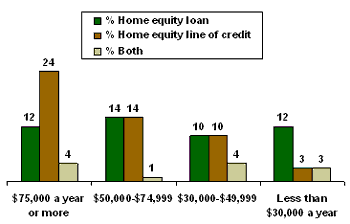
Overall, 3 in 10 homeowners say they have a home equity loan or a home equity line of credit. But once again, homeowners in all income groups have not availed themselves to the same degree of the opportunity to borrow on the equity they have in their homes.
Four in 10 homeowners having annual incomes of $75,000 or more say they have borrowed on the equity they have in their homes using a home equity loan or home equity line of credit, or both. Three in 10 homeowners with incomes in the $50,000 to less than $75,000 range say they have borrowed on their home equity, while one in four of those in the $30,000 to less than $50,000 income range say they have done so. Only 18% of those making less than $30,000 a year say they have borrowed using the equity they have in their homes.
| Percentage of Homeowners Who Have a Home Equity Loan or Home Equity Line of Credit by income distribution |
 |
| April 5-8, 2004 |
Some Consumers Have Both Refinanced and Borrowed on Home Equity
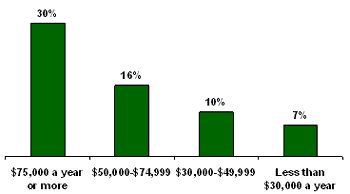
Three in 10 homeowners having annual incomes of $75,000 or more say they have refinanced and also borrowed on the equity they have in their homes. This is nearly twice the rate of those in the $50,000 to less than $75,000 income category, and at least three times the rate of the lower income groups.
| Percentage of Homeowners Who Refinanced a Mortgage and Who Have a Home Equity Loan or Line of Credit |
 |
| April 5-8, 2004 |
Why Did Homeowners Borrow on Their Home Equity?
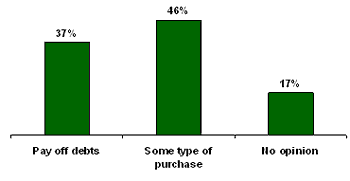
About half of homeowners who say they have a home equity loan or a home equity line of credit say they used the money for some kind of consumer purchase. Another 37% say they used the funds they borrowed to pay off other debts, while 17% didn't tell Gallup what they did with the money they borrowed.
| What Did You Use This Money For? Based on homeowners with a home equity loan or line of credit |
 |
| April 5-8, 2004 |
Easy Access to Home Equity Financing Increases Consumer Spending
Historically low long-term interest rates, as well as aggressive refinancing and home equity lending, have made it easy for most homeowners to borrow during the past several years. Of course, it is easier for those with higher incomes and better credit to both refinance and obtain a low-rate home equity loan. As a result, it is not surprising that higher-income homeowners have been better able to garner the benefits of low interest rates than have homeowners with lower incomes and/or poorer credit.
Nor is it surprising that other Gallup Polls have shown higher-income consumers to be more optimistic and more likely to spend than are other consumers. The former have been well positioned to liquefy their home equity and thus maintain their spending. Higher-income consumers have also been more likely to enjoy the wealth benefits associated with the improving stock markets than have other consumers.
What Happens if Interest Rates Increase?
Some observers are concerned that low rates have created a housing bubble that will burst as interest rates increase. Given that 3 in 10 homeowners with incomes of $75,000 or more not only refinanced but also have a home equity loan or line of credit, such an argument can be made.
Still, higher interest rates may create a more immediate problem for consumer spending. Given that many homeowners have been spending their home equity, higher interest rates could significantly reduce this source of funding for consumer spending. Of course, if higher interest rates are accompanied by higher consumer incomes, this may not be a problem. If consumer incomes remain stagnant, however, then higher interest rates could have a much greater impact on consumer spending than many currently anticipate.
Survey Methods
Results are based on telephone interviews with 1,014 national adults, aged 18 and older, conducted April 5-8, 2004. For results based on this sample, one can say with 95% confidence that the maximum margin of sampling error is ± 3 percentage points. In addition to sampling error, question wording and practical difficulties in conducting surveys can introduce error or bias into the findings of public opinion polls.
