GALLUP NEWS SERVICE
PRINCETON, NJ -- The American public is roughly split down the middle in terms of whether President George W. Bush or likely Democratic presidential nominee John Kerry would do the best job of handling the situation in Iraq. This marks a substantial change from two months ago, when Bush enjoyed a 15-point lead over Kerry on this issue. At the same time, Americans are significantly more likely to see Kerry, rather than Bush, as better able to handle the economy, while the president retains his positioning advantage against Kerry in terms of handling terrorism. All of this results in a situation in which the two candidates are essentially tied in the race for president among likely voters, although Kerry has moved out to a slight lead over Bush among registered voters.
Trial-Heat Ballot
The latest CNN/USA Today/Gallup poll, conducted May 7-9, shows that Bush and Kerry would be in a neck-and-neck race if the presidential election were held today.
From a broad perspective, this represents little significant change over the last several months. From late March to the current survey, Kerry's percentage of support from likely voters has been within a narrow range between 45% and 49%. Bush's support has ranged only between 48% and 51% of likely voters during the same time.
| Presidential Election 2004: Bush vs. Kerry Trial Heat among likely voters |
 |
The lack of change in the intentions of likely voters is perhaps surprising given that Bush's overall job approval rating has dropped to its lowest level of his administration -- 46%. It appears that while the president's positioning in the eyes of voters has become more vulnerable -- as indicated by this job approval rating and the drop in support for U.S. involvement in Iraq -- Kerry has yet to take full advantage of it.
The current parity in the presidential race is partly a result of the fact that Bush is doing better, relatively speaking, among likely voters -- individuals Gallup says would be most likely to actually vote if the election were held today.
Bush does not fare as well among the larger group of all adult Americans who are registered to vote. Kerry has a slight 50% to 44% lead over Bush among this group. Kerry's percentage of the vote among registered voters increased from 47% to 50% between the May 2-4 poll and the May 7-9 poll, while Bush's decreased from 47% to 44%.
| Presidential Election 2004: Bush vs. Kerry Trial Heat among registered voters |
 |
Thus, commensurate with the drop in Bush's job approval rating, Kerry has managed to make some gains on Bush across the broad American population. But these gains have yet to translate to a change in sentiment among that smaller group of Americans who constitute the most likely voting population.
Kerry Versus Bush on Issues
The May 7-9 poll shows that Kerry has moved to a stronger position vis-à-vis Bush on two key issues -- Iraq and the economy. Bush, however, maintains his advantage on terrorism.
A majority of Americans continue to say that Kerry could do a better job than Bush in terms of handling the economy. Kerry's advantage on this issue has expanded slightly since March:
| Would Bush or Kerry Do a Better Job on the Economy? among national adults |
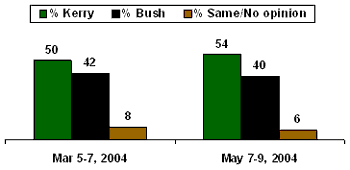 |
There is little doubt that the economy has the potential to become an issue that Kerry could use to significant campaign advantage. Almost all polling conducted over the last five months has indicated that Americans believe the candidates' ability to manage the economy successfully is the top issue they will take into account when voting for president. At the moment, Americans' ratings of the economy are down, not up, suggesting further that a challenger has the opportunity to use the issue as an effective campaign weapon against the incumbent.
Bush and Kerry are now essentially tied when the public is asked who of these two can do the better job of handling the situation in Iraq.
| Would Bush or Kerry Do a Better Job on the Situation in Iraq? among national adults |
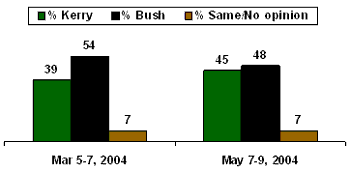 |
This marks a substantial change from March, when Bush had a 15-point advantage on the Iraq issue. Additionally, Bush's overall job approval rating on his handling of Iraq is now at only 41%, the low point of his administration.
| George W. Bush's Job Approval on the Situation in Iraq June 2003 -- Present |
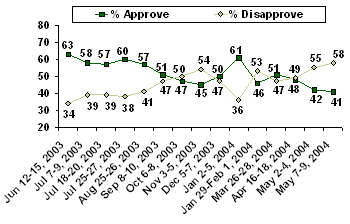 |
Despite the general trend indicating a loss of confidence in the way Bush is handling the Iraq situation, it is important to note that Kerry has not yet been able to move into a clear lead on the issue (which he has done on the economy). There is little question that Iraq is going to be a significant factor in the election this year (as it was in the Democratic primaries), but it appears that Kerry still faces the challenge of clearly and distinctly differentiating himself from Bush on the issue if it is to become a factor he can use to his advantage on Election Day.
Bush continues to have a distinct advantage over Kerry when it comes to handling terrorism.
| Would Bush or Kerry Do a Better Job on Terrorism? among national adults |
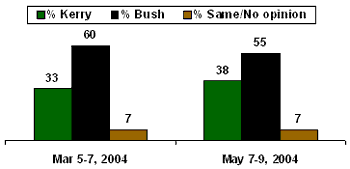 |
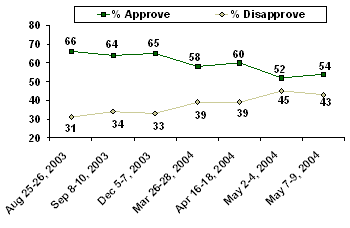
This has been Bush's signature strength since the Sept. 11, 2001, terrorist attacks, and his advantage over Kerry on this issue has diminished only slightly over the past several months. Bush's approval rating on his handling of terrorism is 54%, which -- although down significantly from his ratings on terrorism last year -- continues to be higher than his overall approval rating, or his approval on other specific issues.
| George W. Bush's Job Approval on Terrorism August 2003 -- Present |
 |
This confirmation of Bush's relatively strong positioning against Kerry on terrorism helps explain why Bush's re-election team has been emphasizing and will no doubt continue to emphasize Bush's focus on terrorism in its campaign speeches and advertisements.
Survey Methods
Results are based on telephone interviews with 1,003 national adults, aged 18 and older, conducted May 7-9, 2004. For results based on the total sample of national adults, one can say with 95% confidence that the margin of sampling error is ±3 percentage points. In addition to sampling error, question wording and practical difficulties in conducting surveys can introduce error or bias into the findings of public opinion polls.