GALLUP NEWS SERVICE
PRINCETON, NJ -- Last week's job report indicated that the U.S. economy has created nearly 1 million new jobs over the past three months, which signifies that the economy's continued expansion is finally beginning to be felt by the average American in the job market. This acknowledgment allowed Federal Reserve Board Chairman Alan Greenspan to suggest this week that the recent rise in market interest rates may not only be confirmed but, if need be, also intensified by monetary policy-makers in the months ahead.
The improving job market also helps explain why new CNN/Gallup poll economic data show consumer confidence increasing in early June. The percentage of Americans rating current economic conditions as "good" or "excellent" increased, while the percentage rating the economy as "poor" decreased. At the same time, nearly a third of Americans now say this is a good time to find a quality job -- the highest level in two years.
What the growth of jobs doesn't explain is why only 41% of Americans approve of the way President George W. Bush is handling the economy. Nor, why nearly half of the public continues to feel economic conditions are "getting worse" and not better. And, probably of most concern to the future direction of the economy, why consumer spending intentions continued to decline in June even as job market conditions continued to improve.
Consumers See Better Economic Conditions
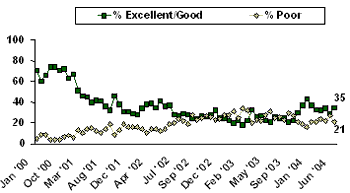
Substantially more consumers (35%) rate current economic conditions as good or excellent than rate them as poor (21%) in early June. The gap between those saying current economic conditions are excellent or good and those saying conditions are poor is now +14 percentage points -- far better than the +2 percentage-point gap in May and the largest positive gap in consumer ratings of the economy since mid-January.
| Current Economic Conditions |
 |
Consumers Remain Divided About the Economy's Direction
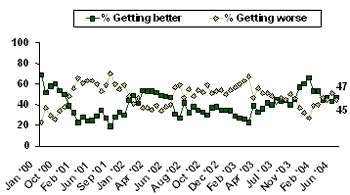
While more consumers are rating current economic conditions favorably, they are not so positive about the direction of the economy. Forty-seven percent of consumers say economic conditions are "getting better," but nearly as many (45%) say they are "getting worse." This is a clear improvement over May, when significantly fewer consumers said economic conditions were getting better (43%) than said they were getting worse (51%). On the other hand, June's percentages are identical to those of April and far less optimistic than those of mid-January (53% getting better and 39% getting worse).
| Economic Outlook |
 |
Consumer Spending Intentions Continue to Decline
In March, 31% of consumers said they intended to increase their spending over the next six months. At the same time, 22% said they intended to decrease their spending, leading to a difference of +9 percentage points. Since then, net consumer spending intentions have declined steadily so that by May, only 24% of consumers said they planned to increase their spending, while 25% said they planned to decrease it, a difference of -1 percentage point.
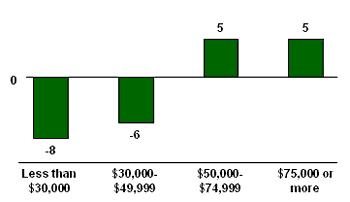
However, consumer spending intentions differ significantly by income. For example, consumers with annual incomes of less than $50,000 show a net decrease in their spending intentions over the next six months, while consumers having incomes of $50,000 or more show a net increase in their spending intentions in the months ahead.
| Personal Spending Over the Next Six
Months by income Net spending (% increase minus % decrease) |
 |
| June 3-6, 2004 |
Gas Prices Are Affecting Spending
Overall, half of American consumers (49%) say recent gas price increases have caused them financial hardship. One in three Americans (34%) say they have cut back significantly on their household spending because of these increases. That alone is enough to significantly impact consumer spending intentions, particularly when more than half of Americans (56%) expect these price increases to be permanent.
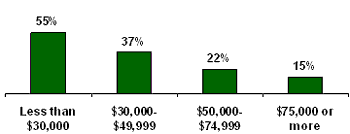
However, the potential impact of gas price increases on consumer spending intentions varies significantly by income. More than half (55%) of those consumers making $30,000 or less annually say they have cut back significantly on their household spending because of rising gas prices. In sharp contrast, only 15% of those having annual incomes of $75,000 or more say they have done likewise.
| Have You Cut Back Significantly on
Household Spending Because of Rising Gas Prices? by income (percentage saying yes) |
 |
| June 3-6, 2004 |
A Conundrum for Policy-Makers
Gallup's consumer confidence, job outlook, and consumer spending intentions data suggest that "on average" the economic expansion is building momentum. In this context, the increased focus of monetary authorities on inflation risk and the need for higher interest rates seems appropriate.
At the same time, it is clear that today's high gas prices are disproportionately affecting middle- and lower-income consumers. One result will be felt by low-end retailers as consumers spend more on gas and less in their stores.
The larger overall question, however, is whether the growing economy will produce income gains that will offset the wage-price squeeze affecting many Americans. If monetary policy-makers slow the economic expansion, they may simply intensify this squeeze on those who can afford it the least. If this is the case, it is difficult to see how Bush's economic approval rating is going to improve in the months ahead, even if the overall economy continues to do well.
Survey Methods
Results are based on telephone interviews with 1,000 national adults, aged 18 and older, conducted June 3-6, 2004. For results based on this total sample, one can say with 95% confidence that the margin of sampling error is ±3 percentage points. In addition to sampling error, question wording and practical difficulties in conducting surveys can introduce error or bias into the findings of public opinion polls.