Despite continued economic expansion, Gallup's economic measures show that consumer confidence declined during the second quarter of 2004. If the U.S. economy is doing so well, why is consumer confidence still low and getting lower? More importantly, will consumers continue to spend in the months ahead even if their confidence in the economy remains low?
An analysis of consumer confidence and spending intentions by annual household income level* provides key insights into both questions, particularly for the nation's low-end consumer retailers.
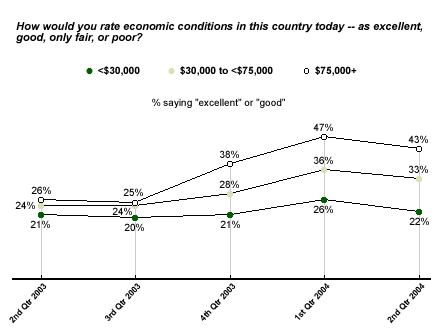
Consumer Ratings of the Economy
Almost a year ago during the third quarter of 2003, 20% of Americans in households earning $30,000 or less annually rated economic conditions as "good" or "excellent." This was four percentage points less than the positive ratings among those earning $30,000 to $75,000 (24%) and five percentage points less than positive ratings among those earning $75,000 or more (25%).
By the first quarter of 2004, all three income groups had become more positive, but the gaps among the groups had increased substantially -- positive ratings among lower-income Americans had improved only moderately, while those of the highest-income Americans had increased dramatically. During the second quarter of 2004, the ratings of Americans in all three income groups declined, but the difference in optimism among the groups remained huge. Only 22% of Americans in households earning $30,000 or less rated economic conditions as good or excellent. In sharp contrast, 43% of those in the highest income group provided positive ratings.
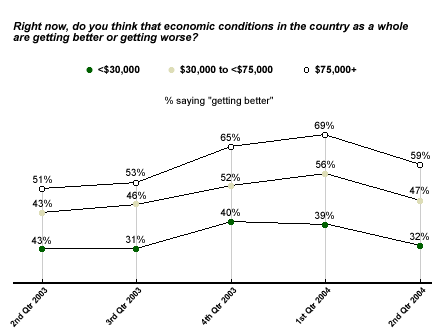
Consumer Ratings of the Economic Direction
Higher-income Americans are also much more optimistic about the direction of the economy than their lower-income counterparts are. During the third quarter of 2003, 31% of Americans earning $30,000 or less thought that economic conditions were getting better, while 46% of those in the middle income group and 53% of those in the highest group said conditions were getting better.
Here also, the gaps widened significantly with time. By the first quarter of 2004, these percentages had increased to 39% in the lowest group and 69% in the highest group, with the middle group in between at 56%. During the second quarter, Americans in all three income groups became less optimistic about the economic direction, but the gaps between the groups remained large.
Consumer Spending Intentions
During the second quarter of 2003, more Americans in all three groups expressed negative spending intentions, with more planning to spend less over the next six months than planning to spend more. Still, households in the lowest income group were considerably more pessimistic about their spending plans than were those in the highest income group.
By the fourth quarter of 2003, spending intentions among all three income groups had ventured into positive territory (that is, those planning to increase their spending outnumbered those planning to decrease it). But during the first half of 2004, the spending intentions of all three groups declined, with the intentions of the lowest income group plunging dramatically. In fact, the net spending intentions of Americans in the lowest income group have given up all they gained during the economic recovery and at a net -8.4 are now just about where they where a year ago.
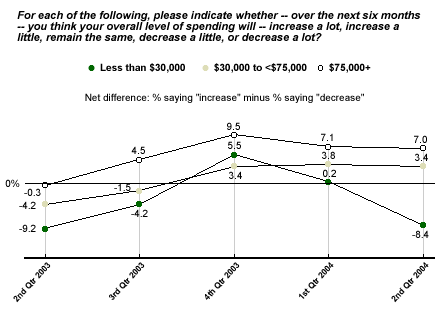
The Outlook for Consumer Spending by Income
More generally over the past year, overall measures of consumer confidence and spending intentions have masked some important underlying trends in the way Americans of varying incomes evaluate the economy. Higher-income consumers have become much more positive than their lower- and middle-income counterparts about current economic and job market conditions (see "Income Colors Job Market Views" in Related Items). Higher-income consumers are also much more optimistic about the direction of the economy and their prospects for increasing their incomes. As a result, the consumer spending intentions of higher-income Americans are much more positive than those of others.
The declining optimism and spending plans among all Americans in the second quarter of 2004 are reason for concern. High gas prices and fears of increasing interest rates appear to be taking a toll on the economy. As a result, both retail sales and the economic expansion are likely to slow during the second half of this year.
While this declining optimism will moderate the need for higher interest rates -- and therefore may not seem bad in terms of the overall economic numbers -- it will have significantly disparate effects on Americans in different income groups. Households in the upper-income group will moderate their buying but continue to enjoy "good" economic conditions overall. In sharp contrast, those in the lower-income group will need to significantly reduce their spending on non-essential purchases as their real disposable incomes decline and they continue to experience "hard" economic times.
Bottom Line
These findings are bad news for the nation's low-end retailers such as Wal-Mart, Target, and Big Lots, which may have to alter their product and price mix in the months ahead. On the other hand, the data suggest that the good times are likely to continue for higher-end retailers such as Saks and Nordstrom.
Nor does the news bode well for the Bush administration. While the economic averages suggest that Fed Chairman Alan Greenspan richly deserves the Senate's confirmation of his appointment to a fifth term, the president's re-election will depend not on the economic averages, but rather on how individual Americans perceive the overall economic situation. Right now, the underlying economic reality is that far fewer Americans are enjoying good economic times than the overall economic averages would suggest.
*Results based on interviews with 2,800+ U.S. adults, aged 18 and older, conducted quarterly from 2003 through 2004, including at least 676 persons with household incomes below $30,000, at least 1,247 persons with household incomes between $30,000 and less than $75,000, and at least 759 interviews with persons with household incomes of $75,000 or more. For results based on this sample, one can say with 95% confidence that the maximum error attributable to sampling and other random effects is ±4 percentage points for persons with incomes below $30,000, ±3 percentage points for persons with incomes between $30,000 and less than $75,000, and ±4 percentage points for persons with incomes of $75,000 or more.