GALLUP NEWS SERVICE
PRINCETON, NJ -- Four new CNN/USA Today/Gallup surveys in Ohio, Wisconsin, Oregon, and Colorado suggest that there could be some switches this year in the vote preferences of "red states" and "blue states" -- the states that gave their electoral votes, respectively, to the Republican and Democratic presidential candidates in 2000. George W. Bush currently leads Sen. John Kerry in Wisconsin, which went for former Vice President Al Gore in 2000; while Kerry is competitive with Bush in Ohio, which gave its electoral votes to Bush in 2000. Oregon was a blue state in 2000, supporting Gore by less than half of a percentage point, and Kerry seems likely to keep the state blue this year. Bush won Colorado by eight percentage points in 2000 and seems to have a lead now, but the state is more competitive this year than it was four years ago.
Each state poll was conducted over four days, between Oct. 14 and Oct. 20. Among likely voters, Bush leads by six points each in Colorado (51% to 45%) and Wisconsin (50% to 44%), while Kerry leads by eight points in Oregon (53% to 45%). The contest in Ohio is a virtual dead heat, with Kerry receiving 49% to Bush's 48% support.

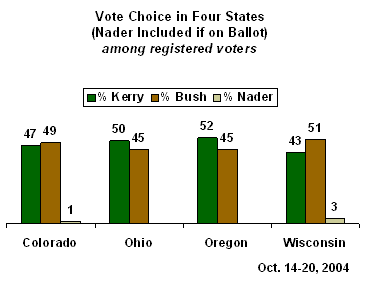
The picture among the wider group of registered voters is quite similar to the results among likely voters in two states: Oregon, where Kerry is up by seven points among registered voters and up by eight points among likely voters; and Wisconsin, where Bush is up by eight points among registered voters, two points more than among likely voters.
In the other two states, however, Kerry fares somewhat better among registered voters than likely voters, suggesting that turnout could be a major factor in who actually wins. In Ohio, Kerry's lead among registered voters is five points (50% to 45%), slightly better than the one-point lead he enjoys among likely voters. And in Colorado, Bush's lead among registered voters is just two points, compared with a six-point lead among likely voters.
Colorado
The new results in Colorado suggest an improvement for the Republicans since a similar poll conducted Oct. 3-6. At that time, just after the first presidential debate, the results showed a dead heat, with each candidate receiving 49% of the vote among likely voters and 48% among registered voters.
Trend in Vote Preferences in Colorado
|
|
Kerry/ |
Bush/ |
Nader/ |
Neither/Other/ |
|
|
% |
% |
% |
% |
|
Likely voters |
|
|
|
|
|
2004 Oct 14-17 |
45 |
51 |
1 |
3 |
|
2004 Oct 3-6 |
49 |
49 |
1 |
1 |
|
|
|
|
|
|
|
Registered voters |
|
|
|
|
|
2004 Oct 14-17 |
47 |
49 |
1 |
3 |
|
2004 Oct 3-6 |
48 |
48 |
2 |
2 |
There was also an improvement for the Republican candidate for the U.S. Senate, Pete Coors, who trailed the Democratic candidate, Ken Salazar, by 11 points (54% to 43%) among likely voters in the Oct. 3-6 poll. Coors trails by only 1 point in the current poll (49% to 48%).
|
|
|
|
Neither/Other/ |
|
|
% |
% |
% |
|
Likely voters |
|
|
|
|
2004 Oct 14-17 |
49 |
48 |
3 |
|
2004 Oct 3-6 |
54 |
43 |
3 |
|
|
|
|
|
|
Registered voters |
|
|
|
|
2004 Oct 14-17 |
51 |
45 |
4 |
|
2004 Oct 3-6 |
53 |
43 |
4 |
Among registered voters, Salazar enjoys a larger lead of 6 points, 51% to 45%, though still diminished from the 10-point lead he had in the earlier poll.
On Nov. 2, Colorado voters will have the opportunity to change the way their state's nine electoral votes are allocated. As with nearly all states, Colorado automatically awards all of its electoral votes to the candidate who wins the most votes among the people. The new amendment, if approved by Colorado voters, would take effect in the 2004 election and would allocate the electoral votes in proportion to the popular vote. If the state's electoral votes had been distributed this way in the 2000 election, Bush would have received only five of Colorado's electoral votes, Gore would have received three, and Gore would have won the presidency.
The poll shows a majority of likely voters oppose the new method of allocating electoral votes, 53% to 39%. Among registered voters, the margin is smaller but still negative: 47% opposed, 43% in favor.
As you may know, there is a proposal on the state ballot that would change the way Colorado awards its electoral votes in presidential elections. Currently, all of the electoral votes are awarded to the candidate who wins the election statewide. Under this new proposal, the electoral votes would be divided proportionately according to how much support each candidate gets. If the election were held today, would you vote for or against this proposal?
|
|
For |
Against |
NOT VOTE (vol.) |
No opinion |
|
|
% |
% |
% |
% |
|
Likely voters |
|
|
|
|
|
2004 Oct 14-17 |
39 |
53 |
* |
8 |
|
|
|
|
|
|
|
Registered voters |
|
|
|
|
|
2004 Oct 14-17 |
43 |
47 |
1 |
9 |
Salazar has officially declared his opposition to the proposal, and many political observers believe that was the kiss of death for the change -- because Salazar is a Democrat and the proposal's immediate impact was seen as most likely to help the Democratic presidential candidate.
Ohio
The current results in the Ohio survey show an improved situation for Kerry among likely voters, compared with the last two polls taken in early and late September.
Trend in Presidential Contest in Ohio
Among Likely and Registered Voters
|
|
Kerry/ |
Bush/ |
Neither/Other/ |
|
Likely voters |
% |
% |
% |
|
2004 Oct 17-20 |
49 |
48 |
3 |
|
2004 Sep 25-28 |
48 |
50 |
2 |
|
2004 Sep 4-7 ^ |
44 |
52 |
4 |
|
2004 Aug 13-15 ^ |
48 |
46 |
6 |
|
2004 Jul 19-22 ^ |
51 |
45 |
4 |
|
|
|
|
|
|
Registered voters |
|
|
|
|
2004 Oct 17-20 |
50 |
45 |
5 |
|
2004 Sep 25-28 |
50 |
46 |
4 |
|
2004 Sep 4-7 ^ |
47 |
48 |
5 |
|
2004 Aug 13-15 ^ |
52 |
42 |
6 |
|
2004 Jul 19-22 ^ |
49 |
44 |
7 |
Among registered voters, Kerry has generally enjoyed a several percentage point lead. The one exception was the Sept. 4-7 poll, which showed a virtual tie (48% for Bush, 47% for Kerry).
Ohio is likely to be one of several states to support a state ban on officially recognizing gay marriages. Voters support the ban by close to a 2-to-1 margin (62% to 33% among likely voters).
As you may know, there is a proposal on the ballot to amend the Ohio state constitution so that only marriages between a man and a woman would be recognized as legal and valid by the state. If the election were held today, would you vote for or against this proposal?
|
|
For |
Against |
NOT VOTE (vol.) |
No opinion |
|
|
% |
% |
% |
% |
|
Likely voters |
|
|
|
|
|
2004 Oct 17-20 |
62 |
33 |
* |
5 |
|
|
|
|
|
|
|
Registered voters |
|
|
|
|
|
2004 Oct 17-20 |
63 |
32 |
* |
5 |
Wisconsin
In the last three polls in Wisconsin, including one in September and two in October, Bush's lead has averaged about six points -- the same as his current lead. Among registered voters, his lead over the September and October polls averaged five points.
|
|
Kerry/ |
Bush/ |
Nader/ |
Neither/Other/ |
|
|
% |
% |
% |
% |
|
Likely voters |
|
|
|
|
|
2004 Oct 16-19 |
44 |
50 |
3 |
3 |
|
2004 Oct 3-5 |
46 |
49 |
2 |
3 |
|
2004 Sep 9-12 |
44 |
52 |
1 |
3 |
|
2004 Aug 23-26 |
45 |
48 |
4 |
3 |
|
|
|
|
|
|
|
Registered voters |
|
|
|
|
|
2004 Oct 16-19 |
43 |
51 |
3 |
3 |
|
2004 Oct 3-5 |
45 |
48 |
3 |
4 |
|
2004 Sep 9-12 |
45 |
49 |
1 |
5 |
|
2004 Aug 23-26 |
47 |
45 |
4 |
4 |
These results suggest that Wisconsin could well change its color this year from blue to red. Gore won the state in 2000 by only .2%, less than 6,000 votes out of more than 2.5 million votes cast.
Oregon
Voters in Oregon, like those in Ohio, have an opportunity to express their views about banning gay marriages. The Oregon poll shows opinion much more divided in the Beaver State than in the Buckeye State -- 50% of likely voters support the amendment, 44% oppose it. The margin is somewhat greater among registered voters, 51% to 42%.
As you may know, there is a proposal on the ballot to amend the Oregon state constitution so that only marriages between a man and a woman would be recognized as legal and valid by the state. If the election were held today, would you vote for or against this proposal?
|
|
For |
Against |
NOT VOTE (vol.) |
No opinion |
|
|
% |
% |
% |
% |
|
Likely voters |
|
|
|
|
|
2004 Oct 15-18 |
50 |
44 |
1 |
5 |
|
|
|
|
|
|
|
Registered voters |
|
|
|
|
|
2004 Oct 15-18 |
51 |
42 |
* |
7 |
Survey Methods
OREGON: Results are based on telephone interviews with 811 registered voters, aged 18 and older, conducted Oct. 15-18, 2004. For results based on this sample, one can say with 95% confidence that the margin of sampling error is ±4 percentage points.
Results for likely voters in Oregon are based on the subsample of 700 survey respondents deemed most likely to vote in the November 2004 presidential election, according to a series of questions measuring current voting intentions and past voting behavior. For results based on the total sample of likely voters, one can say with 95% confidence that the margin of sampling error is ±4 percentage points. Based on past voting history in Oregon, turnout is assumed to be 65% of the voting age population.
In addition to sampling error, question wording and practical difficulties in conducting surveys can introduce error or bias into the findings of public opinion polls.
COLORADO: Results are based on telephone interviews with 815 registered voters, aged 18 and older, conducted Oct. 14-17, 2004. For results based on this sample, one can say with 95% confidence that the margin of sampling error is ±4 percentage points.
Results for likely voters in Colorado are based on the subsample of 666 survey respondents deemed most likely to vote in the November 2004 presidential election, according to a series of questions measuring current voting intentions and past voting behavior. For results based on the total sample of likely voters, one can say with 95% confidence that the margin of sampling error is ±4 percentage points. Based on past voting history in Colorado, turnout is assumed to be 60% of the voting age population.
Approximately 3% of all interviews were conducted in Spanish.
In addition to sampling error, question wording and practical difficulties in conducting surveys can introduce error or bias into the findings of public opinion polls.
WISCONSIN: Results are based on telephone interviews with 818 registered voters, aged 18 and older, conducted Oct. 16-19, 2004. For results based on this sample, one can say with 95% confidence that the margin of sampling error is ±4 percentage points.
Results for likely voters in Wisconsin are based on the subsample of 678 survey respondents deemed most likely to vote in the November 2004 presidential election, according to a series of questions measuring current voting intentions and past voting behavior. For results based on the total sample of likely voters, one can say with 95% confidence that the margin of sampling error is ±4 percentage points. Based on past voting history in Wisconsin, turnout is assumed to be 65% of the voting age population.
In addition to sampling error, question wording and practical difficulties in conducting surveys can introduce error or bias into the findings of public opinion polls.
OHIO: Results are based on telephone interviews with 832 registered voters, aged 18 and older, conducted Oct. 17-20, 2004. For results based on this sample, one can say with 95% confidence that the margin of sampling error is ±4 percentage points.
Results for likely voters in Ohio are based on the subsample of 706 survey respondents deemed most likely to vote in the November 2004 presidential election, according to a series of questions measuring current voting intentions and past voting behavior. For results based on the total sample of likely voters, one can say with 95% confidence that the margin of sampling error is ±4 percentage points. Based on past voting history in Ohio, turnout is assumed to be 60% of the voting age population.
In addition to sampling error, question wording and practical difficulties in conducting surveys can introduce error or bias into the findings of public opinion polls.