GALLUP NEWS SERVICE
PRINCETON, NJ -- A CNN/USA Today/Gallup poll, conducted Dec. 17-19 of last year, showed that 8 in 10 Americans feel it is extremely or very important that the president and Congress deal with Social Security reform in the year ahead. Clearly, the public seems to endorse President Bush's view that it's once again time for the nation to grapple with this so-called "third rail" of American politics.
The poll also found the public evenly split on the idea of allowing Americans to put a percentage of their Social Security contributions into private investment accounts. The public is similarly split over whether this idea would make the Social Security system stronger in the long run.
How do investors feel about Social Security reform? The January UBS/Gallup Index of Investor Optimism provides some significant insights, particularly when today's investor perceptions of this issue are compared with those held by investors five to eight years ago.
The Need for Reform
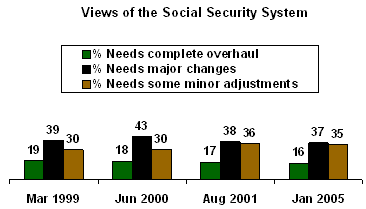
In January, about half of investors say the current Social Security system needs major changes (37%) or a complete overhaul (16%). This is down from 58% in March 1999 and 61% in June 2000. On the other hand, the percentage of investors saying the system needs some minor adjustments has increased from 30% to 35% over the same period.
Benefit Expectations
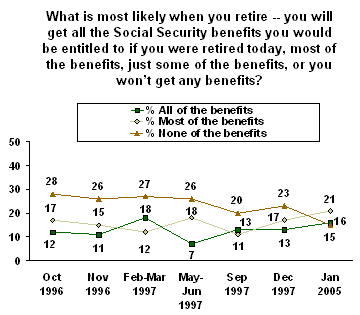
In October 1996, only 3 in 10 non-retired investors thought that when they retired, they would get all (12%) or most (17%) of the Social Security benefits to which they would be entitled. By January of this year, 37% of non-retired investors had this expectation. At the same time, the percentage of non-retired investors saying they did not expect to get any of their Social Security benefits declined from 28% in the 1996 poll to 15% in the January 2005 poll.
In part, investors may continue to be relatively pessimistic about their potential Social Security benefits because two in three believe, correctly, that Social Security is a "pay-as-you-go" system. Accordingly, their current Social Security taxes are used to pay benefits for today's retirees, and when investors retire, their benefits will in turn be paid by those still working. The contrasting view, held by only one in five investors, is that a trust fund exists, into which their current taxes are deposited and from which they will receive their Social Security benefits after they retire.
Social Security's Role in Retirement Income
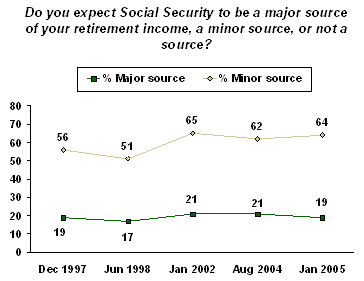
More than 8 in 10 non-retired investors expect Social Security to be a source of their retirement incomes, but only 19% expect it to be a major source, while 64% expect it to be a minor source. Investor expectations in this regard have increased slightly since 1997, when three in four expected Social Security to play a major (19%) or minor (56%) role in their overall retirement incomes.
Ideas for Preserving the Current System
Over the past seven years, investor views of two potential proposals aimed at allowing the Social Security system to continue indefinitely as it is today have changed very little.
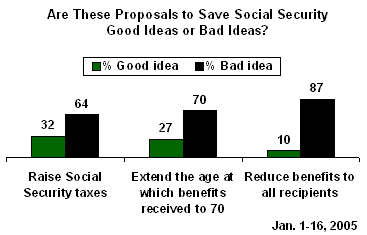
- Today, 87% of investors think reducing benefits for all Social
Security recipients is a bad idea, up from 82% in December
1997.
- Seventy percent of investors think gradually extending to 70 the minimum age at which recipients can receive Social Security benefits is a bad idea, compared with 73% who held this position seven years ago.
On the other hand, although investor opposition to raising Social Security taxes remains high, it has dropped 15 percentage points over the past seven years. Currently, 64% of investors think raising Social Security taxes is a bad idea, down from 79% in December 1997. Thirty-two percent think this is a good idea.
Private Accounts
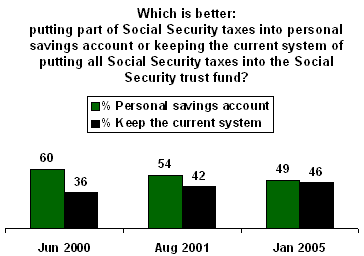
Like the general public, investors are evenly split over whether individuals should be allowed to put part of their Social Security taxes into personal savings accounts for their retirement (49%) or whether the current system should remain in place (46%). This continues a decline in investor support for this idea from 60% in June 2000 and 54% in August 2001.
Investor Optimism Decreases
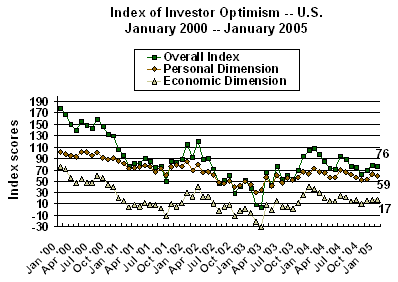
Investor optimism declined slightly in January, as the UBS/Gallup Index of Investor Optimism fell to 76 from 79 in December. More significantly, investors are much less optimistic today than they were a year ago, when the Index stood at 108.
All of this month's decrease in optimism came in the Personal Dimension, as it dropped to 59 from 62 in December. The Economic Dimension, at 17, showed no change, and is 19 points below its level of a year ago.
Not Good News
Overall, this January's investor poll is not encouraging for the proponents of Social Security reform in 2005. As noted previously, today's investors seem no more worried about Social Security than they were five to eight years ago (in fact, in some ways, they seem somewhat less concerned), and they remain opposed to significant changes to the system.
- Fewer of today's investors think the Social Security system
needs major changes or a complete overhaul.
- More of today's non-retired investors think they'll get most or
all of their Social Security benefits, and more expect Social
Security to be a major or minor source of their retirement
income.
- Today's investors overwhelmingly oppose reducing Social Security benefits and extending the retirement age. And although the percentage of investors in favor of raising Social Security taxes has increased since 1997, this proposal is still rejected by a 2-to-1 margin today.
On the other hand, investor support for creating private accounts for Social Security, though it has repeatedly declined over the last five years, is more positive than that for the other proposals. The problem is that creating private accounts without also adopting some or all of the other changes suggested above would increase the revenue/benefit imbalances in the current system, not repair them.
In this regard, one reason for the tepid nature of investor optimism in early 2005 may relate to the priorities the president has set as his second term begins. Of course, Iraq remains a top priority, but uncertainty over the increasing violence as elections approach has not been positive for the investment climate.
On the domestic front, the Bush administration seems content with its current economic policies and those of the Federal Reserve Board, despite oil prices in the upper $40-per-barrel range, a declining dollar, an increasing trade deficit, the high federal budget deficit, concerns about job outsourcing, and increasing interest rates.
Instead of prioritizing any of these domestic economic issues, the administration has established Social Security reform as its top priority. While the American public supports this priority -- and proponents may hope they can mount an "education effort" to change the current perceptions -- it will certainly take a heroic effort to achieve significant change.
Given the top-priority status Bush has assigned Social Security reform as opposed to the other domestic economic issues hurting the current investment climate, it is hardly surprising that investor optimism remains comparatively low. This is particularly true in light of the less-than-stellar prospects for passage of private investment accounts or other significant Social Security reforms this year.
Survey MethodsResults for the Index of Investor Optimism -- U.S. are based on telephone interviews with a randomly selected U.S. sample of 801 adult investors, aged 18 and older, with at least $10,000 of investable assets, conducted Jan. 1-16, 2005. For results based on this sample, one can say with 95% confidence that the maximum error attributable to sampling and other random effects is ±4 percentage points. In addition to sampling error, question wording and practical difficulties in conducting surveys can introduce error or bias into the findings of public opinion polls.
