GALLUP NEWS SERVICE
PRINCETON, NJ -- The U.S. Senate voted Wednesday on a budget resolution that could pave the way for Congress to authorize oil drilling in the Arctic National Wildlife Refuge (ANWR) in Alaska. With the issue now treated as a budget matter, the likelihood for passage appears greater than in recent years, when the issue was brought up separately and opponents were able to filibuster the Senate to block passage.
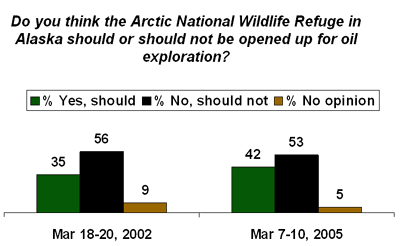
A new Gallup survey reveals a public that leans against oil exploration in ANWR, though a sizable number of people don't appear to care strongly about the issue either way. According to the poll, conducted March 7-10, 53% say ANWR should not be opened up to oil exploration, while 42% say it should. These views represent a slight shift in opinion from three years ago, when Americans opposed oil exploration by 56% to 35%.
Despite the apparent closeness of opinion on this matter, a follow-up question reveals greater intensity among opponents than supporters. Less than half of the supporters of oil exploration say they would be "very" or "somewhat" upset if exploration did not happen, but the majority of opponents say they would be very or somewhat upset if exploration did occur.
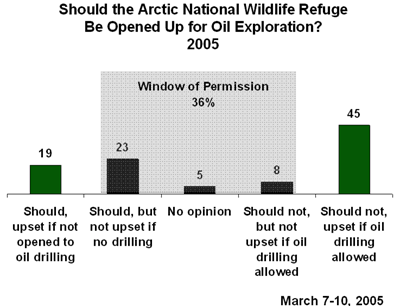
These results suggest that more than a third of all respondents, 36%, don't care enough about the issue to be upset one way or the other. When first asked about the issue, 23% say they feel ANWR should be open to oil exploration, but later admit that they would not be upset if it didn't happen. Another 8% initially oppose oil exploration, but subsequently say they would not be upset if it did happen. Five percent have no opinion at all on the matter.
This group of Americans can be classified as having a "permissive" opinion, either not having an opinion, or not caring if their own opinion prevails. Instead, they appear willing to permit political leaders to do whatever they think is preferable.
The percentage of Americans with permissive opinions is somewhat smaller now than it was three years ago, though the basic pattern of responses is quite similar. At that time, 43% of respondents expressed a permissive opinion on oil exploration, including 21% who were in favor but said they would not be upset if it didn't happen, 13% who opposed the idea but said they would not be upset if it did happen, and 9% who had no opinion.
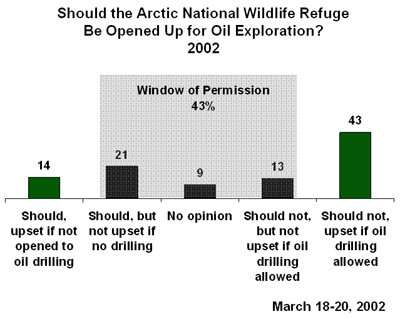
Among those who feel strongly enough about the issue to be either very or somewhat upset if their opinion does not prevail, the ratio of opposition to support is about 2-to-1, with 45% intensely opposed and just 19% intensely in favor.
Gallup's overall results can be compared with other polls, which have shown conflicting opinions on ANWR. These polls show that opinion on this issue is highly influenced by whether the question on oil exploration is asked in an energy framework or an environmental framework. Harris Interactive, for example, found a slight majority of Americans in favor of oil drilling, but it was framed in the context of "reform" in order to "decrease our reliance on foreign oil." The Gallup question that found majority opposition was included amid other questions on a survey on the environment.
The results of Gallup's current poll, as well as the other polls, suggest that overall public opinion on the issue of ANWR is "fuzzy" -- its measurement highly susceptible to the context in which the issue is discussed. The debate that will likely unfold in the weeks ahead, as Congress considers whether to authorize oil drilling in the Arctic reserve, may help bring that opinion into greater focus. Currently, the permissive opinion analysis suggests that more than a third of Americans are susceptible to being persuaded in either direction.
The analysis also shows major differences by party. Republicans are much more likely to intensely favor allowing oil exploration in ANWR (31%) than are independents (14%) or Democrats (11%). Similarly, 59% of Democrats are intensely opposed, compared with 48% of independents and 30% of Republicans.
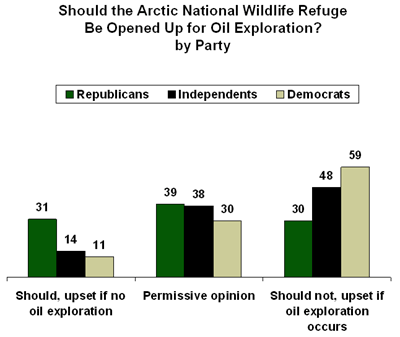
Republicans are evenly divided in terms of their intense opinions on the matter, 31% intensely in favor to 30% intensely opposed. However, when Republicans with permissive opinions are included, the figures show Republicans with net support by 59% to 37%.
A similar pattern appears between the other two groups of partisans. When permissive opinions are included, the margins against opening up ANWR are reduced.
- For independents, intense opinions show a 48% to 14% margin of
opposition. When permissive opinions are included, the margin is
58% to 37% opposed.
- For Democrats, 59% are intensely opposed, 11% intensely in favor. With permissive opinions included, opposition is 68% to 27%.
Survey Methods
Results in the current survey are based on telephone interviews with 1,004 national adults, aged 18 and older, conducted March 7-10, 2005. For results based on the total sample of national adults, one can say with 95% confidence that the maximum margin of sampling error is ±3 percentage points.
In addition to sampling error, question wording and practical difficulties in conducting surveys can introduce error or bias into the findings of public opinion polls.
On another subject,
39. Do you think the Arctic National Wildlife Refuge in Alaska should or should not be opened up for oil exploration?
|
Yes, should |
No, should not |
No opinion |
|
|
|
|
|
|
|
2005 Mar 7-10 |
42% |
53 |
5 |
|
|
|
|
|
|
2002 Mar 18-20 |
35% |
56 |
9 |
40. If the Arctic National Wildlife Refuge WERE NOT opened up for oil exploration, would you be -- very upset, somewhat upset, not too upset, or not at all upset?
41. If the Arctic National Wildlife Refuge WERE opened up for oil exploration, would you be -- very upset, somewhat upset, not too upset, or not at all upset?
COMBINED RESPONSES (Q.39-41)
|
Should, |
Should, |
Should not, |
Should not, upset if does |
|
|
|
|
|
|
|
|
|
|
2005 Mar 7-10 |
19% |
23 |
8 |
45 |
5 |
|
|
|
|
|
|
|
|
2002 Mar 18-20 |
14% |
21 |
13 |
43 |
9 |