GALLUP NEWS SERVICE
PRINCETON, NJ -- Congress returns to session Monday from its Memorial Day recess saddled with its lowest public support levels in nearly a decade. Americans' confidence in Congress, already low to begin with, dropped significantly this year, and Congress' job approval ratings have not been this low since 1997. Amid the controversy over confirming federal court nominees in the Senate and questions about House Majority Leader Tom DeLay's ethics, nearly half of Americans say the conflict between the two parties' leaders in Congress is the worst it has been in their lifetime.
Ratings of Congress
Congress' most recent job approval rating, from a May 2-5 poll, is 35%, with 57% of Americans disapproving. The last time Congress received an approval rating lower than 35% was July 1997. Congress' approval ratings had been 40% or higher from August 2000 to February of this year, before dipping to 37% in March. The all-time-low job rating for Congress is 18% in 1992.
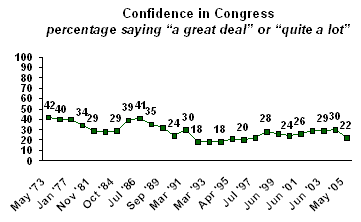
A May 23-26 Gallup Poll finds just 22% of Americans saying they have "a great deal" or "quite a lot" of confidence in Congress. Fifty-one percent say they have "some" confidence, and 26% have "very little" or "none." That puts Congress on par with big business and organized labor among 15 institutions tested, and only slightly better than the lowest-rated, HMOs.
Last year, 30% had a great deal or quite a lot of confidence in Congress. The current confidence reading is also the lowest since 1997, and just slightly better than the all-time-low readings of 18% registered in 1991-1994 (Gallup has asked about confidence in Congress nearly every year since 1973).
A May 20-22 CNN/USA Today/Gallup poll found a plurality of Americans, 47%, saying the country would be better off if the Democrats controlled Congress, while 36% believe that the Republicans should be in control. Two polls conducted last year showed smaller margins, also in favor of the Democrats -- 45% to 41% in October and 41% to 39% in March.
Congressional Leadership
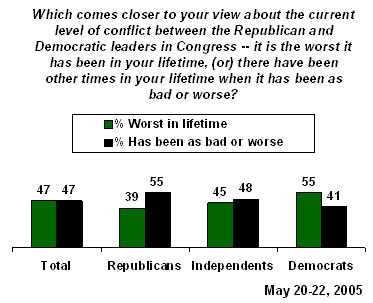
Much of the media coverage of Congress has focused on controversy, including the Senate fight over several of George W. Bush's judicial nominations, the much-publicized hearing on the use of steroids in sports, and questions concerning DeLay's ethics. Meanwhile, little progress has been made on Bush's domestic agenda, including an energy bill and Social Security reform. The May 20-22 poll found 47% of Americans saying the current level of conflict between the Republican and Democratic congressional leaders is the "worst in [their] lifetime," while an equal percentage said it has been as bad or worse at other times during their lives.
These perceptions vary by partisanship -- Democrats tend to view the level of conflict as the worst in their lifetime, while Republicans are inclined to think there have been times in the past when the conflict was as bad or worse. Independents are evenly divided in their views.
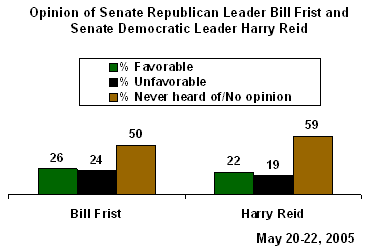
Despite their recent roles in the controversy over using the filibuster on judicial nominations, most Americans are not very familiar with Senate Majority Leader Bill Frist and Senate Minority Leader Harry Reid. Half of Americans do not have an opinion of Frist, and 59% do not have an opinion of Reid. The public's views on both men are fairly evenly split between positive and negative opinions -- 26% view Frist favorably and 24% view him unfavorably, while 22% have a favorable opinion of Reid and 19% have an unfavorable opinion.
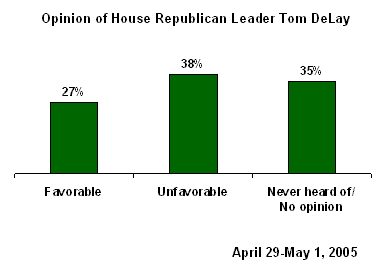
DeLay is a better-known figure than the two main Senate leaders. In an April 29-May 1 poll, 65% had an opinion of him, with views on balance more negative (38% had an unfavorable opinion of DeLay) than positive (27% viewed him favorably).
These results are based on telephone interviews with randomly selected national samples of approximately 1,000 adults, aged 18 and older, conducted in April and May 2005. For results based on these samples, one can say with 95% confidence that the maximum error attributable to sampling and other random effects is ±3 percentage points. In addition to sampling error, question wording and practical difficulties in conducting surveys can introduce error or bias into the findings of public opinion polls.