GALLUP NEWS SERVICE
PRINCETON, NJ -- A new Gallup Poll finds most Americans favoring a partial or complete withdrawal of U.S. troops in Iraq, and for the first time, a majority say they would be upset with the president if he decided to send more troops. This comes at a time when basic support for the war is as low as it has been since the war began. The poll probed Americans' reasons for believing the war was or was not worth fighting. Those who favor the war generally cite the Bush administration's various stated motivations for going to war, such as freeing the Iraqi people from an oppressive regime. Those who oppose the war believe there was insufficient justification for going to war, or say the costs have been too high given the lack of progress.
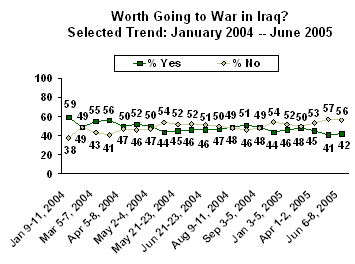
The June 6-8 poll finds 56% of Americans saying it was not worth going to war in Iraq, while 42% say it was worth it. These results are essentially the same as in a late April/early May poll (41% worth it, 57% not worth it), which represent the lowest levels of war support since fighting began in March 2003. Since last October, at least half of Americans have consistently said the war was not worth it.
Gallup asked Americans to explain their positions on the Iraq war. Supporters are most likely to agree with the various motivations for going to war advanced by the Bush administration -- to combat terrorism, to free the Iraqi people from oppression, to protect the United States from the Iraq threat, and to remove Saddam Hussein from power. Nine percent say they support the war as a means of promoting peace in the Middle East and 7% say the U.N. resolutions against Iraq needed to be enforced.
In your own words, why do you think the situation in Iraq was worth going to war over? [OPEN-ENDED; MULTIPLE RESPONSES ALLOWED]
BASED ON ADULTS WHO SAY THE SITUATION IN IRAQ WAS WORTH GOING TO WAR OVER
|
|
Jun |
Jun |
|
% |
% |
|
|
Because of Sept. 11/To stop terrorism |
20 |
13 |
|
Need to free the Iraqi people/stop the oppression |
20 |
18 |
|
Protect the nation/Stop the threat to world security |
19 |
30 |
|
Removing Saddam Hussein from power (evil/cruel dictator) |
16 |
27 |
|
To promote democracy/peace in the Middle East |
9 |
5 |
|
U.N. resolutions needed enforcement/doing what the U.N. should've done |
7 |
-- |
|
To show that you cannot mess with the United States |
6 |
4 |
|
Protect freedom |
4 |
-- |
|
To stop weapons of mass destruction from being sold or made |
3 |
8 |
|
Protect our oil interests |
2 |
-- |
|
Create world peace |
2 |
-- |
|
|
|
|
|
Other |
12 |
4 |
|
No opinion |
1 |
3 |
Opponents generally cite two broad classes of responses for their anti-war stance -- being opposed to the initial decision to go to war and negative assessments of the war's progress. The former category is represented by responses such as false claims that Iraq had weapons of mass destruction (17%), Iraq not posing a threat to the United States (15%), or that the United States should not police the world (11%). Those who base their opposition on the status of the war cite the number of people killed or wounded (15%), the war being poorly planned (8%), a lack of progress made (3%), or a lack of resolution (3%).
In your own words, why do you think the situation in Iraq was NOT worth going to war over? [OPEN-ENDED; MULTIPLE RESPONSES ALLOWED]
BASED ON ADULTS WHO SAY THE SITUATION IN IRAQ WAS NOT WORTH GOING TO WAR OVER
|
|
Jun |
Jun |
|
% |
% |
|
|
Fraudulent claims/No weapons of mass destruction/Lied to the people about them |
17 |
24 |
|
All people killed/wounded |
15 |
24 |
|
Iraq was not a threat to the U.S./Not justified in attacking |
15 |
-- |
|
Stop policing the world/Not our business |
11 |
11 |
|
Poorly planned |
8 |
-- |
|
All about big business/oil/gas |
7 |
7 |
|
Needed more evidence/time to investigate/make a case for war |
5 |
12 |
|
Bush's personal vendetta |
5 |
-- |
|
Need to take care of own problems first |
5 |
3 |
|
They have been fighting for years/cannot stop them |
5 |
-- |
|
Not making any progress |
3 |
-- |
|
Nothing has been resolved |
3 |
-- |
|
Other countries are more of a threat |
3 |
6 |
|
It is going on too long |
3 |
-- |
|
U.S. looks like a bully trying to control the world |
2 |
7 |
|
The U.S. has made things worse |
2 |
-- |
|
The Iraqis do not want us there |
2 |
-- |
|
Costing the U.S. too much money |
2 |
-- |
|
Opposed to war/Needed to be handled peacefully |
1 |
9 |
|
|
|
|
|
Other |
16 |
8 |
|
No opinion |
2 |
3 |
U.S. Troop Levels in Iraq
Gallup finds Americans much more likely to favor reducing U.S. troops in Iraq than increasing or maintaining the status quo. Given a choice of four options, 59% say the United States should withdraw some (31%) or all (28%) of its troops, while 26% say the number should be kept the same as now and 10% say it should be increased.
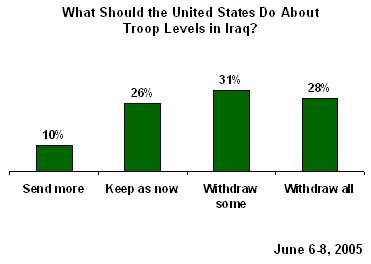
That is a significant increase in support for troop reduction since the question was last asked. In February, immediately following the Iraqi elections, 49% favored a reduction in the number of U.S. troops in Iraq. The current percentage favoring troop reductions is the highest Gallup has found to date, just slightly above a 57% reading in October 2003.
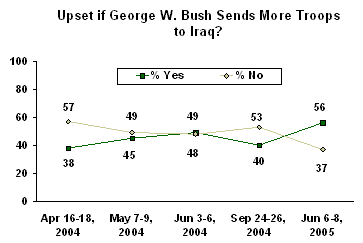
A follow-up question asks those who favor troop reduction or maintenance of the status quo whether they would be "upset" if the president decides to send more troops to Iraq. This question is designed to gauge how much latitude the president might have in this area, as many Americans who express a preference for the status quo or a reduction might nevertheless support the president if he decided that increased troop levels were necessary. Fifty-six percent of all Americans say they would be upset if Bush sent more troops to Iraq, while 37% would not be. That is the first time a majority of the public said it would be upset with an increase in troops since Gallup first asked the follow-up in April 2004.
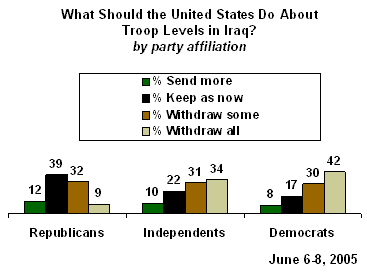
Seventy-six percent of Democrats say they would be upset if Bush sent more troops to Iraq, more than double the percentage of Republicans (32%). Independents (61%) are more aligned with Democrats than Republicans on this matter.
More generally, 72% of Democrats say they favor a partial or complete withdrawal from Iraq, along with 65% of independents and 41% of Republicans. Forty-two percent of Democrats favor a complete withdrawal of U.S. troops from Iraq.
Survey Methods
These results are based on telephone interviews with a randomly selected national sample of 1,002 adults, aged 18 and older, conducted June 6-8, 2005. For results based on this sample, one can say with 95% confidence that the maximum error attributable to sampling and other random effects is ±3 percentage points. In addition to sampling error, question wording and practical difficulties in conducting surveys can introduce error or bias into the findings of public opinion polls.
11. All in all, do you think it was worth going to war in Iraq, or not?
|
Worth |
Not worth |
No |
|
|
% |
% |
% |
|
|
2005 Jun 6-8 |
42 |
56 |
2 |
|
2005 Apr 29-May 1 |
41 |
57 |
2 |
|
2005 Apr 1-2 |
45 |
53 |
2 |
|
2005 Feb 7-10 |
48 |
50 |
2 |
|
2005 Jan 3-5 |
46 |
52 |
2 |
|
2004 Oct 9-10 ^ |
44 |
54 |
2 |
|
2004 Sep 3-5 ^ |
49 |
48 |
3 |
|
2004 Aug 23-25 ^ |
51 |
46 |
3 |
|
2004 Aug 9-11 ^ |
49 |
48 |
3 |
|
2004 Jul 8-11 ^ |
47 |
50 |
3 |
|
2004 Jun 21-23 ^ |
46 |
51 |
3 |
|
2004 Jun 3-6 ^ |
46 |
52 |
2 |
|
2004 May 21-23 ^ |
45 |
52 |
3 |
|
2004 May 7-9 ^ |
44 |
54 |
2 |
|
2004 May 2-4 |
50 |
47 |
3 |
|
2004 Apr 16-18 ^ |
52 |
46 |
2 |
|
2004 Apr 5-8 |
50 |
47 |
3 |
|
2004 Mar 26-28 |
56 |
41 |
3 |
|
2004 Mar 5-7 |
55 |
43 |
2 |
|
2004 Jan 29-Feb 1 |
49 |
49 |
2 |
|
2004 Jan 9-11 |
59 |
38 |
3 |
|
2003 Dec 15-16 ^ † |
65 |
33 |
2 |
|
2003 Dec 14 †‡# |
62 |
33 |
5 |
|
2003 Dec 5-7 † |
59 |
39 |
2 |
|
2003 Nov 14-16 † |
56 |
42 |
2 |
|
2003 Nov 3-5 † |
54 |
44 |
2 |
|
2003 Oct 24-26 † |
54 |
44 |
2 |
|
2003 Oct 6-8 † |
55 |
44 |
1 |
|
2003 Sep 19-21 † |
50 |
48 |
2 |
|
2003 Sep 8-10 † |
58 |
40 |
2 |
|
2003 Aug 25-26 † |
63 |
35 |
2 |
|
2003 Jul 25-27 † |
63 |
34 |
3 |
|
2003 Jul 18-20 † |
63 |
35 |
2 |
|
2003 Jun 27-29 † |
56 |
42 |
2 |
|
2003 Apr 14-16 †‡ |
73 |
23 |
4 |
|
2003 Apr 9 †‡# |
76 |
19 |
5 |
|
2003 Apr 7-8 †‡ |
67 |
30 |
3 |
|
2003 Mar 24-25 †‡ |
68 |
29 |
3 |
|
2003 Jan 3-5 †‡ |
53 |
42 |
5 |
|
|
|
|
|
|
^Asked of a half sample |
|||
|
†WORDING: All in all, do you think the situation in Iraq was worth going to war over, or not? |
|||
|
‡WORDING: All in all, do you think the current situation in Iraq is worth going to war over, or not? |
|||
|
#Polls conducted entirely in one day, such as this one, are subject to additional error or bias not found in polls conducted over several days. |
|||
14. Which comes closest to your view about what the U.S. should now do about the number of U.S. troops in Iraq -- [ROTATED: the U.S. should send more troops to Iraq, the U.S. should keep the number of troops as it is now, the U.S. should withdraw some troops from Iraq, (or) the U.S. should withdraw all of its troops from Iraq]?
|
Send more troops |
Keep as |
With- |
With- |
No |
|
|
% |
% |
% |
% |
% |
|
|
2005 Jun 6-8 |
10 |
26 |
31 |
28 |
5 |
|
2005 Feb 4-6 |
10 |
38 |
32 |
17 |
3 |
|
2005 Jan 14-16 |
24 |
26 |
21 |
25 |
4 |
|
2004 Sep 24-26 |
21 |
35 |
21 |
18 |
5 |
|
2004 Jun 3-6 |
18 |
30 |
23 |
27 |
2 |
|
2004 May 7-9 |
25 |
24 |
18 |
29 |
4 |
|
2004 Apr 16-18 |
33 |
25 |
16 |
21 |
5 |
|
2004 Apr 5-8 |
20 |
29 |
18 |
28 |
5 |
|
2004 Jan 2-5 |
11 |
40 |
29 |
16 |
4 |
|
2003 Dec 15-16 |
14 |
40 |
27 |
15 |
4 |
|
2003 Dec 5-7 |
22 |
33 |
25 |
17 |
3 |
|
2003 Nov 3-5 ^ |
17 |
32 |
29 |
19 |
3 |
|
2003 Oct 24-26 ^ |
14 |
27 |
39 |
18 |
2 |
|
2003 Aug 25-26 ^ |
15 |
36 |
32 |
14 |
3 |
|
|
|
|
|
|
|
|
^ WORDING: Which comes closest to your view about what the U.S. should now do about the number of U.S. troops in Iraq - [ROTATED: the U.S. should send more troops to Iraq, the U.S. should keep the number of troops as it is now, the U.S. should begin to withdraw some troops from Iraq, (or) the U.S. should withdraw all of its troops from Iraq]? |
|||||
15. If President Bush decides to send more troops to Iraq, would you be upset, or not?
[COMBINED RESPONSES]
|
|
Sep |
|
|
Apr 16-18, 2004 |
||
|
% |
% |
% |
% |
% |
||
|
No, not upset |
37 |
53 |
48 |
49 |
57 |
|
|
(Think U.S. should send more troops) |
(10) |
(21) |
(19) |
(25) |
(33) |
|
|
(Do not think U.S. should send more troops) |
(27) |
(32) |
(29) |
(24) |
(24) |
|
|
|
|
|
|
|
||
|
Yes, upset |
56 |
40 |
49 |
45 |
38 |
|
|
|
|
|
|
|
||
|
No opinion |
7 |
7 |
3 |
6 |
5 |
|