GALLUP NEWS SERVICE
PRINCETON, NJ -- President George W. Bush's speech to the nation Sunday night squarely addressed several of the areas where there is the greatest divergence between the administration and the public on Iraq, including whether the United States is winning or losing the war, and whether Bush has a plan that can achieve victory.
A recent CNN/USA Today/Gallup poll suggests that despite hitting these same points in four previous speeches around the country since Thanksgiving, Bush has not succeeded in moving public opinion on Iraq in any significant way. The Dec. 16-18 survey was conducted after the Dec. 15 Iraqi election -- widely hailed for its high turnout -- but before Bush's Sunday night address to the nation in which he forcefully made the case for staying the course in Iraq.
The poll underscores the deep divisions that exist among the American public over the merits of the war in Iraq and the outlook for U.S. victory there -- divisions Bush acknowledged in his speech to the nation on Sunday night.
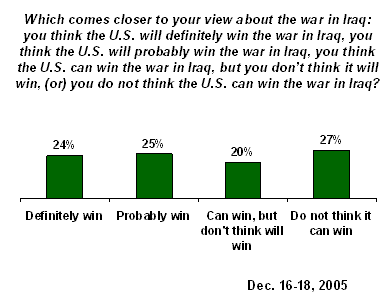
Just slightly more than half of American adults, 52%, say that sending U.S. troops to Iraq was a mistake while 46% disagree. About half of Americans (49%) also tend to believe the United States will eventually win the war in Iraq, while 47% doubt this. These results are generally consistent with public opinion on Iraq throughout the fall.
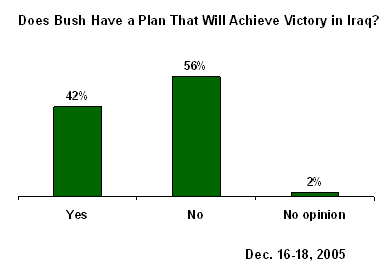
The need for Bush to clearly articulate a plan for achieving victory in Iraq -- as he did Sunday night -- is evident as the weekend poll shows only 42% of Americans believe he has such a plan. Despite the administration's efforts, the majority of Americans have said in three polls conducted since Nov. 30 that Bush does not have a plan.
Bush's latest job approval rating on Iraq (37% approve, 61% disapprove) is even more negative than his overall job rating. As of the weekend poll, 41% approved and 56% disapproved of the overall job Bush is doing as president. Both ratings are very similar to where they stood earlier this month, although Bush's overall job approval rating is slightly higher than the 38% average rating he received in three pre-Thanksgiving Gallup Polls in November.
In his Sunday night speech Bush defined the U.S. goal in Iraq as "a democratic Iraq that can defend itself, that will never again be a safe haven for terrorists, and that will serve as a model of freedom for the Middle East." He insisted that the United States is already winning the war on each dimension, and outlined a three-point plan for ultimate victory.
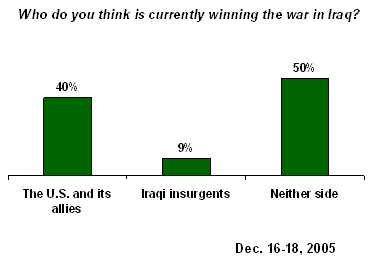
In contrast to Bush's optimism, the pre-speech poll finds only 40% of Americans convinced that the United States and its allies are currently winning the war. Half the public says neither side is winning while an additional 9% say the insurgents are winning.
Little Confidence in Iraqi Security Forces
A key to Bush's exit strategy in Iraq is training Iraqi forces to maintain law and order, but Americans are widely pessimistic about the chances of this happening in the next few years.
Only 37% of Americans foresee the Iraqi military and police forces being able to ensure safety and security in Iraq without U.S. assistance; 62% say this is unlikely.
Similarly, only 35% consider it likely that Iraq will be able to prevent terrorists from using the country as a base of operations for planning future attacks against the United States.
Americans Most Optimistic About Democracy Taking Hold in Iraq
Public opinion is closer to Bush's position when it comes to the perceived likelihood that Iraq will be able to establish a stable democratic government within the next few years -- one that will not be overthrown by terrorists or supporters of Saddam Hussein. But even on this point, the public is closely divided. A 50% plurality of Americans believe Iraqi democracy will succeed; 47% say it is unlikely.
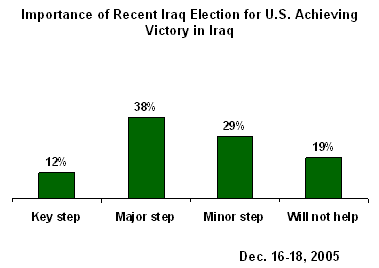
Exactly half of Americans also consider the recent election in Iraq to be either a "key step" (12%) or a "major step" (38%) toward ensuring the United States will achieve its goals in Iraq. Nearly as many view the election as only a "minor step" forward (29%) or as not helpful to the United States in achieving its goals (19%).
Americans Dubious Iraq Is Part of War on Terror
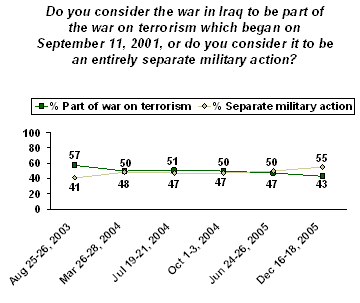
The poll suggests Bush has a hard sell when it comes to convincing Americans that the Iraq war is part of the war on terrorism sparked by the events of Sept. 11, 2001. Only 43% of Americans associate Iraq with the war on terrorism while 55% consider it to be an entirely separate military action. Despite the president's emphasis on the connection between terrorism and the Iraq war in his recent speeches, the percentage linking the two is now significantly lower than it was a year ago (50% in October 2004), and well below where it stood in August 2003 (57%).
Outlook for Troops
In his Sunday address, Bush reiterated his opposition to setting a specific timetable for removing U.S. troops from Iraq, but he held out the hope that troops could start coming home as democracy takes hold, and as Iraqi security forces gain competency. In his words, "Our forces in Iraq are on the road to victory -- and that is the road that will take them home."
Very few Americans (17%) predict there will be a significant withdrawal of U.S. troops from Iraq within one year, but a majority (53%) believes this will happen in one to three years. Only 29% foresee a significant number of troops in Iraq continuing after three years.
This contrasts with Americans' desire to see troops withdrawn much sooner. More than half (59%) say the United States should only maintain a significant number of troops for another year at most. Of this, 21% say the limit should be three months, 14% say three to six months, and 24% say six months to a year. More than a third favor maintaining a significant U.S. military presence in Iraq for longer than a year, including 29% who would stay for one to three years, and 9% who would stay longer than three years.

Survey Methods
These results are based on telephone interviews with a randomly selected national sample of 1,003 adults, aged 18 and older, conducted Dec. 16-18, 2005. For results based on this sample, one can say with 95% confidence that the maximum error attributable to sampling and other random effects is ±3 percentage points. In addition to sampling error, question wording and practical difficulties in conducting surveys can introduce error or bias into the findings of public opinion polls.
1. Do you approve or disapprove of the way George W. Bush is handling his job as president?
|
|
Dis- |
No |
|
|
2005 |
% |
% |
% |
|
2005 Dec 16-18 |
41 |
56 |
3 |
|
|
|
|
|
|
2005 Dec 9-11 |
42 |
55 |
3 |
|
2005 Dec 5-8 |
43 |
52 |
5 |
|
2005 Nov 17-20 |
38 |
57 |
5 |
|
2005 Nov 11-13 |
37 |
60 |
3 |
|
2005 Nov 7-10 |
40 |
55 |
5 |
|
2005 Oct 28-30 |
41 |
56 |
3 |
|
2005 Oct 24-26 |
41 |
56 |
3 |
|
2005 Oct 21-23 |
42 |
55 |
3 |
|
2005 Oct 13-16 |
39 |
58 |
3 |
|
2005 Sep 26-28 |
45 |
50 |
5 |
|
2005 Sep 16-18 |
40 |
58 |
2 |
|
2005 Sep 12-15 |
45 |
52 |
3 |
|
2005 Sep 8-11 |
46 |
51 |
3 |
|
2005 Aug 28-30 |
45 |
52 |
3 |
|
2005 Aug 22-25 |
40 |
56 |
4 |
|
2005 Aug 8-11 |
45 |
51 |
4 |
|
2005 Aug 5-7 |
45 |
51 |
4 |
|
2005 Jul 25-28 |
44 |
51 |
5 |
|
2005 Jul 22-24 |
49 |
48 |
3 |
|
2005 Jul 7-10 |
49 |
48 |
3 |
|
2005 Jun 29-30 |
46 |
51 |
3 |
|
2005 Jun 24-26 |
45 |
53 |
2 |
|
2005 Jun 16-19 |
47 |
51 |
2 |
|
2005 Jun 6-8 |
47 |
49 |
4 |
|
2005 May 23-26 |
48 |
47 |
5 |
|
2005 May 20-22 |
46 |
50 |
4 |
|
2005 May 2-5 |
50 |
45 |
5 |
|
2005 Apr 29-May 1 |
48 |
49 |
3 |
|
2005 Apr 18-21 |
48 |
49 |
3 |
|
2005 Apr 4-7 |
50 |
45 |
5 |
|
2005 Apr 1-2 |
48 |
48 |
4 |
|
2005 Mar 21-23 |
45 |
49 |
6 |
|
2005 Mar 18-20 |
52 |
44 |
4 |
|
2005 Mar 7-10 |
52 |
44 |
4 |
|
2005 Feb 25-27 |
52 |
45 |
3 |
|
2005 Feb 21-24 |
51 |
45 |
4 |
|
2005 Feb 7-10 |
49 |
48 |
3 |
|
2005 Feb 4-6 |
57 |
40 |
3 |
|
2005 Jan 14-16 |
51 |
46 |
3 |
|
2005 Jan 7-9 |
52 |
44 |
4 |
|
2005 Jan 3-5 |
52 |
44 |
4 |
|
2004 |
|
|
|
|
2004 Dec 17-19 |
49 |
46 |
5 |
|
2004 Dec 5-8 |
53 |
44 |
3 |
|
2004 Nov 19-21 |
55 |
42 |
3 |
|
2004 Nov 7-10 |
53 |
44 |
3 |
|
2004 Oct 29-31 |
48 |
47 |
5 |
|
2004 Oct 22-24 |
51 |
46 |
3 |
|
2004 Oct 14-16 |
51 |
47 |
2 |
|
2004 Oct 11-14 |
48 |
49 |
3 |
|
2004 Oct 9-10 |
47 |
49 |
4 |
|
2004 Oct 1-3 |
50 |
48 |
2 |
|
2004 Sep 24-26 |
54 |
44 |
2 |
|
2004 Sep 13-15 |
52 |
45 |
3 |
|
2004 Sep 3-5 |
52 |
46 |
2 |
|
2004 Aug 23-25 |
49 |
47 |
4 |
|
2004 Aug 9-11 |
51 |
46 |
3 |
|
2004 Jul 30-Aug 1 |
48 |
49 |
3 |
|
2004 Jul 19-21 |
49 |
47 |
4 |
|
2004 Jul 8-11 |
47 |
49 |
4 |
|
2004 Jun 21-23 |
48 |
49 |
3 |
|
2004 Jun 3-6 |
49 |
49 |
2 |
|
2004 May 21-23 |
47 |
49 |
4 |
|
2004 May 7-9 |
46 |
51 |
3 |
|
2004 May 2-4 |
49 |
48 |
3 |
|
2004 Apr 16-18 |
52 |
45 |
3 |
|
2004 Apr 5-8 |
52 |
45 |
3 |
|
2004 Mar 26-28 |
53 |
44 |
3 |
|
2004 Mar 8-11 |
50 |
47 |
3 |
|
2004 Mar 5-7 |
49 |
48 |
3 |
|
2004 Feb 16-17 |
51 |
46 |
3 |
|
2004 Feb 9-12 |
51 |
46 |
3 |
|
2004 Feb 6-8 |
52 |
44 |
4 |
|
2004 Jan 29-Feb 1 |
49 |
48 |
3 |
|
2004 Jan 12-15 |
53 |
44 |
3 |
|
2004 Jan 9-11 |
59 |
38 |
3 |
|
2004 Jan 2-5 |
60 |
35 |
5 |
|
2003 |
|
|
|
|
2003 Dec 15-16 |
63 |
34 |
3 |
|
2003 Dec 11-14 |
56 |
41 |
3 |
|
2003 Dec 5-7 |
55 |
43 |
2 |
|
2003 Nov 14-16 |
50 |
47 |
3 |
|
2003 Nov 10-12 |
51 |
45 |
4 |
|
2003 Nov 3-5 |
54 |
43 |
3 |
|
2003 Oct 24-26 |
53 |
42 |
5 |
|
2003 Oct 10-12 |
56 |
40 |
4 |
|
2003 Oct 6-8 |
55 |
42 |
3 |
|
2003 Sep 19-21 |
50 |
47 |
3 |
|
2003 Sep 8-10 |
52 |
43 |
5 |
|
2003 Aug 25-26 |
59 |
37 |
4 |
|
2003 Aug 4-6 |
60 |
36 |
4 |
|
2003 Jul 25-27 |
58 |
38 |
4 |
|
2003 Jul 18-20 |
59 |
38 |
3 |
|
2003 Jul 7-9 |
62 |
34 |
4 |
|
2003 Jun 27-29 |
61 |
36 |
3 |
|
2003 Jun 12-15 |
63 |
33 |
4 |
2. Do you approve or disapprove of the way George W. Bush is handling -- [RANDOM ORDER]?
B. The situation in Iraq
|
|
Dis- |
No |
|
|
2005 |
% |
% |
% |
|
2005 Dec 16-18 |
37 |
61 |
2 |
|
|
|
|
|
|
2005 Dec 9-11 |
39 |
59 |
2 |
|
2005 Nov 11-13 |
35 |
63 |
2 |
|
2005 Sep 16-18 |
32 |
67 |
1 |
|
2005 Sep 8-11 |
40 |
58 |
2 |
|
2005 Aug 28-30 |
40 |
59 |
1 |
|
2005 Jun 24-26 |
40 |
58 |
2 |
|
2005 May 20-22 ^ |
40 |
56 |
4 |
|
2005 Apr 29-May 1 |
42 |
55 |
3 |
|
2005 Apr 1-2 |
43 |
54 |
3 |
|
2005 Feb 25-27 |
45 |
53 |
2 |
|
2005 Feb 4-6 |
50 |
48 |
2 |
|
2005 Jan 7-9 |
42 |
56 |
2 |
|
2004 |
|
|
|
|
2004 Nov 7-10 |
47 |
51 |
2 |
|
2004 Oct 14-16 |
46 |
52 |
2 |
|
2004 Sep 24-26 |
48 |
49 |
3 |
|
2004 Aug 9-11 |
45 |
52 |
3 |
|
2004 Jun 21-23 ^ |
42 |
56 |
2 |
|
2004 Jun 3-6 |
41 |
57 |
2 |
|
2004 May 7-9 ^ |
41 |
58 |
1 |
|
2004 May 2-4 |
42 |
55 |
3 |
|
2004 Apr 16-18 |
48 |
49 |
3 |
|
2004 Mar 26-28 |
51 |
47 |
2 |
|
2004 Jan 29-Feb 1 |
46 |
53 |
1 |
|
2004 Jan 2-5 |
61 |
36 |
3 |
|
2003 |
|
|
|
|
2003 Dec 5-7 |
50 |
47 |
3 |
|
2003 Nov 3-5 |
45 |
54 |
1 |
|
2003 Oct 6-8 |
47 |
50 |
3 |
|
2003 Sep 8-10 |
51 |
47 |
2 |
|
2003 Aug 25-26 |
57 |
41 |
2 |
|
2003 Jul 25-27 |
60 |
38 |
2 |
|
2003 Jul 18-20 |
57 |
39 |
4 |
|
2003 Jul 7-9 |
58 |
39 |
3 |
|
2003 Jun 12-15 |
63 |
34 |
3 |
|
2003 Apr 14-16 |
76 |
21 |
3 |
|
2003 Mar 29-30 |
71 |
27 |
2 |
|
2003 Mar 24-25 |
71 |
26 |
3 |
|
2003 Mar 14-15 |
56 |
41 |
3 |
|
2003 Jan 31-Feb 2 |
54 |
42 |
4 |
|
2003 Jan 3-5 |
55 |
40 |
5 |
|
2002 |
|
|
|
|
2002 Dec 9-10 |
55 |
39 |
6 |
|
2002 Oct 21-22 |
52 |
40 |
8 |
|
^ Asked of a half sample |
|||
11. In view of the developments since we first sent our troops to Iraq, do you think the United States made a mistake in sending troops to Iraq, or not?
|
Yes, a mistake |
No, not |
No opinion |
|
|
Iraq |
% |
% |
% |
|
2005 Dec 16-18 |
52 |
46 |
2 |
|
|
|
|
|
|
2005 Dec 9-11 |
48 |
50 |
2 |
|
2005 Nov 11-13 ^ |
54 |
45 |
1 |
|
2005 Oct 28-30 |
54 |
45 |
1 |
|
2005 Oct 21-23 |
49 |
49 |
2 |
|
2005 Sep 16-18 |
59 |
39 |
2 |
|
2005 Sep 8-11 |
53 |
46 |
1 |
|
2005 Aug 28-30 |
53 |
46 |
1 |
|
2005 Aug 5-7 ^ |
54 |
44 |
2 |
|
2005 Jul 22-24 |
46 |
53 |
1 |
|
2005 Jun 24-26 |
53 |
46 |
1 |
|
2005 Apr 29-May 1 ^ |
49 |
48 |
3 |
|
2005 Mar 18-20 ^ |
46 |
51 |
3 |
|
2005 Feb 25-27 |
47 |
51 |
2 |
|
2005 Feb 4-6 |
45 |
55 |
* |
|
2005 Jan 14-16 |
52 |
47 |
1 |
|
2005 Jan 7-9 |
50 |
48 |
2 |
|
2004 Nov 19-21 |
47 |
51 |
2 |
|
2004 Oct 29-31 ^ |
44 |
52 |
4 |
|
2004 Oct 22-24 |
47 |
51 |
2 |
|
2004 Oct 14-16 |
47 |
52 |
1 |
|
2004 Oct 9-10 ^ |
46 |
53 |
1 |
|
2004 Oct 1-3 |
48 |
51 |
1 |
|
2004 Sep 24-26 |
42 |
55 |
3 |
|
2004 Sep 3-5 ^ |
38 |
57 |
5 |
|
2004 Aug 23-25 ^ |
48 |
50 |
2 |
|
2004 Jul 30-Aug 1 |
47 |
51 |
2 |
|
2004 Jul 19-21 |
50 |
47 |
3 |
|
2004 Jul 8-11 ^ |
54 |
45 |
1 |
|
2004 Jun 21-23 ^ |
54 |
44 |
2 |
|
2004 Jun 3-6 ^ |
41 |
58 |
1 |
|
2004 May 7-9 ^ |
44 |
54 |
2 |
|
2004 Apr 16-18 ^ |
42 |
57 |
1 |
|
2004 Jan 12-15 ^ |
42 |
56 |
2 |
|
2003 Nov 3-5 ^ |
39 |
60 |
1 |
|
2003 Oct 6-8 ^ |
40 |
59 |
1 |
|
2003 Jul 7-9 ^ |
27 |
72 |
1 |
|
2003 Mar 24-25 ^ |
23 |
75 |
2 |
|
Afghanistan |
|
|
|
|
2004 Jul 19-21 |
25 |
72 |
3 |
|
2002 Jan 7-9 |
6 |
93 |
1 |
|
2001 Nov 8-11 |
9 |
89 |
2 |
|
Yugoslavia |
|
|
|
|
1999 Jun 4-5 |
43 |
53 |
4 |
|
1999 Apr 21 |
42 |
51 |
7 |
|
Persian Gulf War |
|
|
|
|
1991 Jul 18-21 |
15 |
82 |
3 |
|
1991 Feb 28-Mar 3 |
10 |
87 |
3 |
|
1991 Feb 7-10 |
21 |
76 |
3 |
|
1991 Jan 30-Feb 2 |
18 |
80 |
2 |
|
1991 Jan 23-26 |
18 |
77 |
5 |
|
1991 Jan 17-20 |
16 |
80 |
4 |
|
1991 Jan 11-13 |
29 |
65 |
6 |
|
1991 Jan 3-6 |
30 |
61 |
9 |
|
1990 Dec 6-9 |
28 |
66 |
6 |
|
1990 Nov 29-Dec 2 |
29 |
66 |
5 |
|
1990 Nov 15-18 |
27 |
65 |
8 |
|
1990 Nov 8-11 |
27 |
68 |
5 |
|
1990 Nov 2-4 |
25 |
67 |
8 |
|
1990 Aug 30-Sep 2 |
16 |
76 |
8 |
|
1990 Aug 23-26 |
18 |
76 |
6 |
|
1990 Aug 16-19 |
17 |
75 |
8 |
|
1990 Aug 30-Sep 2 |
16 |
76 |
8 |
|
1990 Aug 23-26 |
18 |
76 |
6 |
|
1990 Aug 16-19 |
17 |
75 |
8 |
|
1990 Oct 25-28 |
24 |
71 |
5 |
|
1990 Oct 18-21 |
26 |
67 |
7 |
|
1990 Oct 11-14 |
27 |
68 |
5 |
|
1990 Oct 3-4 |
21 |
71 |
8 |
|
1990 Sep 27-30 |
20 |
73 |
7 |
|
1990 Sep 14-16 |
18 |
73 |
10 |
|
1990 Sep 10-11 |
19 |
76 |
5 |
|
Vietnam War |
|
|
|
|
2000 Nov 13-15 |
69 |
24 |
7 |
|
1995 Apr 21-24 |
71 |
23 |
6 |
|
1990 Mar 15-18 |
74 |
22 |
4 |
|
1973 Jan 12-15 |
60 |
29 |
11 |
|
1971 May 14-17 |
61 |
28 |
11 |
|
1971 Jan 8-11 |
60 |
31 |
9 |
|
1970 May 21-26 |
56 |
36 |
8 |
|
1970 Apr 2-7 |
51 |
34 |
15 |
|
1970 Jan 15-20 |
57 |
32 |
11 |
|
1969 Sep 17-22 |
58 |
32 |
10 |
|
1969 Jan 23-28 |
52 |
39 |
9 |
|
1968 Sep 26-Oct 1 |
54 |
37 |
9 |
|
1968 Aug 7-12 |
53 |
35 |
12 |
|
1968 Apr 4-9 |
48 |
40 |
12 |
|
1968 Feb 22-27 |
49 |
42 |
9 |
|
1968 Feb 1-6 |
46 |
42 |
12 |
|
1967 Dec 7-12 |
45 |
46 |
9 |
|
1967 Oct 6-11 |
47 |
44 |
9 |
|
1967 Jul 13-18 |
41 |
48 |
11 |
|
1967 Apr 19-24 |
37 |
50 |
13 |
|
1967 Jan 26-31 |
32 |
52 |
16 |
|
1966 Nov 10-15 |
31 |
52 |
17 |
|
1966 Sep 8-13 |
35 |
48 |
17 |
|
1966 May 5-10 |
36 |
49 |
15 |
|
1966 Mar 3-8 |
26 |
59 |
15 |
|
1965 Aug 27-Sep 1 |
24 |
60 |
16 |
|
Korean War |
|
|
|
|
2000 Jun 6-7 |
34 |
47 |
19 |
|
1953 Jan 11-16 |
36 |
50 |
14 |
|
1952 Oct 17-22 |
43 |
37 |
19 |
|
1952 Oct 9-14 |
43 |
37 |
20 |
|
1952 Feb 28-Mar 5 |
51 |
35 |
14 |
|
1951 Aug 3-8 |
42 |
48 |
11 |
|
1951 Jun 16-21 |
43 |
40 |
17 |
|
1951 Apr 16-21 |
37 |
45 |
18 |
|
1951 Mar 26-31 |
45 |
43 |
12 |
|
1951 Feb 4-9 |
49 |
41 |
9 |
|
1951 Jan 1-5 |
49 |
38 |
13 |
|
1950 Aug 20-25 |
20 |
65 |
15 |
|
AFGHANISTAN WORDING: Do you think the United States made a mistake in sending military forces to Afghanistan, or not? |
|||
|
YUGOSLAVIA WORDING: In view of the developments since we entered the fighting in Yugoslavia, do you think the United States made a mistake sending military forces to fight in Yugoslavia? |
|||
|
PERSIAN GULF WAR WORDING (Feb. 28-Mar 3, 1991-Jul. 18-21, 1991): In view of the developments since we first sent our troops to the Persian Gulf region, do you think the United States made a mistake in sending troops to the Persian Gulf region, or not? |
|||
|
PERSIAN GULF WAR WORDING (Aug. 16-19, 1990-Feb. 7-10, 1990): In view of the developments since we first sent our troops to Saudi Arabia, do you think the United States made a mistake in sending troops to Saudi Arabia, or not? |
|||
|
VIETNAM WAR WORDING (1990-2000): Looking back, do you think the United States made a mistake sending troops to fight in Vietnam? |
|||
|
VIETNAM WAR WORDING (1965-1973): In view of the developments since we entered the fighting in Vietnam, do you think the U.S. made a mistake sending troops to fight in Vietnam? |
|||
|
KOREAN WAR WORDING (2000): Based on what you have heard or read, do you think the United States made a mistake in going into the war in Korea, or not? |
|||
|
KOREAN WAR WORDING (Feb. 1951-Jan. 1953): Do you think the United States made a mistake in going into the war in Korea, or not? |
|||
|
KOREAN WAR WORDING (Aug. 1950-Jan. 1951): In view of the developments since we entered the fighting in Korea, do you think the United States made a mistake in deciding to defend Korea, or not? |
|||
Q.12-13 SPLIT SAMPLED
12. Who do you think is currently winning the war in Iraq -- the U.S. and its allies, the insurgents in Iraq, or neither side?
BASED ON 481 NATIONAL ADULTS IN FORM A
|
U.S. and |
Insurgents |
Neither |
No |
|
|
% |
% |
% |
% |
|
|
2005 Dec 16-18 ^ |
40 |
9 |
50 |
1 |
|
|
|
|
|
|
|
2005 Dec 9-11 ^ |
36 |
13 |
49 |
2 |
|
2005 Jun 24-26 |
34 |
14 |
50 |
2 |
|
2005 Feb 25-27 |
43 |
7 |
48 |
2 |
|
2004 Nov 19-21 |
44 |
7 |
46 |
3 |
|
2004 Oct 22-24 ^ |
35 |
10 |
53 |
2 |
|
^ Asked of a half sample |
||||
13. Which comes closer to your view about the war in Iraq -- [ROTATED: you think the U.S. will definitely win the war in Iraq, you think the U.S. will probably win the war in Iraq, you think the U.S. can win the war in Iraq, but you don't think it will win, (or) you do not think the U.S. can win the war in Iraq]?
BASED ON 522 NATIONAL ADULTS IN FORM B
|
|
|
Can win, |
Do not |
|
|
|
|
|
% |
% |
% |
% |
% |
% |
% |
|
|
2005 Dec 16-18 ^ |
24 |
25 |
20 |
27 |
4 |
69 |
49 |
|
|
|
|
|
|
|
|
|
|
2005 Dec 9-11 ^ |
25 |
21 |
19 |
30 |
5 |
65 |
46 |
|
2005 Nov 11-13 |
23 |
23 |
17 |
33 |
4 |
63 |
46 |
|
2005 Sep 16-18 |
21 |
22 |
20 |
34 |
3 |
63 |
43 |
|
^ Asked of a half sample |
|||||||
14. Do you think George W. Bush does -- or does not -- have a plan that will achieve victory for the United States in Iraq?
|
Yes, does |
No, does not |
No opinion |
|
|
% |
% |
% |
|
|
2005 Dec 16-18 |
42 |
56 |
2 |
|
|
|
|
|
|
2005 Dec 9-11 |
38 |
58 |
4 |
|
2005 Nov 30 ^ |
41 |
55 |
4 |
|
^ Polls conducted entirely in one day are subject to additional error or bias not found in polls conducted over several days. |
|||
15. Just your best guess, do you think each of the following is likely -- or unlikely -- to happen in Iraq in the next few years? How about -- [RANDOM ORDER]?
A. Iraq will have a democratic government that will not be overthrown by terrorists or supporters of Saddam Hussein
|
Likely |
Unlikely |
No opinion |
|
|
% |
% |
% |
|
|
2005 Dec 16-18 |
50 |
47 |
3 |
|
|
|
|
|
|
2005 Nov 30 ^ |
47 |
49 |
4 |
|
^ Polls conducted entirely in one day are subject to additional error or bias not found in polls conducted over several days. |
|||
B. Iraqi military and police will be able to ensure safety and security in Iraq without assistance from the United States
|
Likely |
Unlikely |
No opinion |
|
|
% |
% |
% |
|
|
2005 Dec 16-18 |
37 |
62 |
1 |
|
|
|
|
|
|
2005 Nov 30 ^ |
44 |
54 |
2 |
|
^ Polls conducted entirely in one day are subject to additional error or bias not found in polls conducted over several days. |
|||
C. Iraq will be able to prevent terrorists from using the country as a base of operations for planning attacks against the United States
|
Likely |
Unlikely |
No opinion |
|
|
% |
% |
% |
|
|
2005 Dec 16-18 |
35 |
63 |
2 |
|
|
|
|
|
|
2005 Nov 30 ^ |
33 |
63 |
4 |
|
^ Polls conducted entirely in one day are subject to additional error or bias not found in polls conducted over several days. |
|||
16. Do you consider the war in Iraq to be part of the war on terrorism which began on September 11, 2001, or do you consider it to be an entirely separate military action?
|
Part of war |
Separate |
No |
|
|
% |
% |
% |
|
|
2005 Dec 16-18 |
43 |
55 |
2 |
|
|
|
|
|
|
2005 Jun 24-26 ^ |
47 |
50 |
3 |
|
2004 Oct 1-3 |
50 |
47 |
3 |
|
2004 Jul 19-21 ^ |
51 |
47 |
2 |
|
2004 Mar 26-28 |
50 |
48 |
2 |
|
2003 Aug 25-26 |
57 |
41 |
2 |
|
^ Asked of a half sample |
|||
Trends for Comparison: If the United States goes to war with Iraq, would you consider that to be part of the war on terrorism which began on September 11th, or would you consider it to be an entirely separate military action?
|
Part of war |
Separate |
No |
|
|
% |
% |
% |
|
|
2003 Jan 23-25 |
50 |
48 |
2 |
|
2002 Sep 20-22 |
55 |
42 |
3 |
17. Just your best guess, how much longer do you think the U.S. will have a significant number of troops in Iraq -- less than three months, three to six months, six months to a year, one to three years, or longer than three years?
|
Less |
|
Six months |
|
Longer than |
|
|
|
|
|
|
|
|
|
|
|
2005 Dec 16-18 |
1% |
3 |
13 |
53 |
29 |
1 |
18. How much longer do you think the U.S. should have a significant number of troops in Iraq -- less than three months, three to six months, six months to a year, one to three years, or longer than three years?
|
Less |
|
Six months |
|
Longer than |
|
|
|
|
|
|
|
|
|
|
|
2005 Dec 16-18 |
21% |
14 |
24 |
29 |
9 |
3 |
|
^ The 21% of respondents mentioning "less than three months" includes 1% that volunteered that U.S. troops should be withdrawn from Iraq now. |
||||||
19. Which comes closest to your views about what the recent election in Iraq means for the United States -- [ROTATED: it is the key step that ensures the U.S. will achieve its goals in Iraq, it is a major step toward the U.S. achieving its goals, it is a minor step toward the U.S. achieving its goals, (or) it will not help the U.S. achieve its goals in Iraq]?
|
Key |
Major |
Minor |
Will not |
No |
|
|
|
|
|
|
|
|
|
2005 Dec 16-18 |
12% |
38 |
29 |
19 |
2 |