GALLUP NEWS SERVICE
PRINCETON, NJ -- President George W. Bush will face a mostly disgruntled public next Tuesday when he delivers his State of the Union address, in which he will reportedly focus on the positive regarding the economy, Iraq, and government spending. Most Americans are dissatisfied with the way things are going in the country, have negative views of the economy, disapprove of the job Bush is doing as president -- both generally and on several major issues -- and believe the country is worse off than it was five years ago.
Here are the details of what the latest CNN/USA Today/Gallup poll, conducted Jan. 20-22, finds Americans saying about the nation's well-being at the start of 2006.
Direction of the Country
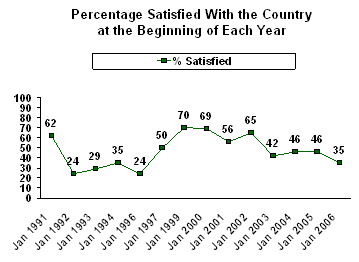
- Americans' overall assessment of the country today is fairly negative. Only 35% are satisfied with the way things are going in the United States; 65% are dissatisfied. This is consistent with Americans' generally dour mood on this measure for the past year.
- The 35% figure for satisfaction with the country is not a record low. That was 12%, set in July 1979, during an economic recession under President Jimmy Carter. Public satisfaction also dipped below 25% amid economic downturns in the early 1980s under Ronald Reagan and in the early 1990s under George H.W. Bush.
- Still, Gallup polling indicates that this is the most discouraged Americans have been about the country on the eve of a president's State of the Union address for a decade.
Is the Country Better Off?
In his closing remarks in the 1980 presidential debate with President Jimmy Carter, Ronald Reagan asked the rhetorical question that has become a mainstay of political discourse ever since: "Are you better off than you were four years ago?"
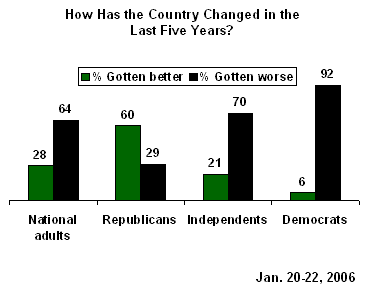
- In a variant of this, Gallup recently asked Americans "In general, do you think things have gotten better or gotten worse in this country in the last five years?" The answer is a strong rebuke of the Bush era, as nearly two-thirds of Americans say things have gotten worse. Only 28% say they have improved.
- A negative assessment of the last five years is nearly universal among Democrats (92%) and is quite widespread among independents (70%).
- While 60% of Republicans think things have improved in the United States, nearly 3 in 10 disagree.
Issues of Greatest Concern
- When those who think things have gotten worse in the country are asked to explain why, the single most frequently cited reasons are Iraq (26%) and "the economy" (24%).
- When all economic and foreign policy answers are combined, the economy appears to be the bigger concern. All economic-oriented concerns account for 55% of mentions to this multiple-response question, versus 37% for Iraq and related issues such as foreign policy, terrorism, and homeland security.
- Nineteen percent mention some aspect of government management with which they are dissatisfied -- ranging from the administration, generally, to the national debt and concern about the treatment of civil liberties.
- Separately, 19% mention some other domestic issue -- crime and healthcare among them -- as the area they think has gotten worse since Bush took office.
|
Ways in Which Things Have Gotten Worse |
|
|
Economic Issues |
|
|
The economy |
24% |
|
Inflation/Cost of living |
10 |
|
Jobs/Unemployment |
9 |
|
Gas and oil prices/demand |
6 |
|
Poverty/Homelessness |
3 |
|
Outsourcing jobs to other countries |
2 |
|
Gap between the rich and poor |
1 |
|
55% |
|
|
Iraq/Defense Issues |
|
|
The situation in Iraq |
26% |
|
Foreign relations/Foreign policies |
6 |
|
Terrorism |
3 |
|
Homeland security |
2 |
|
37% |
|
|
Government Management |
|
|
Government/Politics/Administration |
10% |
|
National debt/Government spending |
3 |
|
Civil liberties |
3 |
|
Natural disaster relief/funds |
2 |
|
Taxes |
1 |
|
19% |
|
|
Other Domestic Issues |
|
|
Crime |
5% |
|
Healthcare/Health insurance coverage |
5 |
|
Morals/Ethics/Religion |
3 |
|
Education |
3 |
|
Immigration |
2 |
|
Environment |
1 |
|
19% |
|
|
Note: Percentages add to more than 100% because of multiple responses. |
|
These are the views of people who believe things have gotten worse in the past five years. Among all Americans, foreign policy concerns edge out economic matters as the issues perceived to be the biggest problems facing the country.
- Close to 4 in 10 (38%) mention Iraq or some other aspect of foreign policy or national defense as the nation's top problem.
- A slightly lower number (30%) mention an economic issue.
|
Most Important Problem Facing the Country |
|
|
Iraq/Defense Issues |
|
|
Situation in Iraq/War |
23% |
|
Terrorism |
7 |
|
National security |
3 |
|
Foreign aid/Focus overseas |
3 |
|
International issues/problems |
2 |
|
38% |
|
|
Economic Issues |
|
|
Economy in general |
10% |
|
Unemployment/Jobs |
7 |
|
Fuel/Oil prices |
5 |
|
Federal budget deficit/Federal debt |
3 |
|
High cost of living/Inflation |
1 |
|
Lack of money |
1 |
|
Gap between rich and poor |
1 |
|
Corporate corruption |
1 |
|
Wage issues |
1 |
|
30% |
|
Economic Mood
While Americans are particularly dissatisfied today with the general state of the country, their past assessments of the economy under Bush have been worse, particularly earlier in his administration.
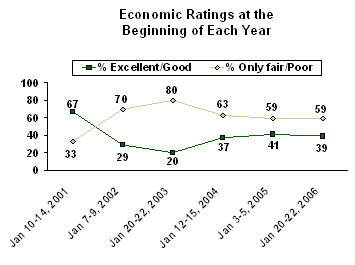
- According to the latest survey, 39% of Americans consider the economy to be in excellent or good shape while 59% consider it to be in "only fair" or poor shape.
- This is slightly higher than the average positive rating given to the economy throughout 2005 (35%) and is significantly higher than the 28% recorded in mid-October. Consumer spirits have been slowly improving since that time.
- Today's assessment of current economic conditions is similar to consumer attitudes at the beginning of each of the past two years, and is more positive than was seen in 2002 and 2003. The high consumer optimism in January 2001 was recorded at the very end of the Clinton administration.
- At the same time, the public's outlook for the economy is worse today than it was a year ago. Today, only 35% of Americans believe the economy is getting better, while the majority say it is getting worse. Last January, close to half of Americans were optimistic about the economy.
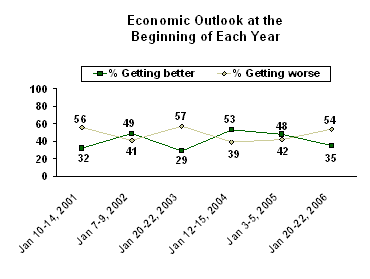
- As pessimistic as Americans are about the economy today, this pessimism was even more pronounced a few months ago, when only 24% thought the economy was getting better and 68% said it was getting worse.
Bush's Public Image
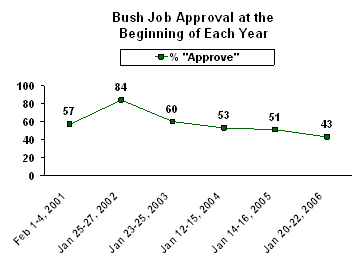
- Despite the improvement in economic ratings since last fall, public approval of Bush's overall job performance (43%) has not budged for weeks, and is similar to where it stood in late October. Fifty-four percent of Americans disapprove.
- As is true for general satisfaction with the country, the percentage approving of Bush before his annual State of the Union address is the lowest pre-address rating of his presidency. It also marks the first time Bush will make this speech with more Americans disapproving than approving of his performance as president.
- A majority of Americans disapprove of Bush's handling of every major national issue tested in the new poll, with the lone exception of terrorism.
|
Bush Job Performance on Issues |
||
|
|
|
|
|
% |
% |
|
|
Terrorism |
52 |
44 |
|
The problems caused by Hurricane Katrina |
41 |
53 |
|
The economy |
39 |
56 |
|
The situation in Iraq |
39 |
58 |
|
Healthcare policy |
31 |
60 |
|
Corruption in government |
28 |
62 |
|
Immigration |
25 |
62 |
-
Bush's issue-specific approval ratings are lower today than they were a year ago on all five major issues tested for which trends from a year ago are available.
|
Bush Job Performance on Issues |
||
|
January 2006 |
January/ |
|
|
% |
% |
|
|
Terrorism |
52 |
57* |
|
The economy |
39 |
50* |
|
The situation in Iraq |
39 |
46* |
|
Healthcare policy |
31 |
40 |
|
Immigration |
25 |
34 |
|
(* figures based on average of early January/early February polls) |
||
- Along with their weakened outlook for the economy, Americans are now less likely to approve of the way Bush is handling the economy: 39% approve today, down from 50% in early February 2005.
- Support for Bush's leadership has also declined in the areas of healthcare policy, immigration, terrorism, and the situation in Iraq.
Bush's Accomplishments
- Americans who told Gallup they think national conditions have improved over the past five years (a group mostly Republican in composition) are most likely to cite the economy and the related issues of jobs and increased wages when asked to explain why they feel that way. A combined 63% mention the economy in this context, similar to the 55% who say the economy is the main reason they feel the country is worse off today than five years ago.
- Only 19% of this upbeat group mentions Iraq or defense issues as the main factor behind their positive assessments of the country. (This contrasts with 37% mentioning Iraq or defense issues as a factor in their negative assessments.)
- Nine percent of this group mentions some aspect of government management as their reason for feeling positive about the nation since Bush took office. (This is lower than the 19% citing government management as a negative.)
|
Ways in Which Things Have Gotten Better |
|
|
|
|
|
Economic Issues |
|
|
The economy |
42% |
|
Employment/Jobs |
15 |
|
Increased wages |
3 |
|
More financially sound |
3 |
|
63% |
|
|
Iraq/Defense Issues |
|
|
National security |
12% |
|
War on terrorism |
6 |
|
The situation in Iraq |
1 |
|
19% |
|
|
Government Management |
|
|
Good leadership by Bush |
6% |
|
Taxes |
3 |
|
9% |
|
|
Other Domestic Issues |
|
|
Morals/Ethics/Religion |
6% |
|
Overall improvement/Better outlook |
5 |
|
Education |
3 |
|
Healthcare/Medicare/Prescription drugs |
2 |
|
16% |
|
|
Note: Percentages add to more than 100% because of multiple responses. |
|
Survey Methods
These results are based on telephone interviews with a randomly selected national sample of 1,006 adults, aged 18 and older, conducted Jan. 20-22, 2006. For results based on this sample, one can say with 95% confidence that the maximum error attributable to sampling and other random effects is ±3 percentage points. In addition to sampling error, question wording and practical difficulties in conducting surveys can introduce error or bias into the findings of public opinion polls.