GALLUP NEWS SERVICE
PRINCETON, NJ -- The American public has no more of a definitive conception of what the United States should do next in regard to the situation in Iraq than do their elected representatives. In recent weeks, the Senate and the House have debated resolutions that would mandate specific policies for dealing with Iraq, resulting in little more than a reinforcement of the view that the lawmakers have sharply differing views on what should be done. This is occurring in an environment in which Iraq is considered by Americans to be the most important problem facing the country, and the number one priority for the government to address at this point.
It is clear that Americans are not confident that they understand either Bush administration's or the Democrats' policies on Iraq.
How well would you say you understand the Bush administration's current policies regarding Iraq -- very well, somewhat well, not too well, or not at all?
|
Very well |
Somewhat well |
Not too well |
Not at all |
No opinion |
|
|
2006 Jun 26-29 |
25% |
39 |
20 |
16 |
* |
|
* = Less than 0.5% |
|||||
How well would you say you understand what the Democratic Party's current positions are regarding Iraq -- very well, somewhat well, not too well, or not at all?
|
Very well |
Somewhat well |
Not too well |
Not at all |
No opinion |
|
|
2006 Jun 26-29 |
19% |
35 |
29 |
16 |
1 |
While just 25% of Americans say they understand the Bush administration's current policies in Iraq very well, even fewer -- 19% -- say they understand the Democratic Party's current position regarding Iraq very well.
This lack of a clear understanding of what the Bush administration is up to in Iraq perhaps reflects the fact that the administration has argued that it is necessary to stay the course in Iraq while at the same time talking about withdrawal of troops at some point in the future. The lack of understanding of what the Democrats would suggest as an alternative is more straightforward given the sometimes rancorous debate within the Democratic Party on Iraq policy alternatives.
A recent Gallup Panel poll asked Americans a straightforward question: "What do you think the United States should do next in regard to Iraq?", and allowed people to respond in their own words. The responses were then categorized as follows:
What do you think the United States should do next in regard to Iraq? (OPEN-ENDED)
|
2006 Jun 26-29 |
|
|
% |
|
|
Pull the troops out and come home |
31 |
|
Stay the course/Doing a good job |
16 |
|
Train Iraqis to run own country |
15 |
|
Be aggressive/Finish what we started |
13 |
|
Come up with an exit strategy |
10 |
|
Make a gradual withdrawal |
8 |
|
Send more troops/Build up military presence |
2 |
|
Work with advisers/Act on advice |
2 |
|
Work with the United Nations |
2 |
|
Admit we made a mistake/Apologize and move forward |
2 |
|
Keep the public informed/Explain what is going on |
1 |
|
Other |
4 |
|
No opinion |
8 |
|
Percentages add to more than 100% due to multiple responses. |
|
It is immediately obvious that Americans have widely differing views on the question of what to do next in Iraq, ranging from "Pull the troops out" to "Send more troops."
For analysis purposes, the responses can be usefully grouped as follows (the percentages for each category do not necessarily add to those shown above because some respondents gave multiple responses within the same category):
1. Gradual Withdrawal: 31%
|
Train Iraqis to run own country |
|
|
Come up with an exit strategy |
|
|
Make a gradual withdrawal |
2. Immediate Withdrawal: 31%
|
Pull the troops out and come home |
3. Stay the Course: 30%
|
Stay the course/Doing a good job |
|
|
Be aggressive/Finish what we started |
|
|
Send more troops/Build up military presence |
4. Other: 7%
|
Work with advisers/Act on advice |
|
|
Work with the United Nations |
|
|
Admit we made a mistake/Apologize and move forward |
|
|
Keep the public informed/Explain what is going on |
These categorized results reinforce the difficulty that public opinion analysts have in pinpointing the direction that the American people would give their elected representatives on this issue. The types of suggestions that Americans provide for what to do next in Iraq can be split roughly into thirds: suggestions that advocate some type of gradual withdrawal, those that advocate immediate withdrawal, and those that advocate staying the course or being even more aggressive in Iraq.

These data can be interpreted in several different ways, depending on one's orientation.
Those who are strongly opposed to the United States' involvement in Iraq may take comfort in the fact that about two-thirds of all Americans focus on some type of withdrawal from Iraq, albeit a gradual one.
Those who strongly support the Bush administration's efforts in Iraq, on the other hand, may find support for their views in the fact that about two-thirds of Americans are focused on plans other than immediate withdrawal, as has been advocated by some critics.
Taken together, it is perhaps fair to say that a significant majority of Americans would like the United States to either withdraw troops from Iraq or make specific plans to do so, although there is no majority demand that troops be withdrawn immediately.
These results underscore the difficulty Iraq presents for Democratic candidates for office this fall and in the 2008 presidential election. A hard-line campaign position that the United States should withdraw immediately from Iraq would find favor from only a minority of the general population (although this would vary, of course, in specific states and congressional districts). But while a campaign position that the United States should plan on some type of a more gradual withdrawal from Iraq would most likely be much more acceptable, it is close to the position of the Republican administration and thus would not provide a highly differentiated position for a Democratic candidate on this issue.
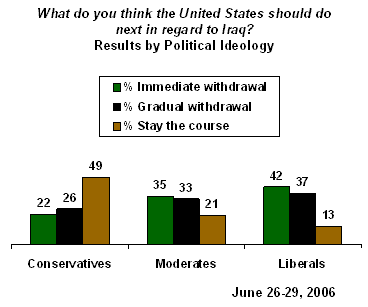
There are differences -- large differences -- in the views on what to do in Iraq expressed across partisan groups.

A majority of Republicans offer a suggestion for handling the situation in Iraq that can be classified as "staying the course." Independents are more divided, while Democrats make suggestions that tilt toward immediate withdrawal from Iraq.
But there is certainly no consensus among Democrats on this issue. Just less than half -- hardly a ringing majority -- of Democrats make suggestions that advocate immediate withdrawal, with most of the rest of the suggestions made by Democrats arguing for some type of a more gradual withdrawal.
The same type of pattern is evident among ideological groups in America:
There are some strong differences of people's positions on Iraq within educational groups.
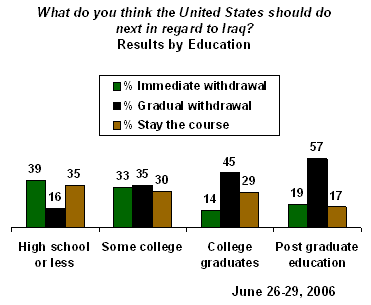
Suggestions that the United States engage in some type of gradual withdrawal increase significantly as educational level increases, from just 16% among those who have a high school education or less, to 57% among those with post graduate degrees.
In part, this pattern may reflect the tendency of those with higher levels of education to be more nuanced or equivocal in their thinking. The "gradual withdrawal" option is one that involves the "on one hand/on the other hand" type of thinking that usually is associated with higher education. But assuming that those with college educations are most likely to be highly knowledgeable about Iraq, the fact that they tend to advocate neither a quick withdrawal nor a "stay the course" alternative underscores the complex dilemma presented by the current situation in which the United States finds itself in over Iraq.
Survey Methods
Results for this panel study are based on telephone interviews with 1,002 national adults, aged 18 and older, conducted June 26-29, 2006. Respondents were randomly drawn from Gallup's nationally representative household panel, which was originally recruited through random selection methods. For results based on the total sample of national adults, one can say with 95% confidence that the margin of sampling error is ±3 percentage points. In addition to sampling error, question wording and practical difficulties in conducting surveys can introduce error or bias into the findings of public opinion polls.