GALLUP NEWS SERVICE
PRINCETON, NJ -- A recent USA Today/Gallup poll finds that Americans have a more negative than positive opinion of presidential adviser Karl Rove, a pattern that has been consistent over the last year. Rove's current ratings have recovered somewhat from the low point measured in April, shortly after some of Rove's White House duties were reduced and as reports continued to suggest Rove might be indicted in the CIA leak investigation. His current ratings are roughly in line with his ratings from last October.
Nearly 4 in 10 Americans say Rove has too much influence over the decisions the Bush administration makes. Views of Rove are predictably divided along partisan lines; Democrats are more critical than Republicans in their overall opinion and a majority of Democrats say he has too much influence over the Bush administration.
Favorable Ratings of Karl Rove
The poll, conducted July 28-30, finds that 22% of Americans have a favorable opinion of Rove, while 38% have an unfavorable opinion and the rest either don't know who Rove is, or don't know enough about him to have an opinion. This is a continuation of the pattern observed across the five Gallup surveys that have included measurements of Rove's image since July 2005; Americans' ratings of Rove always have been more negative than positive. Rove's current net favorable rating (the percentage rating him favorably minus the percentage rating him unfavorably) is -16, which is more positive than the -28 net rating in April and is roughly the same as in two polls in October 2005.
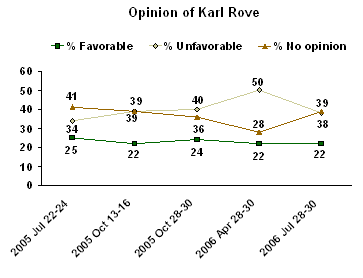
Rove's favorable ratings have shown little change since last summer, ranging between 22% and 25%. However, his unfavorable ratings have varied much more, with his lowest unfavorable rating at 34% in July 2005 and his highest at 50% this April, when Rove reduced some of his responsibilities in the Bush administration.
Slightly fewer Americans now than in April have an opinion of Rove, which most likely reflects that news about his possible involvement in the Valerie Plame case has faded from the front page.
Democrats are much more negative in their assessment of Rove than are Republicans, as would be expected for a highly visible Republican White House official. Only 9% of Democrats have a favorable view of Rove, while 44% of Republicans share this point of view. Half of Democrats rate Bush's top adviser unfavorably. Independents' ratings of Rove also are much more negative (44%) than positive (18%).
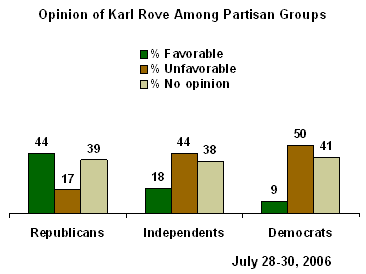
Republicans have consistently rated him more favorably than unfavorably, although not universally so. Rove's highest favorable rating among Republicans, 50%, came in mid-October 2005 and his lowest was 40% in late October 2005. At least half of Democrats have rated Rove unfavorably since July 2005, with this percentage ranging between 50% in both July 2005 and again this month and 63% in April.
Rove's Influence Over the Bush Administration
Since he appeared the national spotlight when President George W. Bush was first elected in 2000, Rove's influence with President Bush and his political role in recent elections have been the subject of a great deal of discussion and much criticism in some quarters. The current poll asked Americans whether Rove has too much, too little, or just about the right amount of influence over decisions the Bush administration makes.
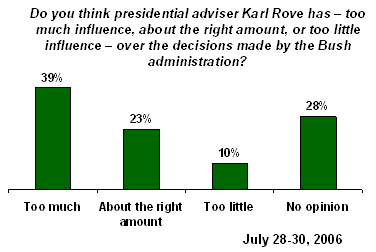
The results show that 39% of Americans feel Rove has too much influence over the decisions made by the Bush administration, while 23% say he has about the right amount and 10% say he has too little. Twenty-eight percent have no opinion on this matter.
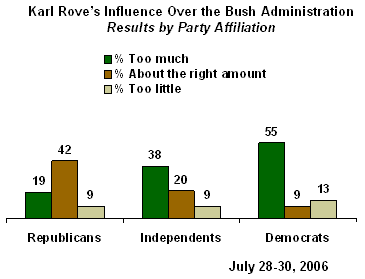
These results are again highly partisan. A majority of Democrats, 55%, say Rove has too much influence over Bush administration decisions. This sentiment is much lower among Republicans, at 19%; Republicans are most inclined to say Rove has the right amount of influence over the Bush administration. Among independents, 38% say he has too much influence, 20% say the right amount, and 9% say too little.
Survey Methods
The latest results are based on telephone interviews with a randomly selected national sample of 1,007 adults, aged 18 and older, conducted July 28-30, 2006. For results based on this sample, one can say with 95% confidence that the maximum error attributable to sampling and other random effects is ±3 percentage points. In addition to sampling error, question wording and practical difficulties in conducting surveys can introduce error or bias into the findings of public opinion polls.