GALLUP NEWS SERVICE
PRINCETON, NJ -- A new USA Today/Gallup poll finds George W. Bush's presidential job approval rating at 42%. That is slightly better than his summer readings, which have varied between 36% and 40%, and is Bush's best ratings in a single poll since early February. Bush's approval rating for handling terrorism increased significantly from the rating last month, while his ratings on other issues are flat, suggesting that more positive evaluations of Bush are likely tied to his handling of terrorism.
Overall Job Approval
Forty-two percent of Americans approve and 54% disapprove of the job Bush is doing as president, according to the Aug. 18-20 poll. That is the first time Bush's approval rating has exceeded 40% in a poll since early February. The last time Bush had a significantly better rating than the current 42% was last September, when he had two 45% approval ratings and one 46% rating. Despite a higher approval rating in this poll, a majority of Americans continue to disapprove of Bush's performance as president, as they have since July 2005.
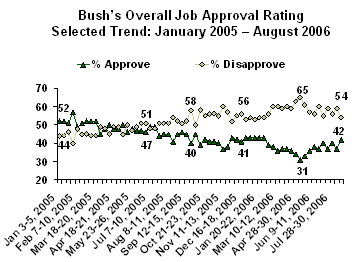
Bush has averaged 38% approval since June 1, so the current reading is slightly better than his recent average. It won't be clear whether the new poll represents a temporary blip in his rating or a more lasting change in perceptions until further polling is conducted. It is clear that Bush's ratings are better than they were as recently as May, when the president averaged 32% job approval.
Looking at the current poll data, Bush's rating has changed more among independents than among Republicans or Democrats. Thirty-six percent of independents approve of Bush in the current poll, compared with an average of 30% since June 1. The figures for Republicans (81% in the current poll, compared with 80% since June) and Democrats (11% compared with 9%) are essentially steady.
Women are another group that shows a more favorable evaluation of the president in the current poll. Forty-one percent of women approve of Bush, which is his best performance among them in any poll since January and well above the 34% approval he has been averaging among women this summer. His 43% approval rating among men is in line with his 42% average among them since June.
Bush on the Issues
The poll asked Americans to judge Bush's performance on each of seven issues.
Do you approve or disapprove of the way George W. Bush is handling -- [RANDOM ORDER]?
|
2006 Aug 18-20 |
|
|
|
% |
% |
|
|
Terrorism |
55 |
43 |
|
Foreign affairs |
39 |
55 |
|
The situation in the Middle East |
39 |
56 |
|
The economy |
39 |
57 |
|
The problems caused by Hurricane Katrina |
37 |
56 |
|
The situation in Iraq |
36 |
61 |
|
Energy policy |
30 |
60 |
Of these issues, Bush is rated most highly on terrorism, with a 55% approval rating, and worst on energy policy, at 30%. His ratings on the other five issues range between 36% and 39%. Terrorism is the only issue that exceeds Bush's overall 42% job approval rating.
Bush's approval rating on terrorism has improved significantly from last month (47%), and is his best score on this issue since June 2005 (55%). Terrorism has typically ranked as Bush's strongest issue since the Sept. 11, 2001, terrorist attacks. The current increase could be an outcome of the recently foiled London plot to use liquid explosives to blow up airplanes flying between the United States and Great Britain.

Terrorism is the only issue on which Bush's ratings have shown significant improvement from the last time they were measured. Ratings on each of the other issues are essentially unchanged. This pattern suggests that higher public support for Bush in general is likely tied to a sharper focus on the terrorism issue.
George W. Bush Approval Ratings on Issues Compared With Last Time Measured
|
Current |
Last |
Time of last |
|
|
% |
% |
|
|
|
Terrorism |
55 |
47 |
Jul 2006 |
|
Foreign affairs |
39 |
38 |
Jul 2006 |
|
The situation in the Middle East |
39 |
37 |
Jul 2006 |
|
The economy |
39 |
39 |
Jul 2006 |
|
The problems caused by Hurricane Katrina |
37 |
41 |
Jan 2006 |
|
The situation in Iraq |
36 |
35 |
Jul 2006 |
|
Energy policy |
30 |
30 |
Jun 2006 |
Survey Methods
These results are based on telephone interviews with a randomly selected national sample of 1,001 adults, aged 18 and older, conducted Aug. 18-20, 2006. For results based on this sample, one can say with 95% confidence that the maximum error attributable to sampling and other random effects is ±3 percentage points. In addition to sampling error, question wording and practical difficulties in conducting surveys can introduce error or bias into the findings of public opinion polls.