GALLUP NEWS SERVICE
PRINCETON, NJ -- A recent Gallup panel survey finds that the Iraq war continues to surpass all other issues by a wide margin when Americans are asked what should be the government's top priority.
In the Aug. 28-31 survey, 51% of Americans say the war in Iraq should be the top priority for "the president and Congress to deal with at this time." No other issue is mentioned with near this frequency; the next group of issues are only mentioned by 12%-16% of Americans, and include the economy, energy and gas prices, healthcare, and immigration.
Concerns about terrorism are also evident in the poll, as 9% mention terrorism specifically and another 7% say national security. Gallup conducted the poll near the time of the one-year anniversary of Hurricane Katrina, and 7% mentioned natural disaster relief as a top government priority.
In your view, what one or two issues should be the top priorities for the president and Congress to deal with at this time? [Open-ended]
|
Issue |
Percent mentioning |
|
% |
|
|
Situation in Iraq/war |
51 |
|
Economy in general |
16 |
|
Fuel/oil prices/lack of energy sources/the energy crisis |
15 |
|
Poor healthcare/hospitals; high cost of healthcare |
14 |
|
Immigration/illegal aliens |
12 |
|
Terrorism |
9 |
|
National security |
7 |
|
Natural disaster relief/funding |
7 |
|
Education/poor education/access to education |
5 |
|
War/conflict in the Middle East |
4 |
|
Federal budget deficit/federal debt |
3 |
|
Foreign aid/focus overseas |
3 |
|
Unemployment/jobs |
3 |
|
Social Security |
3 |
|
Environment/pollution |
2 |
|
Medicare |
2 |
|
Taxes |
2 |
|
Poor leadership/corruption/dissatisfaction with government/Congress/politicians/candidates |
2 |
|
Poverty/hunger/homelessness |
1 |
|
Wages |
1 |
|
Welfare |
1 |
|
Abortion |
1 |
|
Homosexual issues/gay marriage |
* |
|
Lack of military defense |
* |
|
International issues/problems |
* |
|
Judicial system/courts/laws |
* |
|
Unifying the country |
* |
|
Crime/Violence |
* |
|
The situation in North Korea |
* |
|
Ethics/moral/religious/family decline; dishonesty; lack of integrity |
* |
|
Election year/election reform |
* |
|
High cost of living/inflation |
* |
|
Gap between rich and poor |
* |
|
Trade deficit/foreign trade |
* |
|
Lack of money |
* |
|
|
|
|
Other |
1 |
|
|
|
|
No opinion |
3 |
|
|
|
|
* Less than 0.5% |
|
|
Percentages add to more than 100% due to multiple responses. |
|
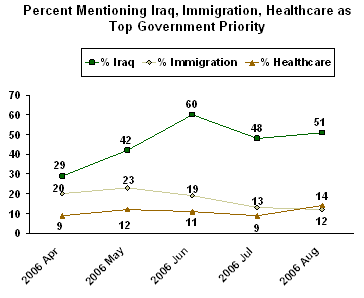
Iraq has been the top priority each of the five times Gallup has asked this question since April 2006. The percentage mentioning Iraq as the number one priority climbed from 29% in April to 42% in May before reaching its highest point at 60% in June. In the last two surveys, about half of Americans have named the war in Iraq as the top government priority.
While Iraq has gained in importance compared with surveys conducted in the spring and early summer months, the relative ranking of immigration has declined during that time. In April, May, and June, between 19% and 23% of Americans said immigration should be the government's top priority. In the last two polls, the percentage has dropped to 12%-13%.
Healthcare has increased slightly in perceived importance, from 9% in July to 14% in the August survey.
Republicans and Democrats differ in their views of what the government's priorities should be. Both rank Iraq as the number one priority, but Democrats (61%) are much more likely to do so than Republicans (38%). Republicans' other priorities for the government are fuel prices and energy (20%), immigration (19%), and terrorism (18%). Democrats' secondary priorities are the economy (19%) and healthcare (18%).
|
Mentions of Top Government Priority, by Party Affiliation |
|||||
|
Democrat |
% |
Independent |
% |
Republican |
% |
|
War in Iraq |
61 |
War in Iraq |
52 |
War in Iraq |
38 |
|
Economy |
19 |
Economy |
18 |
Fuel prices/ |
20 |
|
Healthcare |
18 |
Healthcare |
14 |
Immigration |
19 |
|
Fuel prices/ |
10 |
Fuel prices/ |
13 |
Terrorism |
18 |
|
Natural disaster relief |
10 |
Immigration |
9 |
National security |
12 |
|
Immigration |
9 |
Terrorism |
8 |
Economy |
11 |
|
Education |
9 |
Natural disaster relief |
7 |
Healthcare |
8 |
|
National security |
4 |
National security |
5 |
Natural disaster relief |
3 |
|
Terrorism |
2 |
Education |
3 |
Education |
2 |
Survey Methods
Results for this panel study are based on telephone interviews with 1,001 national adults, aged 18 and older, conducted August 28-31, 2006. Respondents were randomly drawn from Gallup's nationally representative household panel, which was originally recruited through random selection methods. For results based on this sample of national adults, one can say with 95% confidence that the maximum margin of sampling error is ±3 percentage points. In addition to sampling error, question wording and practical difficulties in conducting surveys can introduce error or bias into the findings of public opinion polls.