GALLUP NEWS SERVICE
PRINCETON, NJ -- Perhaps the single most important question about the Iraqi situation at this moment is very straightforward. What should the United States do next?
The answer to that question is not clear even among political leaders in this country. Democratic leaders, while focusing on using voters' negative views of the war as a political issue, have not coalesced around a clear strategy for what they would do differently. In particular, while there have been calls for an immediate withdrawal of all U.S. troops from Iraq by some Democrats, that position is by no means a dominant party platform. On the Republican side, while the Bush administration continues to argue that it is important to stay the course and avoid "cutting and running," not all Republicans agree. And some Republicans, such as John McCain, have even argued that more troops need to be sent.
For the American public, a good deal of survey research has documented that dealing with Iraq is by far their government's top priority.
But what exactly does the American public want their elected representatives to do about Iraq?
A recent Gallup Poll asked just that question ("What do you think the United States should do next in regard to Iraq?") and allowed respondents to answer in their own words. The table summarizes the responses, grouped into categories:
What do you think the United States should do next in regard to Iraq?
|
Sep 21-24, |
Jun 26-29, |
|
|
% |
% |
|
|
|
|
|
|
Pull the troops out and come home |
37 |
33 |
|
|
|
|
|
|
|
|
|
Gradual withdrawal/transition to the Iraqis |
26 |
30 |
|
|
|
|
|
Come up with an exit strategy |
8 |
8 |
|
Make a gradual withdrawal |
4 |
8 |
|
Train Iraqis to run own country |
14 |
14 |
|
|
|
|
|
Continue/Stay the course |
30 |
31 |
|
|
|
|
|
Stay the course/Doing a good job |
16 |
17 |
|
Be aggressive/Finish what we started |
10 |
12 |
|
Send more troops/Build up military presence |
4 |
2 |
|
|
|
|
|
Miscellaneous |
4 |
4 |
|
|
|
|
|
Work with advisers/Act on advice |
2 |
1 |
|
Admit we made a mistake/Apologize/move forward |
1 |
2 |
|
Work with the United Nations |
1 |
1 |
|
Keep the public informed/Explain what is going on |
-- |
* |
|
|
|
|
|
Other |
3 |
4 |
|
No opinion |
6 |
9 |
|
Percentages add to more than 100% due to multiple responses. |
The recommendations of the American public about Iraq can be categorized into three broad categories: removing troops now, a gradual withdraw of troops and eventually turning the country over to the Iraqis, or staying the course in Iraq.
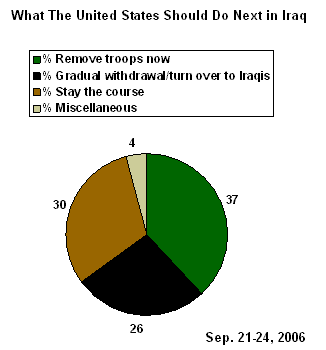
The most important conclusion to be reached based on these data is the fact that, perhaps not surprisingly, there is no one dominant recommendation for dealing with the situation in Iraq percolating up from the public. The segment of Americans that recommend immediate withdrawal is just slightly larger than the segment that recommends staying the course and the segment that recommends a plan of gradual withdrawal and transition. But there is no majority sentiment in favor of either immediate withdrawal, or in favor of staying the course without plans for withdrawal or transition to the Iraqis.
There are significant differences in views on what should be done now in Iraq by partisan orientation as demonstrated in the table:
|
What Should The United States Do Next in Iraq? Sept. 21-24, 2006 |
||
|
Republicans (including "leaners") |
Democrats (including "leaners") |
|
|
% |
% |
|
|
Pull troops out of Iraq now |
20 |
53 |
|
Gradual withdrawal/ transition to Iraqis |
27 |
25 |
|
Stay the course |
43 |
17 |
|
Miscellaneous responses |
4 |
4 |
Less than half of Republicans recommend a course of action that is similar to that of the current Republican administration -- staying the course -- although another group of about one-fourth recommend gradual withdrawal and/or turning control over to the Iraqis -- a position that in a broader sense is at least somewhat close to the administration's position. Notably, one in five Republicans recommends an immediate withdrawal of troops from Iraq.
On the other hand, a majority (albeit a slight majority) of Democrats recommend an immediate withdrawal. But that leaves 4 in 10 Democrats who adopt a position that is more similar to that advocated by the Republican administration.
The same types of patterns are observable in the division of the American public by ideology.
|
What Should The United States Do Next in Iraq? Sept. 21-24, 2006 |
|||
|
Conservatives |
Moderates |
Liberals |
|
|
% |
% |
% |
|
|
Pull troops out of Iraq now |
28 |
35 |
57 |
|
Gradual withdrawal/ transition to Iraqis |
22 |
29 |
26 |
|
Stay the course |
41 |
29 |
11 |
|
Miscellaneous responses |
4 |
4 |
4 |
Implications
There are some instances in which the public coalesce around a solution for tricky issues and policy decisions more quickly than do their leaders, but Iraq does not appear to be such a case. There is no majority consensus from the public on what to do next. In general, the majority mandate from the public is neither to immediately withdraw troops, nor is it to do exactly what is being done now in Iraq without plans for at least a gradual withdrawal.
Republicans can presumably take solace in the fact that less than half of the public advocates immediate withdrawal, while Democrats presumably would underscore the fact that less than half of the public advocates continuing precisely with the current course of action.
This lack of strong public consensus as to what to do in Iraq no doubt reflects the fact that the issue is quite complicated and that there are no easy solutions. There are significant downsides to pulling the troops out of Iraq before the country is stable, but there are also significant risks to the United States of continuing to keep a large troop presence there. The lack of consensus may also reflect that fact that the debate over Iraq is highly partisan, and perhaps more than most other wars has been closely identified with one president and one party.
The mixed messages from Americans about their preferred Iraq policy may indicate that there will be a continuation of the current political quagmire on the issue, regardless of who wins control of Congress this November. Even though most Americans disapprove of the way Bush has handled the situation in Iraq, these data show that there is no strong direction from the public that he (or Congress) should immediately begin to withdraw U.S. troops. It appears that in this situation the American public is very much open to leadership initiatives or approaches which might suggest different ways of dealing with what has become the public's top priority.
Survey Methods
Results for this panel study are based on telephone interviews with 1,010 national adults, aged 18+, conducted Sept. 21-24, 2006. Respondents were randomly drawn from Gallup's nationally representative household panel, which was originally recruited through random selection methods. For results based on the total sample of national adults, one can say with 95% confidence that the margin of sampling error is ±3 percentage points. In addition to sampling error, question wording and practical difficulties in conducting surveys can introduce error or bias into the findings of public opinion polls.