GALLUP NEWS SERVICE
PRINCETON, NJ -- The news is mixed for George W. Bush in his latest quarterly report card. On the plus side, his 39.1% approval rating for his most recent quarter in office is a significant improvement from his prior quarter's average and marks the first time since his 16th quarter that his average has not declined from the previous time. On the down side, his latest average still rates as the third worst of his presidency and only ranks in the 12th percentile of all presidential quarters since the Truman presidency, placing 214th out of the 244 quarters for which Gallup has data.
In the eight Gallup Polls conducted between July 20 and Oct. 19, 2006, coinciding with his 23rd quarter in office, Bush averaged a 39.1% approval rating. That is a significant improvement from the prior quarter's average of 35.8%, which included Bush's low point of 31% approval in early May.
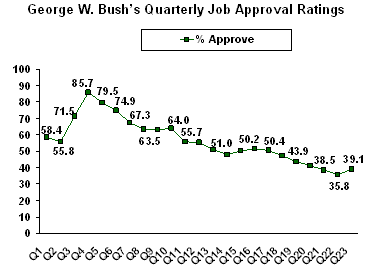
Generally speaking, Bush's second term in office has not been well-received by the public. His quarterly approval averages have ranged from a low of 35.8% to a high of just 50.4%, all below average historically. In this, his sixth year in office, Bush's quarterly averages have all been below 40%.
The latest Gallup update on Bush's job approval rating, from an Oct. 9-12 poll, shows Bush's approval rating holding steady at 37%, but down from a 44% reading in mid-September.
Historical Comparison
Prior presidents who served a 23rd quarter in office were either quite popular or quite unpopular. The popular presidents include Dwight Eisenhower, Ronald Reagan, and Bill Clinton, all of whose approval averages for the quarter were near 60%. Bush would clearly fall in the unpopular camp, with his 39.1% average, similar to Harry Truman's 37.3% 23rd quarter average. Richard Nixon began but did not finish a 23rd quarter in office, resigning office during the Watergate scandal just after his last quarter began. Nixon's final approval rating was a dismal 24%.
|
Twenty-third Quarter Presidential Job Approval Averages, Gallup Polls |
|||
|
President |
Dates of 23rd Quarter |
Average |
Number of Measures |
|
|
% |
|
|
|
Truman |
Oct 20, 1950-Jan 19, 1951 |
37.3 |
4 |
|
Eisenhower |
Jul 20-Oct 19, 1958 |
56.4 |
5 |
|
Nixon |
Jul 20-Aug 9, 1974 |
24.0 |
1 |
|
Reagan |
Jul 20-Oct 19, 1986 |
61.7 |
3 |
|
Clinton |
Jul 20-Oct 19, 1998 |
63.9 |
8 |
|
George W. Bush |
Jul 20-Oct 19, 2006 |
39.1 |
8 |
For most presidents, the 23rd quarter is the last full quarter prior to the second midterm election of their presidency. In 1986, Republicans lost just five seats in the U.S. House of Representatives with the popular Reagan in office, while Democrats gained seats in the 1998 elections. Republicans suffered significant losses in the 1974 elections even though Gerald Ford had replaced Nixon in office. Ford's unpopular decision to pardon Nixon in September 1974 did not help the Republican cause. Despite Eisenhower's popularity, Republicans still performed poorly in the 1958 elections, losing a large number of seats in both the House and Senate.
Bush's low level of popularity does not augur well for Republicans in this year's elections, and Democrats have had significant leads on Gallup's measure of congressional voting intentions all year long.
Survey Methods
These data are based on an average of eight polls, each of approximately 1,000 adults aged 18 and older, conducted between July 20-Oct. 19, 2006. Each individual poll has a maximum margin of sampling error of ±3 percentage points, while the maximum margin of error for the eight-poll average is ±1 percentage point. In addition to sampling error, question wording and practical difficulties in conducting surveys can introduce error or bias into the findings of public opinion polls.