GALLUP NEWS SERVICE
PRINCETON, NJ -- The latest USA Today/Gallup survey, conducted Oct. 20-22, 2006, reinforces the findings from a Gallup survey conducted earlier this month: Americans' mostly negative assessment of the nation's economy may be on the mend. Gallup's two key measures of consumer confidence -- how Americans rate current economic conditions and whether they think the economy is getting better or getting worse -- show significant improvement over the low points recorded this summer. Still, despite this recent improvement, less than half of Americans rate the economy as excellent or good or say the economy is getting better.
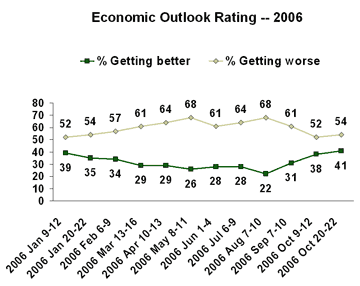
After mostly registering in the mid- to high-30s since late January, the percentage of Americans giving the U.S. economy a positive review finally cracked the 40% barrier in the Oct. 9-12, 2006, Gallup Poll, and is now at 44%. Additionally, 41% consider the economy to be improving. While a majority of Americans -- 54% -- continue to say the economy is getting worse, the current numbers are up from the recent low point recorded in August when high gas prices were stifling consumer optimism. Economic ratings are now roughly the same as measured at the beginning of the year.
Current Conditions
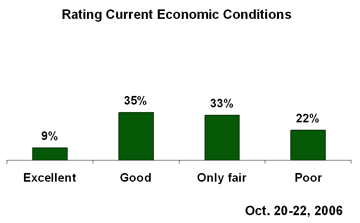
When given four options for rating current economic conditions, 44% of Americans now choose the positive categories of "excellent" or "good." However, the majority (55%) continue to take one of the two more negative positions, calling the economy "only fair" or "poor."
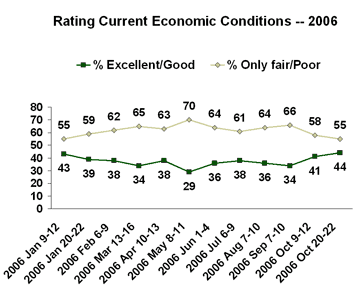
Positive evaluations of the economy had fallen during the first months of this year to a low point of 29% in Gallup's May 8-11 poll. More recently, however, positive ratings have edged up, growing from 34% in September to 41% in early October to 44% in the latest poll. Attitudes now have returned a point very similar to where they stood in January of this year.
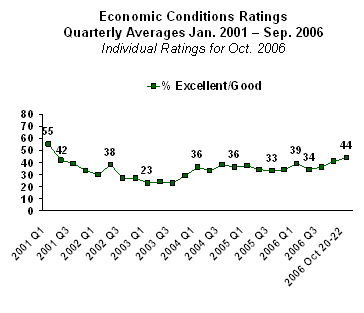
Americans' ratings of the economy have approached today's level at various times since the start of President Bush's first term in January 2001; however, there has not been a sustained period of 40%-plus ratings since the second quarter of 2001, when an average of 42% of Americans rated the economy excellent or good. Thus, the fourth quarter of 2006 is starting off auspiciously with two ratings above 40%.
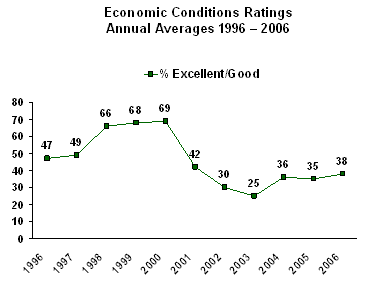
The longer view, however, provides a more discouraging perspective on Americans' ratings of current economic conditions, with the excellent/good score averaging 38% from January through October of this year. From 1998 to 2000, the average annual figure topped 60%, with individual polls in this period showing confidence greater than 70%. From 1996 to 1997, confidence averaged near 50%.
The average for 2006 to date (38%) is better than that seen in 2003 (25%), but is not much different from 2004 and 2005.
Economic Outlook
The percentage of Americans saying the economy is "getting better" fell from 39% in January to a low point of 22% in August, and then recovered to 31% in September, to 38% in early October, and now stands at 41%. The latest reading restores confidence in the direction of the economy to roughly where it was in January.
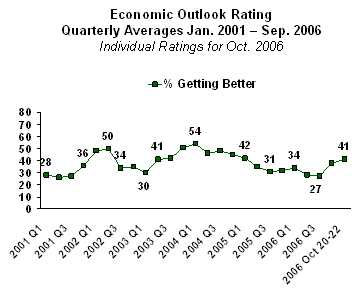
Unlike Americans' ratings of current economic conditions -- which have been in a slump for most of the past five years -- their outlook for the economy has been quite variable. The average "getting better" score has not approached the level seen in the current October poll since the first quarter of 2005. However, it matched or exceeded this level throughout 2004 and for several quarters in 2002 and 2003.
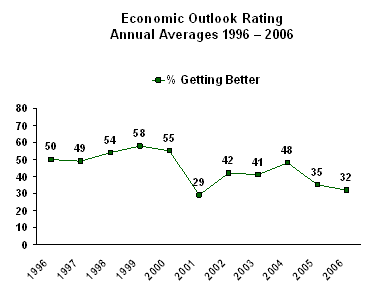
Longer term, the average percentage holding a positive outlook for the economy in 2006 (32%) is on the low end of annual scores for this measure since 1996. The percentage saying the economy is getting better was much higher toward the end of President Bill Clinton's second term. As George W. Bush took office in January 2001, however, consumer optimism soured on the news of a slowing economy and remained quite low until the terrorist attacks on 9/11. This event triggered a rally in consumer optimism that expanded in subsequent months.
Bottom Line
While Gallup's recent surveys have shown an improvement in Americans' attitudes about the economy, the public's overall assessment remains quite negative. A majority of Americans still say the economy is getting worse, and less than half are willing to rate the economy as excellent or good.
Gallup's monthly economic tracking will help determine whether the current upward trend is the start of a long-term recovery in consumer attitudes, or merely another case of temporal change as has been measured at numerous points before.
Survey Methods
These results are based on telephone interviews with a randomly selected national sample of 1,002 adults, aged 18 and older, conducted Oct. 20-22, 2006. For results based on this sample, one can say with 95% confidence that the maximum error attributable to sampling and other random effects is ±3 percentage points. In addition to sampling error, question wording and practical difficulties in conducting surveys can introduce error or bias into the findings of public opinion polls.
