GALLUP NEWS SERVICE
PRINCETON, NJ -- Republican presidential nominee George W. Bush is viewed favorably by just over half of the likely voters in the country today, compared to a little more than 60% who have a favorable opinion of Al Gore. This represents a continuation of a change in the relative positioning of these two candidates that began after Gore's successful Democratic convention in August. Gore's running mate, Joe Lieberman, is also now viewed more favorably than GOP vice presidential nominee Dick Cheney, although Lieberman's favorable rating is actually down slightly from immediately after the convention. Additionally, the public has now changed its mind radically about who they think will win the election. After the Republican convention this summer, Bush was perceived as the probable victor by a two-to-one margin; now Al Gore is ahead on this projective measure, 54% to 33%, the first time Gore has been viewed as the likely winner by the public this year.
Al Gore and George W. Bush Favorables
Here are the latest numbers on the way likely voters rate the two
major-party candidates, based on CNN/USA Today/Gallup poll
tracking conducted September 15-17:
|
Do you have a favorable or unfavorable opinion of Al Gore/George W. Bush? Among Likely Voters |
||
|
Al Gore % |
George W. Bush % |
|
|
Favorable |
61 |
52 |
|
Unfavorable |
33 |
42 |
|
No Opinion |
6 |
6 |
The graph below displays the trends in the percentage of the population that views each of these candidates favorably, based on the views of likely voters tracked from January of this year through this past weekend:
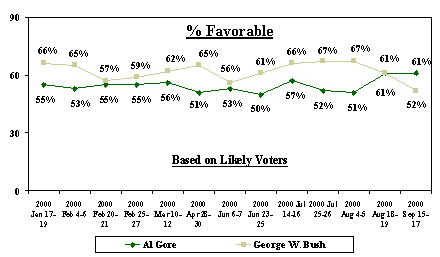
Although the favorable ratings of the two candidates have been close at several different times earlier this year, the current positioning of Al Gore's favorable line above George W. Bush's marks a first.
To some extent, of course, the change in the images of the two candidates is reflective of their overall ballot standing. Since Labor Day, Gore has fared better than Bush in terms of likely voters' preferences for president, and it is therefore not surprising that the ways in which voters view the candidates on this favorable/unfavorable dimension would change as well.
Still, it is interesting to look at the way in which the attitudes towards the two candidates have changed – essentially in two phases. First, immediately after the Democratic convention, Al Gore's favorable rating increased to his high point of the year, 61%, where it still is. This compares to Gore's 51% favorable rating recorded after the Republican convention, and favorable ratings that were generally in the 50s throughout the year.
Bush's favorable rating fell some after the Democratic convention, but not by a large amount. His 61% in late August was down from 67% after the GOP convention. But, unlike Gore's rating, which has stayed flat, Bush's has continued to fall, from the 61% tie with Gore after the Democratic convention to its current 52% favorable, the lowest favorable rating for Bush this year.
Lieberman Viewed More Favorably Among Vice Presidential
Candidates
What about the vice presidents? Democratic vice presidential
candidate Joe Lieberman's favorable number is higher than
Republican vice presidential nominee Dick Cheney's, as we might
predict (given the fact that the Democratic ticket is ahead of the
Republican ticket) by a 58% to 52% margin, among likely voters.
The interesting finding, however, is that the favorable ratings of both candidates have fallen since the Democratic convention. Among likely voters, Cheney has fallen nine points during this time, in line with the change seen for his running mate, George W. Bush. Over the same time period, Lieberman also has fallen, a total of seven percentage points -- from 65% immediately after the Democratic convention to 58% now.
Here is the full trend:
|
Do you have a favorable or unfavorable opinion of Joe Lieberman/Dick Cheney? Among Likely Voters |
||||
|
Joe Lieberman |
Dick Cheney |
|||
|
Favorable % |
Unfavorable % |
Favorable % |
Unfavorable % |
|
|
September 15-17 |
58 |
17 |
52 |
25 |
|
August 18-19 |
65 |
13 |
61 |
21 |
|
August 4-5 |
-- |
-- |
54 |
23 |
|
July 25-26 |
-- |
-- |
60 |
12 |
The pattern of the public's assessment of Cheney is of particular interest. Note that his image actually became less favorable after the GOP convention, then went back up after the Democratic convention, and now has fallen back down again. Lieberman's image was, like Cheney's, initially quite positive, but then fell back down slightly in this most recent polling.
Job Approval Ratings for Gore and Bush
An interesting shift has occurred in the public's assessment of the
job being done by George W. Bush as governor of Texas. As far back
as September 1999, 68% of likely voters said that they approved of
the job Bush was doing as governor of Texas. That number has
declined gradually in the year since. By July, prior to the
conventions, at a time at which Bush was doing well
vis-à-vis Gore in the polls, just 58% of the likely voter
population said that they approved. Now, that number has fallen to
just 50%, with 29% disapproving and the remainder having no
opinion.
Conversely, approval of the way Gore is handling his job has gone up, from 58% in July, to 65% today.
Who Will Win?
No one knows now who will win the election in November,
particularly given historical evidence that demonstrates how a
candidate's positioning in the minds of voters can change as the
fall campaign progresses. The average American, however, is quite
willing to venture a guess when called upon to answer this
question: "Regardless of who you support, and trying to be as
objective as possible, who do you think will win the election in
November?" The answer? Likely voters say that Al Gore will win, by
a 54% to 33% margin over George W. Bush.
It is important to keep in mind that these same voters favor Gore over Bush in the election per se by only a 48% to 43% margin. In other words, the sample of likely voters favors Gore by five points, but the gap on whom they believe will win the election is 21 points. This is based on the fact that almost nine out of 10 Democrats say that Gore will win, while only about six out of 10 Republicans say that Bush will win. Additionally, more independents currently think Gore will be the eventual victor.
Voters change their minds quickly on this measure. Immediately after the Republican convention, voters favored Bush by a 17-point margin, but said that Bush would win the election by an overwhelming 43-point margin, 68% to 25%.
Survey Methods
The results reported here are based on telephone interviews with a randomly selected national sample of 741 Americans deemed likely to vote, 18 years and older, conducted September 15-17, 2000. For results based on this sample, one can say with 95 percent confidence that the maximum error attributable to sampling and other random effects is plus or minus 4 percentage points. In addition to sampling error, question wording and practical difficulties in conducting surveys can introduce error or bias into the findings of public opinion polls.