GALLUP NEWS SERVICE
PRINCETON, NJ -- The Centers for Disease Control and Prevention reports that serious birth defects are the leading cause of infant deaths in this country, and that birth defects affect 1 in 33 babies, or approximately 3% of babies, born each year. The American public, however, greatly overestimates the percentage of babies born with a birth defect in the United States today, with the average estimate being more than five times the actual rate. Americans perceive a pregnant woman's exposure to drugs, toxic substances, and alcohol, along with genetics or family history, as the most common causes of birth defects.
Percentage of Babies Born With Birth Defects
Gallup's annual Health and Healthcare poll, conducted Nov. 9-12, finds Americans estimating, on average, that 17% of babies born today are born with a birth defect. The median percentage estimated is lower, at 10% -- meaning that half of Americans estimate a percentage below 10% and half believe it is greater than 10%. Both the mean and median estimates are significantly higher than the CDC's reported rate of 3%. Only about one in six Americans correctly estimates that birth defects affect less than 5% of babies.
|
Just your best guess, what percentage
of babies born today are born with a birth
defect? |
|
|
% |
|
|
Less than 5% |
15 |
|
5% to less than 10% |
17 |
|
10% to less than 20% |
22 |
|
20% or more |
31 |
|
|
|
|
No opinion |
15 |
|
|
|
|
Mean |
16.5 |
|
Median |
10 |
The poll finds few significant differences among most segments of the population in estimates of the incidence of birth defects in the country.
For example, men, on average, say that 15% of babies are born with birth defects. This is not much different from the 19% average among women. Similarly, the average for younger adults (those under age 50) is 18%, not much different from the 15% approximation among older adults.
Also of interest, parents with children younger than age 18 (who estimate 17%) do not differ from those who are not parents of young children (who estimate 16%) in their estimates of the incidence of birth defects.
One area in which estimates do differ is by educational attainment. Americans with less formal education tend to give much higher estimates of the birth defect rate than do those with more formal education.
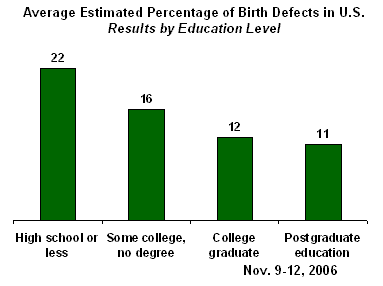
These results by education are even more revealing when looking at the median response. The median is 15% for those with a high school level education and 10% for those with some college education or a undergraduate college degree. The median is 5% for those with postgraduate education, similar to the 3% the CDC reported.
Causes of Birth Defects
The poll also tested Americans' awareness of seven different factors that can cause birth defects in newborns.
|
Next, thinking about the causes of
birth defects today, based on what you know and have read, would
you say each of the following does or does not cause birth
defects? |
|||
|
|
|
No opinion |
|
|
% |
% |
% |
|
|
The mother taking drugs during pregnancy |
99 |
* |
1 |
|
The mother being exposed to toxic substances during pregnancy |
95 |
3 |
1 |
|
The mother drinking alcohol during pregnancy |
94 |
4 |
2 |
|
Genetics or family history |
90 |
7 |
2 |
|
The mother smoking during pregnancy |
88 |
9 |
3 |
|
The mother not getting adequate prenatal care during pregnancy |
78 |
19 |
3 |
|
The mother not taking the proper vitamins during pregnancy |
63 |
34 |
3 |
At least 9 in 10 Americans associate each of four factors with causing birth defects: the mother taking drugs during pregnancy (99%), the mother being exposed to toxic substances during pregnancy (95%), the mother drinking alcohol during pregnancy (94%), and genetics or family history (90%). Eighty-eight percent of Americans say the mother smoking during pregnancy can cause birth defects.
Although still a solid majority, Americans are much less likely to say that either the mother not getting adequate prenatal care during pregnancy (78%) or the mother not taking the proper vitamins during pregnancy (63%) can cause birth defects.
While there is evidence that these seven factors can lead to birth defects or increased likelihood of infant mortality, the CDC reports that the more common birth defects include heart defects, "neural tube defects" affecting the spine and brain, or "orofacial clefts" affecting the lip and roof of the mouth.
Given the widespread belief that five of the seven factors tested in this survey cause birth defects, there are not a lot of significant variations by population subgroup. There are some differences, however, about mothers getting adequate prenatal care and taking the proper vitamins during pregnancy.
- Women are more likely than men to say that not taking the proper vitamins during pregnancy (67% to 59%) as well as not getting adequate prenatal care (81% to 74%) can cause birth defects.
- Parents with children under age 18 are actually less likely than those who are not parents of young children to say both of these factors can cause birth defects. Fifty-seven percent of parents of young children say not taking the proper vitamins can cause birth defects, while 66% of those who are not the parents of young children believe this. Also, 74% of parents with children under 18 say not getting adequate prenatal care can cause birth defects, compared with 80% of those who are not parents of young children.
Survey Methods
Results are based on telephone interviews with 1,004 national adults, aged 18 and older, conducted Nov. 9-12, 2006. For results based on the total sample of national adults, one can say with 95% confidence that the maximum margin of sampling error is ±3 percentage points. In addition to sampling error, question wording and practical difficulties in conducting surveys can introduce error or bias into the findings of public opinion polls.