GALLUP NEWS SERVICE
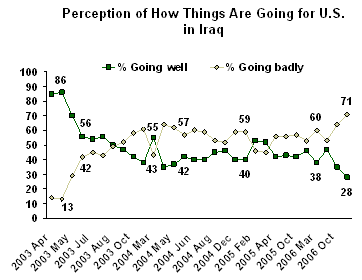
PRINCETON, NJ -- Americans' assessment of the situation in Iraq has become progressively more negative in recent months, as the percentage saying things are going "badly" for the United States has jumped to a record high of 71% in the latest USA Today/Gallup poll. This is up from 64% in October 2006. On the flip side, just 28% think things are going well, down from the previous low of 35% last fall.
The latest two readings are markedly more negative than the average sentiment on this question for each of the last three years. From 2004 through 2006, an average of 43% thought the war was going well while 56% said it was going badly. By contrast, in the first year of the war (2003), an average of 58% thought it was going well and only 40% perceived that it was going badly.
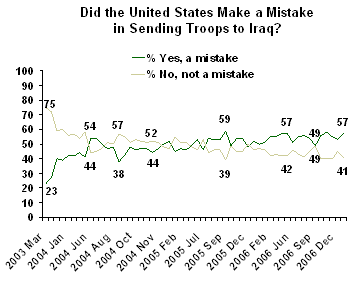
The recent decline in American attitudes about Iraq is also evident in the trend from Gallup's measure of public support for the Iraq war, which asks whether the United States made a mistake in sending troops there. The percentage calling it a mistake is slightly higher today (57%) than it was a month ago (53% in early December), and stands near the high-water mark for this question (59% in September 2005).
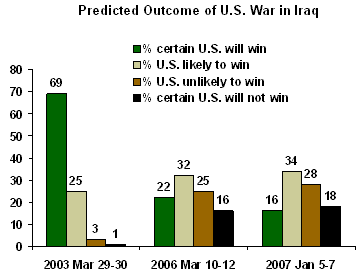
The new survey, conducted Jan. 5-7, also finds the lowest proportion on record of Americans (16%) saying the United States is certain to win in Iraq, although nearly as few (22%) were optimistic about victory last March. The combined percentage saying the United States is either certain or likely to win is 50%. About the same number (46%) now say the United States is either unlikely to win or certain not to win. Last March, the balance of opinion on this question was slightly more optimistic, with 54% predicting victory and only 41% expecting failure.
The extent to which public opinion about Iraq has changed since the beginning of the war is clearly evident in the first readings on this measure in 2003. At that time, as many as 69% of Americans believed the United States was certain to win and another 25% thought victory was likely.
Rationale for More Troops Not Embraced
Public discouragement about the Iraq war is clearly not lost on President George W. Bush, who is scheduled to address the subject in a speech to the nation on Wednesday night. Based on his advance briefings to lawmakers, Bush is expected to propose sending as many as 20,000 more troops to the most troubled areas of Iraq to try to stem the sectarian violence plaguing that country. Congressional Democrats are portraying this as a major escalation of the war, and indicate they will insist Bush first seek congressional approval, and that they may block funding for it.
The latest poll shows that barely a third of Americans are poised to support Bush's position in this political confrontation. Only 36% say they would favor sending more troops to Iraq if Bush proposes it in his speech; 61% say they would oppose this. Whether Bush is able to expand that support could depend on how well he makes the argument that the new deployment is essential to achieving the United States' goals in Iraq. As of now, he faces a clear uphill battle.
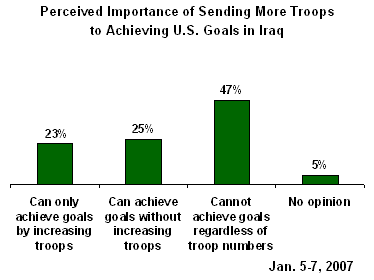
Only a quarter of Americans (23%) believe sending more troops to Iraq is essential to the United States achieving its goals there. Another quarter (25%) say U.S. goals can be achieved without sending more troops, while nearly half (47%) say U.S. goals cannot be achieved regardless of how many troops it has there.
Saddam Execution Not Seen as Problematic
The taunting Saddam Hussein received from onlookers in the final moments before his execution by the Iraqis -- something captured on video via cell phone and posted on the Internet -- created some concern in the United States that the process was mishandled in a way that could further harm the United States' image in the region. Though he emphasized that Hussein had received justice, President Bush said he wished the execution had been handled in a more "dignified" way.
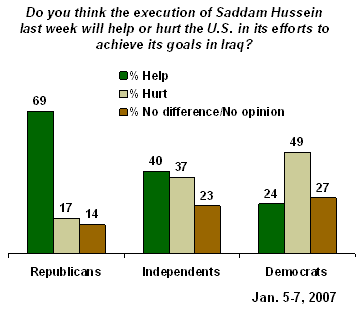
The American public shows rather little concern about this. Asked whether Hussein's execution will help or hurt the United States in achieving its goals in Iraq, only 36% say it will hurt the country, while 43% say it will help. One in five either say it will make no difference (16%) or have no opinion about it (5%).
Republicans widely believe Hussein's execution will be helpful to the United States; independents are closely divided while Democrats are more likely to believe it will harm U.S. interests. However, not even half of Democrats think it will have a negative impact on U.S. efforts.
Survey Methods
These results are based on telephone interviews with a randomly selected national sample of 1,004 adults, aged 18 and older, conducted Jan. 5-7, 2007. For results based on this sample, one can say with 95% confidence that the maximum error attributable to sampling and other random effects is ±3 percentage points. In addition to sampling error, question wording and practical difficulties in conducting surveys can introduce error or bias into the findings of public opinion polls.
15. In view of the developments since we first sent our troops to Iraq, do you think the United States made a mistake in sending troops to Iraq, or not?
|
|
Yes, a
|
No, not |
No
|
|
|
|
|
|
|
2007 Jan 5-7 |
57 |
41 |
2 |
|
|
|
|
|
|
2006 Dec 8-10 ^ |
53 |
45 |
2 |
|
2006 Nov 2-5 |
55 |
40 |
5 |
|
2006 Oct 20-22 |
58 |
40 |
2 |
|
2006 Oct 6-8 |
56 |
40 |
4 |
|
2006 Sep 15-17 |
49 |
49 |
2 |
|
2006 Jul 28-30 |
54 |
45 |
2 |
|
2006 Jul 21-23 |
56 |
41 |
2 |
|
2006 Jun 23-25 |
55 |
43 |
1 |
|
2006 Jun 9-11 |
51 |
46 |
2 |
|
2006 Apr 7-9 |
57 |
42 |
1 |
|
2006 Mar 10-12 ^ |
57 |
42 |
1 |
|
2006 Feb 28-Mar 1 |
55 |
43 |
2 |
|
2006 Feb 9-12 ^ |
55 |
42 |
3 |
|
2006 Jan 20-22 |
51 |
46 |
3 |
|
2006 Jan 6-8 ^ |
50 |
47 |
3 |
|
2005 Dec 16-18 |
52 |
46 |
2 |
|
2005 Dec 9-11 |
48 |
50 |
2 |
|
2005 Nov 11-13 ^ |
54 |
45 |
1 |
|
2005 Oct 28-30 |
54 |
45 |
1 |
|
2005 Oct 21-23 |
49 |
49 |
2 |
|
2005 Sep 16-18 |
59 |
39 |
2 |
|
2005 Sep 8-11 |
53 |
46 |
1 |
|
2005 Aug 28-30 |
53 |
46 |
1 |
|
2005 Aug 5-7 ^ |
54 |
44 |
2 |
|
2005 Jul 22-24 |
46 |
53 |
1 |
|
2005 Apr 29-May 1 ^ |
49 |
48 |
3 |
|
2005 Mar 18-20 ^ |
46 |
51 |
3 |
|
2005 Feb 25-27 |
47 |
51 |
2 |
|
2005 Feb 4-6 |
45 |
55 |
* |
|
2005 Jan 14-16 |
52 |
47 |
1 |
|
2005 Jan 7-9 |
50 |
48 |
2 |
|
2004 Nov 19-21 |
47 |
51 |
2 |
|
2004 Oct 29-31 ^ |
44 |
52 |
4 |
|
2004 Oct 22-24 |
47 |
51 |
2 |
|
2004 Oct 14-16 |
47 |
52 |
1 |
|
2004 Oct 9-10 ^ |
46 |
53 |
1 |
|
2004 Oct 1-3 |
48 |
51 |
1 |
|
2004 Sep 24-26 |
42 |
55 |
3 |
|
2004 Sep 3-5 ^ |
38 |
57 |
5 |
|
2004 Aug 23-25 ^ |
48 |
50 |
2 |
|
2004 Jul 30-Aug 1 |
47 |
51 |
2 |
|
2004 Jul 19-21 |
50 |
47 |
3 |
|
2004 Jul 8-11 ^ |
54 |
45 |
1 |
|
2004 Jun 21-23 ^ |
54 |
44 |
2 |
|
2004 Jun 3-6 ^ |
41 |
58 |
1 |
|
2004 May 7-9 ^ |
44 |
54 |
2 |
|
2004 Apr 16-18 ^ |
42 |
57 |
1 |
|
2004 Jan 12-15 ^ |
42 |
56 |
2 |
|
2003 Nov 3-5 ^ |
39 |
60 |
1 |
|
2003 Oct 6-8 ^ |
40 |
59 |
1 |
|
2003 Jul 7-9 ^ |
27 |
72 |
1 |
|
2003 Mar 24-25 ^ |
23 |
75 |
2 |
|
* Less than 0.5% |
|||
|
^ Asked of a half sample |
|||
16. In general, how would you say things are going for the U.S. in Iraq -- [ROTATED: very well, moderately well, moderately badly, (or) very badly]?
|
|
Very
|
Moder-
|
Moder-
|
Very
|
No
|
Total
|
Total
|
|
% |
% |
% |
% |
% |
% |
% |
|
|
2007 Jan 5-7 |
3 |
25 |
33 |
38 |
1 |
28 |
71 |
|
|
|
|
|
|
|
|
|
|
2006 Oct 20-22 ^ |
3 |
32 |
29 |
35 |
2 |
35 |
64 |
|
2006 Jun 9-11 |
8 |
39 |
30 |
23 |
1 |
47 |
53 |
|
2006 Mar 10-12 |
6 |
32 |
32 |
28 |
1 |
38 |
60 |
|
2006 Jan 6-8 |
8 |
38 |
32 |
21 |
1 |
46 |
53 |
|
2005 Oct 21-23 |
7 |
35 |
29 |
28 |
1 |
42 |
57 |
|
2005 Aug 5-7 |
5 |
38 |
28 |
28 |
1 |
43 |
56 |
|
2005 Apr 29-May 1 |
6 |
36 |
31 |
25 |
2 |
42 |
56 |
|
2005 Mar 18-20 |
8 |
44 |
24 |
21 |
3 |
52 |
45 |
|
2005 Feb 4-6 |
13 |
40 |
28 |
18 |
1 |
53 |
46 |
|
2005 Jan 7-9 |
5 |
35 |
29 |
30 |
1 |
40 |
59 |
|
2004 Dec 5-8 |
6 |
34 |
26 |
33 |
1 |
40 |
59 |
|
2004 Sep 24-26 |
4 |
42 |
27 |
25 |
2 |
46 |
52 |
|
2004 Aug 9-11 ^ |
5 |
40 |
28 |
25 |
2 |
45 |
53 |
|
2004 Jul 8-11 |
5 |
35 |
30 |
29 |
1 |
40 |
59 |
|
2004 Jun 3-6 |
6 |
34 |
35 |
25 |
* |
40 |
60 |
|
2004 May 21-23 |
7 |
35 |
26 |
31 |
1 |
42 |
57 |
|
2004 May 2-4 |
4 |
33 |
32 |
30 |
1 |
37 |
62 |
|
2004 Apr 5-8 |
5 |
30 |
31 |
33 |
1 |
35 |
64 |
|
2004 Mar 5-7 |
9 |
46 |
28 |
15 |
2 |
55 |
43 |
|
2003 Nov 3-5 † |
4 |
34 |
34 |
27 |
1 |
38 |
61 |
|
2003 Oct 6-8 ^† |
6 |
36 |
34 |
24 |
* |
42 |
56 |
|
2003 Sep 8-10 † |
6 |
41 |
31 |
21 |
1 |
47 |
52 |
|
2003 Aug 25-26 † |
6 |
44 |
30 |
19 |
1 |
50 |
49 |
|
2003 Jul 25-27 † |
10 |
46 |
28 |
15 |
1 |
56 |
43 |
|
2003 Jul 18-20 † |
6 |
48 |
30 |
15 |
1 |
54 |
45 |
|
2003 Jun 27-29 † |
5 |
51 |
29 |
13 |
2 |
56 |
42 |
|
2003 May 30-Jun 1 † |
11 |
59 |
22 |
7 |
1 |
70 |
29 |
|
2003 May 5-7 ^† |
30 |
56 |
10 |
3 |
1 |
86 |
13 |
|
2003 Apr 22-23 ^† |
21 |
64 |
12 |
2 |
1 |
85 |
14 |
|
* Less than 0.5% |
|||||||
|
^ Asked of a half sample |
|||||||
|
† WORDING: How would you say things are going for the U.S. in Iraq now that the major fighting has ended -- [ROTATED: very well, moderately well, moderately badly, (or) very badly]? |
|||||||
19. Which comes closest to your view about the war with Iraq -- [ROTATED: you are certain that the U.S. will win, you think it is likely that the U.S. will win, but you are not certain, you think it is unlikely that the U.S. will win, but you are not certain, (or) you are certain that the U.S. will NOT win]?
|
|
Certain
|
Likely
|
Unlikely
|
Certain
|
No
|
|
% |
% |
% |
% |
% |
|
|
2007 Jan 5-7 |
16 |
34 |
28 |
18 |
4 |
|
|
|
|
|
|
|
|
2006 Mar 10-12 |
22 |
32 |
25 |
16 |
6 |
|
2003 Apr 5 ^ |
79 |
17 |
1 |
-- |
3 |
|
2003 Mar 29-30 |
69 |
25 |
3 |
1 |
2 |
|
^ Polls conducted entirely in one day, such as this one, are subject to additional error or bias not found in polls conducted over several days. |
|||||
23. Which comes closest to your view -- [ROTATED: the U.S. can only achieve its goals in Iraq if it increases the numbers of troops it has there, the U.S. can achieve its goals in Iraq without sending more troops there, or the U.S. cannot achieve its goals in Iraq regardless of how many troops it has there]?
|
|
Can only
|
Can achieve
|
Cannot
|
|
|
2007 Jan 5-7 |
23% |
25 |
47 |
5 |
24. Do you think the execution of Saddam Hussein last week will help or hurt the U.S. in its efforts to achieve its goals in Iraq?
|
|
|
|
NO
|
No
|
|
2007 Jan 5-7 |
43% |
36 |
16 |
5 |
|
(vol.) = Volunteered response |
||||