GALLUP NEWS SERVICE
PRINCETON, NJ -- New York Sen. Hillary Rodham Clinton ended the speculation about when she would step into the race for president on Saturday -- few doubted it would happen -- by announcing her exploratory committee on her new HillaryClinton.com Web site.
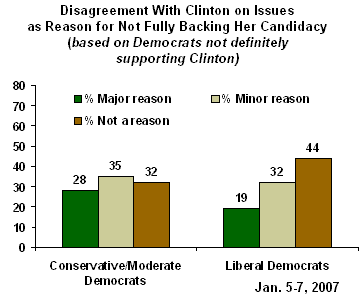
This has only fueled the already rampant political discussion about all the reasons why Clinton may not succeed in capturing her party's nomination. The theories range from her vote to authorize the Iraq war to the association of her candidacy with former president Bill Clinton, to her inability to connect with voters on a personal level. A recent USA Today/Gallup poll suggests all of those, and more, are factors, but that the paramount ones are her perceived chances of winning in the general election, and her issue positions. Contrary to conventional wisdom about the liability of her support for the Iraq war among liberals, Clinton's issue positions are more often raised as a concern by conservative and moderate Democrats than by liberal Democrats.
Clinton's Core Support Hovers Around a Third of Democrats
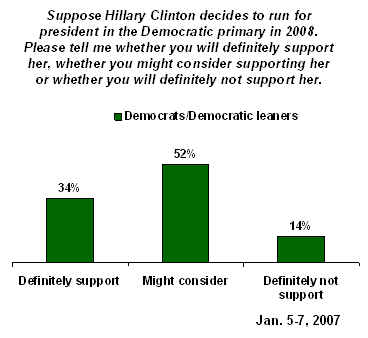
While most Democrats would likely back Clinton should she win the 2008 Democratic presidential nomination, only about one-third give their unreserved support for her candidacy today. According to a Jan. 5-7, 2007 USA Today/Gallup poll, only 34% of Democrats and independents who lean to the Democratic Party say they will definitely support Clinton for the nomination.
An additional 52% of Democrats say they might consider supporting Clinton, suggesting she has a pool of as many as 86% of Democrats from which to draw votes. Only 14% rule out supporting her.
The 34% of Democrats saying they would definitely support Clinton for the nomination is close to the 29% who favor her when asked to choose among 12 Democrats listed as possibly running for the nomination. This is according to the latest USA Today/Gallup test election, conducted Jan. 12-14, 2007. Illinois Sen. Barack Obama ranks second, with 18%, followed by former North Carolina Sen. John Edwards, at 13%.
However, when Democrats are asked who they would prefer to see win if the race narrows to just Clinton and Obama, only a bare majority (53%) choose Clinton -- far less than the potential 86%. About 4 out of 10 (39%) prefer Obama, while the remaining 8% are undecided.
"I'm in" Launches Media Rush to Judgment
Much of the political analysis surrounding Clinton's announcement -- "I'm in" -- has been focused on the negative factors that might derail her candidacy in the primaries. One prominent theory is that Democratic voters perceive Clinton has an electability problem with the general public. Voters may believe she has too many detractors outside of her own party to be a strong presidential candidate.
An editorial in Monday's Washington Post summarized the buzz around this issue by asking, "Is she such a polarizing figure, with such high negatives that she would be at a disadvantage in the fall campaign?"
Gallup's Jan. 5-7, 2007 poll probed Democrats who were not confirmed Clinton supporters about their reasons. Those saying they only might support her for the nomination, or would definitely not support her, were asked to rate the importance of five different factors as potential grounds for their reluctance.
None of the five factors emerges as an overwhelming basis for Democratic aversion to Clinton. However, on a relative basis, her perceived electability is a top detraction. Of Democrats asked the question, 29% say their belief that she can not win the presidential election is a major reason why they do not definitely support her today. Another 32% say this is a minor reason.
Nearly as prominent an explanation is her stand on issues. About a quarter (26%) of non-core Clinton supporters say the fact that they do not agree with her on the issues is a major reason for their reluctance to support her; another 34% say this is a minor reason.
Far fewer Democrats in this group cite Clinton's ability to win the Democratic nomination as a major reason (16%) for not fully supporting her at this time. Even fewer cite disliking her personality (11%) or being opposed to sending another Clinton to the White House (10%) as major reasons.
For each of the following, please say whether it is a major reason, a minor reason, or not a reason why you [might not/will not] support Hillary Clinton in the Democratic primaries.
BASED ON 378 DEMOCRATS AND DEMOCRATIC LEANERS WHO SAY THEY MIGHT CONSIDER SUPPORTING OR WILL DEFINITELY NOT SUPPORT HILLARY CLINTON
|
2007 Jan 5-7, (sorted by "major reason") |
Major reason |
Minor reason |
Not a reason |
|
% |
% |
% |
|
|
You do not think she can win the presidential election |
29 |
32 |
36 |
|
You do not agree with her on the issues |
26 |
34 |
36 |
|
You do not think she can win the Democratic nomination for president |
16 |
40 |
42 |
|
You do not like her personality |
11 |
29 |
57 |
|
You do not want to see another Clinton in the White House |
10 |
19 |
71 |
Most Liberals Don't Reject Clinton Based on "the Issues"
Hillary's support for the Iraq war -- she voted for the Iraq war resolution in October 2002, giving President Bush the authority to send troops -- has been widely discussed as a potential liability for her with Democrats. However, according to the Jan. 5-7 poll, it is conservative and moderate Democrats who are most likely to cite disagreement with Clinton over "the issues" as reasons why they don't fully back her. Liberals (who tend to be the most opposed to the war) are less likely to give this as a major reason.
Liberals Especially Anxious for a White House Win?
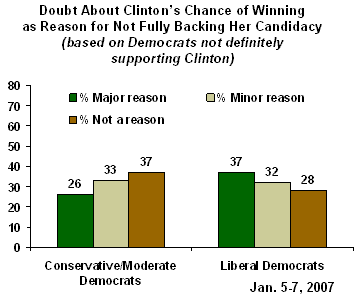
Clinton-averse liberals are a much more likely to focus on her electability as their primary concern. Thirty-seven percent of liberal Democrats, compared with 26% of conservative and moderate Democrats, say their doubts about her ability to win the general election are a major reason why they don't fully support her.
This could conceivably inflate the importance of the electability factor for Clinton if the views of liberal Democrats are disproportionately represented in the primary process next year, due to higher turnout.
Profile of Clinton's Core Supporters
More generally, support for Clinton's candidacy among Democrats comes about equally from conservative/moderate and liberal Democrats. The percentages saying they would definitely vote for her in the primaries are 32% and 38%, respectively. Women are more likely to support her than are men, 37% vs. 29%. She performs best among low-income Democrats: 49% of those earning under $30,000 would definitely support her, compared with 30% of those making $30,000 to 74,999 and 26% of those making $75,000 or more. She also receives nearly twice as much support from nonwhites as from whites, 50% vs. 28%.
Survey Methods
Results are based on telephone interviews with 1,004 national adults, aged 18 and older, conducted Jan. 5-7, 2007. For results based on the total sample of national adults, one can say with 95% confidence that the maximum margin of sampling error is ±3 percentage points. In addition to sampling error, question wording and practical difficulties in conducting surveys can introduce error or bias into the findings of public opinion polls.