GALLUP NEWS SERVICE
PRINCETON, NJ -- Investor optimism declined for the second month in a row in March and now stands at its lowest level since September 2006, according to the March UBS/Gallup Index of Investor Optimism. The reason: Surging gas prices at the pump, fears that the residential real estate market has not reached bottom, and concerns about declining consumer confidence have made investors a lot less optimistic about the economic outlook for the next 12 months.
Investor Optimism Tumbles Once Again
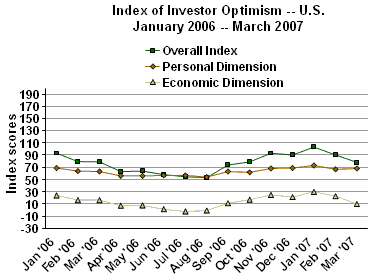
The Index of Investor Optimism stood at 103 in January and has fallen 25 points over the past two months -- 13 points from January to February and 12 points from February to March -- and now stands at 78. This places investor optimism at its lowest level since September 2006 and at essentially the same level as a year ago -- 79 in March 2006. The Index is conducted monthly and started with a baseline score of 124 when it was established in October 1996.
The drop in the Index is largely attributable to a sharp decline in investor optimism concerning the future course of the U.S. economy. The Economic Dimension of the Index measures people's optimism about the economy over the next 12 months. In March, it fell for the second month in a row and now stands at 10 -- down 13 points from 23 in February, down 20 points from 30 in January, and about where it was in September 2006 when it stood at 11.
In sharp contrast, the Personal Dimension of the Index, which measures people's optimism about their own portfolios over the next 12 months, is now at 68 -- essentially unchanged from last month's level (67 in February 2006) and just about where it ended last year (69 in December 2006). The Personal Dimension is down only 5 points from the 73 recorded in January of this year.
Investors Fear Higher Gas Prices
One reason for the sharp drop in investor optimism about the outlook for the U.S. economy in the months ahead probably has to do not only with the recent surge in gas prices at the pump, but also with the impact these price increases have had on investors' expectations for future energy prices. In March, high energy prices continue to top investor concerns with 63% of respondents saying they believe energy prices are hurting the current investment climate "a lot" -- up from 58% in February and the highest level for investor worries about energy prices since September 2006. This compares with 52% of investors who point to international tensions as hurting the investment climate "a lot" and 51% who say the federal budget deficit is a major concern.

On average, investors report paying $2.50 for a gallon of gas in March -- up $0.29 from what they said they were paying a month ago. More importantly, investors now expect gas prices to increase to an average price of $2.74 a gallon over the next three months.
Investors Say Residential Real Estate Conditions Are Getting Worse
Another reason for the recent drop in investor optimism probably involves continued concerns about conditions in the residential real estate markets. Many investors say that the real estate markets are getting worse, not better -- not only nationally, but also in their local communities.
The March results find nearly three in four investors (72%) saying economic conditions in the residential real estate market nationwide are getting worse, as opposed to 21% who say they are getting better. This is up from 63% of investors who said in February that conditions were getting worse.
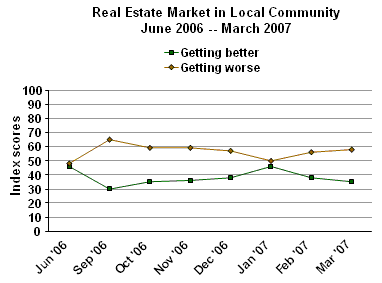
Fifty-eight percent of investors surveyed in March say conditions in their local community's residential real estate market are getting worse. This is up from the 56% who felt this way in February and the 50% of investors voicing similar perceptions in January. Thirty-six percent of investors rate conditions in their local residential real estate market as "good" or "excellent" in March, while 63% rate conditions as "fair" (44%) or "poor" (19%).
Is the "Goldilocks" Scenario Morphing Into "Stagflation"?
The Personal Credit Index (PCI) found in the March Experian/Gallup poll fell 15 points to 90 from 105 in January and February, suggesting that the early signs of a consumer credit crunch could be showing up in response to the sub-prime mortgage market lending debacle. In a March 11-14, 2007, Gallup poll, 62% of Americans tell Gallup that they think economic conditions in the country as a whole are getting worse, while 28% say conditions are getting better.
Add gas prices, which have increased 18% from the beginning of February to the middle of March and the continued deterioration -- not stabilization -- of the residential real estate market, and it is not surprising that in March 62% of investors describe the current U.S. economy as being in a slowdown (52%) or a recession (10%). What seemed like a "Goldilocks" economy -- where nothing is too hot or too cold but is just right -- only a month ago now seems to be morphing into something much more familiar -- "Stagflation," which is essentially a no-growth economy bordering on recession with not only gas and food prices increasing, but also with the core inflation rate (excluding food and energy prices) rising.
Survey Results
Investor results are based on telephone interviews with 802 investors, aged 18 and older, conducted Mar. 1-17, 2007. For results based on the total sample of investors, one can say with 95% confidence that the maximum margin of sampling error is ±4 percentage points.
Results for the Experian/Gallup Personal Credit Index poll are based on telephone interviews with 1,005 adults, aged 18 and older, conducted Mar. 1-6, 2007. For results based on the total sample of investors, once can say with 95% confidence that the maximum margin of sampling error is ±3 percentage points.
Results for Gallup's annual Environment Poll are based on telephone interviews with 1,009 national adults, aged 18 and older, conducted Mar. 11-14, 2007. For results based on the total sample of national adults, one can say with 95% confidence that the maximum margin of sampling error is ±3 percentage points.
