GALLUP NEWS SERVICE
PRINCETON, NJ -- Former New York City mayor Rudy Giuliani will join his rivals for the 2008 Republican presidential nomination for a debate tonight at the Ronald Reagan Presidential Library. Giuliani -- the consistent leader in Republicans' preferences for the nomination -- is viewed more positively than any presidential candidate of either party. This is still the case despite a slight dip in favorable ratings in recent weeks. The decline in ratings of Giuliani has occurred more among Democrats and independents than Republicans, and more among liberals and moderates than conservatives.
Giuliani Favorable Ratings
In the most recent USA Today/Gallup poll, conducted April 13-15, 57% of Americans gave Giuliani a favorable rating. That is the first time Gallup has measured a favorable rating below 60% for Giuliani since it first asked about him in 2004. His high was a 77% rating last December.
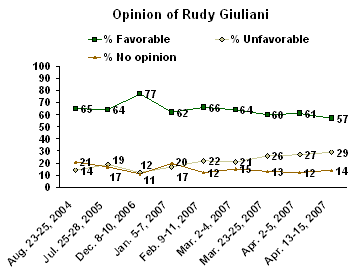
Even with that decline, Giuliani remains the most popular of the leading presidential contenders. The following table shows the average favorable ratings for the leading presidential candidates from January through early March, from mid-March through April, and each candidate's most recent rating. The table does not include candidates who are still unknown to most Americans, such as Mitt Romney, Fred Thompson, and Bill Richardson.
|
Recent Favorable Ratings, Leading Presidential Candidates |
|||
|
Candidate |
Avg. favorable rating, Jan. to early March |
Avg. favorable rating, mid-March to April |
Favorable rating in most recent poll (Apr 13-15) |
|
% |
% |
% |
|
|
Rudy Giuliani |
64 |
59 |
57 |
|
Barack Obama |
56 |
51 |
52 |
|
John Edwards |
50 |
53 |
52 |
|
John McCain |
54 |
53 |
51 |
|
Al Gore |
54 |
51 |
48 |
|
Hillary Clinton |
56 |
47 |
45 |
Giuliani has remained the most highly rated presidential candidate throughout the year. From January to early March, he averaged 64% favorability, eight percentage points higher than the next most positively rated candidates, Barack Obama and Hillary Clinton. Since then, Giuliani has averaged 59%, still six points higher than John McCain and John Edwards, who now rate as the next most-popular candidates.
Edwards is the only leading candidate who has not seen at least a small decline in his average favorable rating from the earlier part of this year. He may have been aided by news of his wife Elizabeth's cancer and the couple's response to it. Clinton's rating has declined more than the other candidates' during this time.
It is not unexpected for candidates' favorable ratings to decline over the course of a highly partisan political campaign, as they are forced to take positions on controversial issues that are sure to meet disagreement from some segments of the population. In fact, it is not unusual for even winning presidential candidates to have favorable ratings in the low 50s at the time of an election. So while decline in and of itself may not be overly concerning, there are some warning signs, such as favorable ratings dipping below 50% and a significant loss of support from members of one's own party.
Giuliani became well-known and well-regarded following his leadership of New York City after Sept. 11 terror attacks. Now, as he seeks the Republican nomination, it is reasonable to expect some decline in his ratings among Democrats and ideological liberals.
An analysis of Giuliani's favorable ratings from the earlier part of the year and his more recent ones confirms that his favorable rating has dropped six percentage points among Democrats, and is now below 50%. Independents show a similar drop, but there has been only a negligible change among Republicans. Also, conservatives show little change in their views of Giuliani, while moderates and liberals have become slightly more negative.
Giuliani's rating has declined slightly more among women than men in recent weeks, but he continues to be rated positively by both men and women.
Interestingly, opinions of Giuliani are holding steady in the East and Midwest, they are down slightly in the South, and down more significantly in the West. It is unclear why this is, but his two chief rivals for the Republican nomination -- McCain and Romney -- both have strong ties to the West.
|
Changes in Rudy Giuliani Favorable Ratings |
||||
|
Group |
Subgroup |
Favorable, Jan 5-Mar 4 |
Favorable, Mar 23-Apr 15 |
Change in favorable rating |
|
% |
% |
|||
|
Total |
All U.S. adults |
64 |
59 |
-5 |
|
Party |
Democrat |
51 |
45 |
-6 |
|
Independent |
63 |
57 |
-6 |
|
|
Republican |
81 |
79 |
-2 |
|
|
Ideology |
Liberal |
50 |
43 |
-7 |
|
Moderate |
68 |
60 |
-8 |
|
|
Conservative |
70 |
69 |
-1 |
|
|
Gender |
Male |
66 |
63 |
-3 |
|
Female |
63 |
56 |
-7 |
|
|
Age |
18 to 29 |
61 |
58 |
-3 |
|
30 to 49 |
69 |
65 |
-4 |
|
|
50 to 64 |
65 |
59 |
-6 |
|
|
65 and older |
55 |
51 |
-4 |
|
|
Race |
White |
68 |
63 |
-5 |
|
Nonwhite |
51 |
45 |
-6 |
|
|
Black |
37 |
38 |
-1 |
|
|
Education |
High school or less |
53 |
51 |
-2 |
|
Some college |
69 |
62 |
-7 |
|
|
Four-year college grad |
76 |
70 |
-6 |
|
|
Postgraduate work |
70 |
64 |
-6 |
|
|
Household income |
Less than $30,000
|
50 |
47 |
-3 |
|
$30,000 to $74,999
|
67 |
60 |
-7 |
|
|
$75,000 or more
|
73 |
70 |
-3 |
|
|
Residence |
Urban |
62 |
55 |
-7 |
|
Suburban |
68 |
64 |
-4 |
|
|
Rural |
59 |
54 |
-5 |
|
|
Region |
East |
62 |
62 |
0 |
|
Midwest |
61 |
59 |
-2 |
|
|
South |
65 |
60 |
-5 |
|
|
West |
68 |
57 |
-11 |
|
|
Church attendance |
Weekly |
61 |
60 |
-1 |
|
Monthly |
69 |
59 |
-10 |
|
|
Seldom or never |
64 |
60 |
-4 |
|
Survey Methods
These results are based on telephone interviews with a randomly selected national sample of 1,007 adults, aged 18 and older, conducted April 13-15, 2007. For results based on this sample, one can say with 95% confidence that the maximum error attributable to sampling and other random effects is ±3 percentage points. In addition to sampling error, question wording and practical difficulties in conducting surveys can introduce error or bias into the findings of public opinion polls.
Results for the aggregate of January through early March surveys are based on interviews with 3,020 national adults conducted between Jan. 5 and March 4, 2007, and have a maximum margin of sampling error of ±2 percentage points.
Results for the aggregate of mid-March through April surveys are based on interviews with 3,022 national adults conducted between March 13 and April 15, 2007, and have a maximum margin of sampling error of ±2 percentage points.