GALLUP NEWS SERVICE
PRINCETON, NJ -- A new USA Today/Gallup poll finds that most Americans disagree with President George W. Bush's decision to intervene in the case of former vice presidential aide Lewis "Scooter" Libby. Bush's actions apparently did not help him among his party base -- the vast majority of Republicans say it has not affected their level of confidence in Bush and more say it has caused them to lose confidence than gain confidence in him. Republicans and Democrats are about equally likely to be paying attention to the story, and those paying close attention are especially critical of Bush.
On July 2, Bush announced he was commuting the prison sentence of Libby, former aide to Vice President Cheney, who was convicted of perjury and obstruction of justice in the government investigation into the leak of CIA agent Valerie Plame's identity to the news media. The July 6-8 poll finds 66% of Americans saying Bush should not have intervened on Libby's behalf. Only 13% say Bush was "right to commute Libby's sentence," while even fewer, 6%, say Bush "should have gone farther and granted [Libby] a full pardon." About one in six have no opinion of the matter.

These results mirror earlier Gallup polling on this topic. Shortly after he was found guilty in March, 67% of Americans said Bush should not issue a pardon for Libby, while 21% were in favor of such a move.
The latest poll finds 56% of Americans saying they are following news of the case closely, including 20% who say "very closely." The 56% figure for the Libby case is near the average of 60% that Gallup has found for over 180 news events it has tested since 1991. It is just below the 62% of Americans who in February 2001 said they were following the news of "Bill Clinton's pardons his last week in office," but substantially higher than the 43% who said they were following the news of George H.W. Bush's pardon of Caspar Weinberger in December 1992.
Republicans and Democrats are equally likely to be paying attention to the story. Fifty-six percent of Republicans (including Republican-leaning independents) and 58% of Democrats (including Democratic-leaning independents) say they are following the news about this case closely.
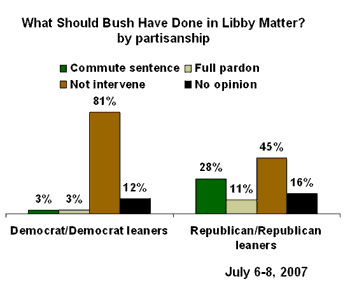
Opinions of Bush's recent actions are generally similar regardless of how much attention people are paying to the case. However, they do vary significantly by partisanship. As one would expect, Democrats overwhelmingly believe Bush should not have intervened -- 81% say this. In contrast, only 45% of Republicans take that view. However, it is notable that more Republicans say Bush should not have intervened than say his actions were the correct ones (28%) or say he should have gone farther and fully pardoned Libby (11%).
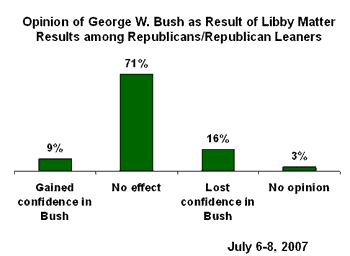
Some have speculated that Bush made the move because he was under pressure from prominent conservatives to intervene on Libby's behalf, and that if he did so it would please his Republican base. However, the poll suggests little benefit will accrue to Bush from rank-and-file Republicans -- only 9% say they have gained confidence in Bush because of his handling of this matter. Nearly twice as many, 16%, have lost confidence in the president, while the vast majority (71%) says it has had no effect on their opinion of Bush.
The Libby case may have helped to further sink Bush's already low approval rating among the general public. In the poll, 29% of Americans approve of Bush. This is the lowest Gallup has measured for him and the lowest any president has received since the elder George Bush also had a 29% approval rating in the summer of 1992.
Survey Methods
These results are based on telephone interviews with a randomly selected national sample of 1,014 adults, aged 18 and older, conducted July 6-8, 2007. For results based on this sample, one can say with 95% confidence that the maximum error attributable to sampling and other random effects is ±3 percentage points. In addition to sampling error, question wording and practical difficulties in conducting surveys can introduce error or bias into the findings of public opinion polls.
For results based on the sample of 394 Republicans and independents who lean to the Republican Party, the maximum margin of sampling error is ±5 percentage points.
26. How closely are you following the news about President Bush's decision to commute the prison sentence of former vice presidential aide, Lewis "Scooter" Libby -- very closely, somewhat closely, not too closely, or not at all?
|
Very
|
Some-
|
Not
|
Not
|
No
|
|
|
2007 Jul 6-8 |
20% |
36 |
24 |
19 |
1 |
27. From what you have heard or read, do you think President Bush was right to commute Libby's sentence, do you think he should have gone further and granted him a full pardon, or do you think he should not have intervened at all on Libby's behalf?
|
Right to
|
Should have
|
Should not
|
|
|
|
2007 Jul 6-8 |
13% |
6 |
66 |
15 |
28. (Asked of Republicans and independents who lean to the Republican Party) Has George W. Bush's recent handling of this matter caused you to -- [ROTATED: gain confidence in Bush, has it not affected your opinion either way, or has it caused you to lose confidence in Bush]?
BASED ON -- 394 --- REPUBLICANS AND REPUBLICAN LEANERS
|
Gain
|
Not
|
Lose
|
No
|
|
|
2007 Jul 6-8 |
9% |
71 |
16 |
3 |