GALLUP NEWS SERVICE
PRINCETON, NJ -- The latest USA Today/Gallup poll finds a more optimistic public assessment of the surge of U.S. troops in Iraq, but still only about one in three Americans say the increased U.S. troop levels are making the situation there better. Opposition to the war has decreased slightly from the high set last month, and is similar to the level seen throughout most of this year. Americans continue to be inclined to wait for September and General David Petraeus' report to Congress about the status of the war before developing a new Iraq policy. More generally, the poll shows that the public continues to favor removing most U.S. troops from Iraq by next spring.
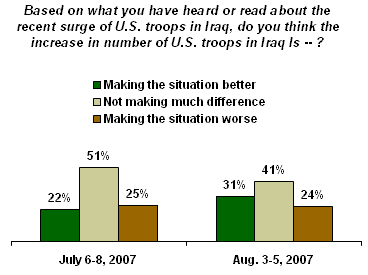
According to the Aug. 3-5, 2007, poll, 31% of Americans say the surge of U.S. troops in Iraq is making the situation there better, up from 22% last month. The plurality of 41% continues to say the surge is not making much difference, but this is down from 51% last month. There has been no change in the percentage of Americans who say the surge is making the situation in Iraq worse (25% in July; 24% in August).
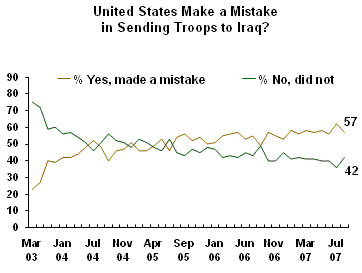
Fifty-seven percent of Americans say the United States made a mistake in sending troops to Iraq, down from the high point of 62% last month, but at about the same level found in surveys throughout 2007. It has now been more than two years (July 2005) since war support exceeded opposition on this measure by a significant margin in any Gallup poll.
Public support remains high for a timetable to withdraw most U.S. troops from Iraq. Sixty-six percent of Americans say they favor removing all U.S. troops from Iraq by April of next year, except for a limited number involved in counter-terrorist operations. Last month, 71% favored this proposal.
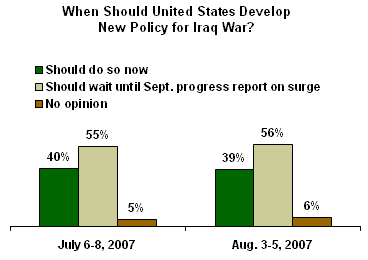
Even with widespread support for a timetable to withdraw U.S. troops from Iraq, Americans continue to be willing to wait until September before setting a new course in Iraq. At that time, Gen. Petraeus reports to Congress about the progress of the war effort. Fifty-six percent of Americans are inclined to wait until then for a new Iraq policy, while 39% say Congress should develop a new policy now. These views are little changed from last month.
Views about the surge progress, support for withdrawing troops by next spring, and whether to wait until September before developing a new war strategy are related to one's general opinion of the war, but not completely so.
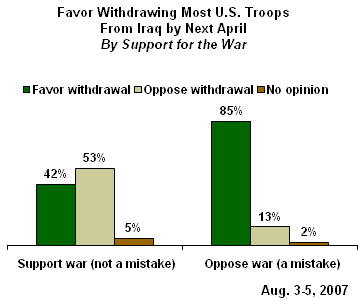
For example, close to half of those who support the war (i.e., say it was not a mistake to send troops) still favor withdrawing most U.S. troops from Iraq by next spring. As would be expected, the vast majority of war opponents favor this timetable for withdrawal.
Meanwhile, only a slight majority of war opponents, 51%, want Congress to develop a new policy on Iraq now, while 43% are content to wait. Even though the vast majority of war supporters would like to wait until September for a new policy, one in five say Congress should not wait that long.

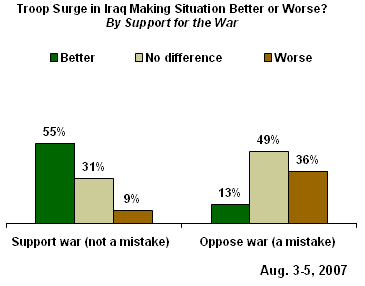
A majority of war supporters believe the surge is working. War opponents are nearly three times more likely to say the surge is making the situation in Iraq worse rather than better, but the greatest proportion of war opponents currently say the surge is neither helping nor hurting the situation in Iraq.
Survey Methods
These results are based on telephone interviews with a randomly selected national sample of 1,012 adults, aged 18 and older, conducted Aug. 3-5, 2007. For results based on this sample, one can say with 95% confidence that the maximum margin of error attributable to sampling and other random effects is ±3 percentage points. In addition to sampling error, question wording and practical difficulties in conducting surveys can introduce error or bias into the findings of public opinion polls.16. In view of the developments since we first sent our troops to Iraq, do you think the United States made a mistake in sending troops to Iraq, or not?
|
Yes |
No |
No opinion |
|
|
% |
% |
% |
|
|
2007 Aug 3-5 |
57 |
42 |
2 |
|
2007 Jul 6-8 |
62 |
36 |
2 |
|
2007 Jun 1-3 |
56 |
40 |
4 |
|
2007 May 4-6 |
58 |
40 |
2 |
|
2007 Apr 13-15 |
57 |
41 |
2 |
|
2007 Mar 23-25 |
56 |
43 |
2 |
|
2007 Mar 2-4 |
59 |
39 |
2 |
|
2007 Feb 9-11 |
56 |
42 |
2 |
|
2007 Jan 12-14 |
58 |
41 |
2 |
|
2007 Jan 5-7 |
57 |
41 |
2 |
|
2006 Dec 8-10 ^ |
53 |
45 |
2 |
|
2006 Nov 2-5 |
55 |
40 |
5 |
|
2006 Oct 20-22 |
58 |
40 |
2 |
|
2006 Oct 6-8 |
56 |
40 |
4 |
|
2006 Sep 15-17 |
49 |
49 |
2 |
|
2006 Jul 28-30 |
54 |
45 |
2 |
|
2006 Jul 21-23 |
56 |
41 |
2 |
|
2006 Jun 23-25 |
55 |
43 |
1 |
|
2006 Jun 9-11 |
51 |
46 |
2 |
|
2006 Apr 7-9 |
57 |
42 |
1 |
|
2006 Mar 10-12 ^ |
57 |
42 |
1 |
|
2006 Feb 28-Mar 1 |
55 |
43 |
2 |
|
2006 Feb 9-12 ^ |
55 |
42 |
3 |
|
2006 Jan 20-22 |
51 |
46 |
3 |
|
2006 Jan 6-8 ^ |
50 |
47 |
3 |
|
2005 Dec 16-18 |
52 |
46 |
2 |
|
2005 Dec 9-11 |
48 |
50 |
2 |
|
2005 Nov 11-13 ^ |
54 |
45 |
1 |
|
2005 Oct 28-30 |
54 |
45 |
1 |
|
2005 Oct 21-23 |
49 |
49 |
2 |
|
2005 Sep 16-18 |
59 |
39 |
2 |
|
2005 Sep 8-11 |
53 |
46 |
1 |
|
2005 Aug 28-30 |
53 |
46 |
1 |
|
2005 Aug 5-7 ^ |
54 |
44 |
2 |
|
2005 Jul 22-24 |
46 |
53 |
1 |
|
2005 Jun 24-26 |
53 |
46 |
1 |
|
2005 Apr 29-May 1 ^ |
49 |
48 |
3 |
|
2005 Mar 18-20 ^ |
46 |
51 |
3 |
|
2005 Feb 25-27 |
47 |
51 |
2 |
|
2005 Feb 4-6 |
45 |
55 |
* |
|
2005 Jan 14-16 |
52 |
47 |
1 |
|
2005 Jan 7-9 |
50 |
48 |
2 |
|
2004 Nov 19-21 |
47 |
51 |
2 |
|
2004 Oct 29-31 ^ |
44 |
52 |
4 |
|
2004 Oct 22-24 |
47 |
51 |
2 |
|
2004 Oct 14-16 |
47 |
52 |
1 |
|
2004 Oct 9-10 ^ |
46 |
53 |
1 |
|
2004 Oct 1-3 |
48 |
51 |
1 |
|
2004 Sep 24-26 |
42 |
55 |
3 |
|
2004 Sep 3-5 ^ |
38 |
57 |
5 |
|
2004 Aug 23-25 ^ |
48 |
50 |
2 |
|
2004 Jul 30-Aug 1 |
47 |
51 |
2 |
|
2004 Jul 19-21 |
50 |
47 |
3 |
|
2004 Jul 8-11 |
54 |
45 |
1 |
|
2004 Jun 21-23 |
54 |
44 |
2 |
|
2004 Jun 3-6 |
41 |
58 |
1 |
|
2004 May 7-9 |
44 |
54 |
2 |
|
2004 Apr 16-18 |
42 |
57 |
1 |
|
2004 Jan 12-15 |
42 |
56 |
2 |
|
2003 Nov 3-5 |
39 |
60 |
1 |
|
2003 Oct 6-8 |
40 |
59 |
1 |
|
2003 Jul 7-9 |
27 |
72 |
1 |
|
2003 Mar 24-25 |
23 |
75 |
2 |
|
|
|
|
|
|
^ Asked of a half sample. |
|||
17. Based on what you have heard or read about the recent surge of U.S. troops in Iraq, do you think the increase in the number of U.S. troops in Iraq is -- [ROTATED: making the situation there better, not making much difference, or is it making the situation there worse]?
|
|
Better |
Not making
|
Worse |
No
|
|
2007 Aug 3-5 |
31% |
41 |
24 |
4 |
|
2007 Jul 6-8 ^ |
22% |
51 |
25 |
2 |
|
|
|
|
|
|
|
^ Asked of a half sample. |
||||
Trends for Comparison: Based on what you have heard or read about the recent surge of U.S. troops in Baghdad, do you think the increase in the number of U.S. troops in Baghdad is -- [ROTATED: making the situation there better, not making much difference, or is it making the situation there worse]?
|
|
|
Not making
|
Worse |
No
|
|
2007 Jul 6-8 ^ |
17% |
49 |
30 |
3 |
|
2007 Apr 13-15 |
26% |
41 |
29 |
4 |
|
2007 Mar 23-25 |
29% |
43 |
22 |
5 |
|
|
|
|
|
|
|
^ Asked of a half sample. |
||||
18. (Asked of a half sample) Do you favor or oppose removing all U.S. troops from Iraq by April 1st of next year, except for a limited number that would be involved in counter-terrorism efforts?
|
Favor |
Oppose |
No opinion |
|
|
2007 Aug 3-5 |
66% |
30 |
4 |
|
2007 Jul 6-8 |
71% |
26 |
4 |
19. (Asked of a half sample) Which comes closer to your view about U.S. policy toward the situation in Iraq -- [ROTATED: Congress should act now to develop a new policy on Iraq, (or) Congress should not develop a new policy on Iraq until September when General Petraeus reports on the progress of the U.S. troop surge in Iraq]?
|
|
Not develop
|
|
|
|
2007 Aug 3-5 |
39% |
56 |
6 |
|
2007 Jul 6-8 |
40% |
55 |
5 |