GALLUP NEWS SERVICE
PRINCETON, NJ -- Steve Forbes, officially announcing his departure from the race for the presidency Thursday, spent a fortune of his own money on a campaign that never was able to catch on with the American public.
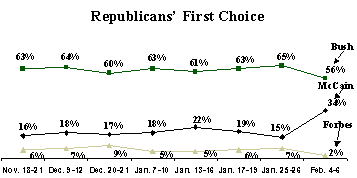
The high point for Forbes among registered Republicans nationwide was in mid-December, when he received 9% of the vote for the Republican nomination. Even that slim level of support began to slip in recent weeks, and Gallup's most recent poll, conducted February 4-6, shows that Forbes had dropped to only 2% of the Republican vote. Forbes was far behind the two front-runners, George W. Bush, with 56%, and John McCain, with 34%, and ended up one point behind the only other remaining candidate, former Ambassador Alan Keyes, who has 3%:
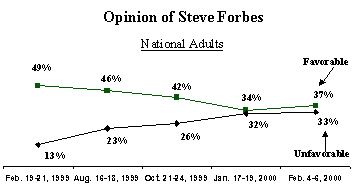
The public's image of Forbes also became less favorable as the
months of the campaign went by, rather than more favorable. A year
ago, in February 1999, 49% of the public had a favorable image of
the millionaire publisher, with only 13% evincing an unfavorable
image. In the most recent Gallup poll, his favorable rating had
slipped to 37%, and his unfavorable number was almost as high, at
33%:
If there is an impact of Forbes' departure on the Republican race,
it will most likely be the result of subtle factors relating to the
issues he raised in the debates or the absence of messages carried
by his paid advertising. Mathematically, given that Forbes had only
2% of the Republican vote nationally, there can be expected to be
almost no direct result of his dropping out on the standing of the
other candidates left in the race.
Survey Methods
The results reported here are based on telephone interviews with a
randomly selected national sample of 1,018 adults, 18 years and
older, conducted February 4-6, 2000. For results based on the whole
sample, one can say with 95 percent confidence that the maximum
error attributable to sampling and other random effects is plus or
minus 4 percentage points. In addition to sampling error, question
wording and practical difficulties in conducting surveys can
introduce error or bias into the findings of public opinion
polls.