GALLUP NEWS SERVICE
PRINCETON, NJ -- Vice President Al Gore and former New Jersey Senator Bill Bradley, the two major contenders for the Democratic nomination for president, appeal to extraordinarily different types of Democrats, a new special Gallup Poll analysis shows. Gore's voters tend to be traditional Democrats -- older, living in the South, minorities, those with lower levels of education and income, and women. Bradley's constituency is skewed strongly towards certain geographic areas of the country -- particularly the Northeast -- and also towards independents who tend to vote Democratic, whites, men, and those with higher levels of education and income.
This analysis is based on an aggregated sample of 1,631 Democrats who are registered voters and who were asked about their first choice for the Democratic nomination in four different Gallup surveys conducted in the months of November and December 1999. Overall, 55% of this group said they would prefer Gore, while 37% said Bradley.
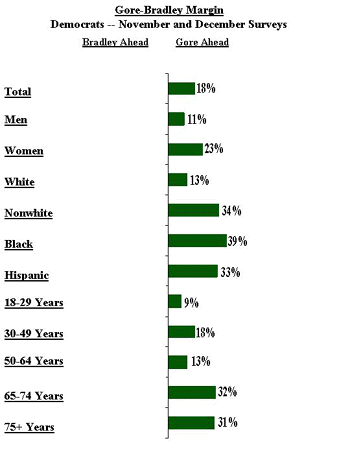
Bradley Scores Best Among Younger White Men
Some of the largest differences between Gore and Bradley are based
on standard demographic categories. Gore has over twice the lead
among Democratic women as he does among men. Additionally, Gore has
a 34% lead among nonwhites in the sample, including a 39% lead, 65%
to 26%, among blacks, while Bradley cuts Gore's lead to only 13%
among white Democrats. Gore also overwhelms Bradley, 65% to 32%,
among Hispanic Democratic voters.
The pattern of voting by age is similarly straightforward. The older the Democrat, the more likely he or she is to support Gore. The range is striking, from only a 9% Gore lead among 18- to 29-year-old Democrats, to a full 31% lead for Gore among those 65 and older.
Bradley Beats Gore in East, but Loses Elsewhere Across the
Country
Bill Bradley has deep roots in the Northeast. Although he was born
and raised in Missouri, Bradley was an all-American basketball
player at Princeton University, played professional basketball for
the New York Knicks, and represented New Jersey in the U.S. Senate
for 18 years. It may not be surprising, then, that Bradley's
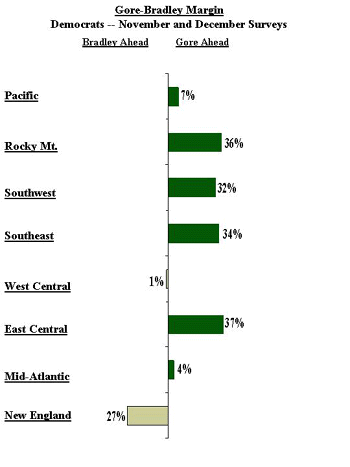
support is strong in this region. Overall, Bradley beats Al Gore by
2 percentage points, 47% to 45%, in states classified by the Census
Bureau as "East," and does particularly well in the New England
states. Gore, who represented Tennessee in the Senate, does very
well in the South, beating Bradley by 62% to 29%. Gore also wins
over Bradley in the Midwest, although Bradley does better in the
western Midwest than in the eastern Midwest. In the West, Gore
wins, 53% to 37%, although in the Pacific states -- dominated by
California -- the aggregated poll data show that Gore's lead over
Bradley is only 7 percentage points.
Positive Relationship Between Socioeconomic Status and
Support for Bradley
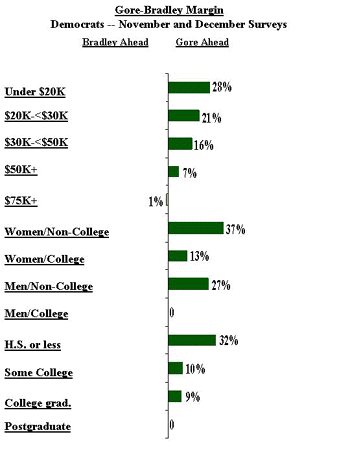
Bradley has a strong appeal to Democrats who have high
socioeconomic status. The patterns are remarkably linear -- in
general, the higher the level of education and the higher the
income, the more likely the Democrat is to vote for Bradley.
Whereas Gore wins over Bradley by 28 percentage points among those
with under $20,000 a year in household income, this lead shrinks to
only 7% among those making $50,000 and over, and Bradley squeaks
out a win, by 47% to 46%, among Democrats in the
$75,000-a-year-and-higher category. In similar fashion, among
Democrats with no college education, Gore's lead is 32%, while
among those with graduate degrees, the two candidates break even,
47% to 47%.
The impact of education on support for Bradley is more powerful than is the impact of gender. Among men who are college graduates, the two candidates are dead even, while among men without a college education, Gore leads by 27%. Among college-educated women, Gore wins by 13 percentage points, while among women without college, Gore's lead stretches to 37 percentage points.
Gore Does Best Among Hard-Core Democrats, Bradley Among
Independents Who Lean Democratic
The Gallup Poll asks these questions about the Democratic primary
of two groups of individuals in the poll sample: those who identify
themselves as Democrats in response to a party identification
question, and those who initially identify themselves as
independents, but who say that they lean towards the Democratic
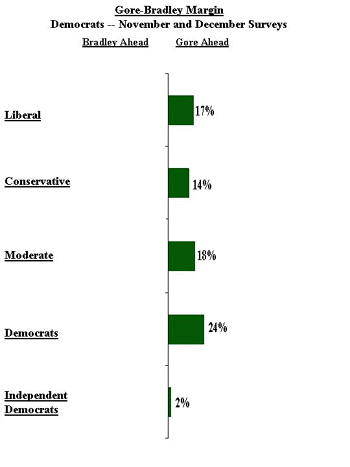
party in response to a follow-up question. Gore does much better
among the core group of Democrats who immediately identify
themselves as Democrats, beating Bradley by 57% to 33%. Among the
smaller group of independents who lean Democratic, however, Bradley
is behind the vice president by only 2 percentage points. This may
have implications in a primary season in which core Democrats are
usually the most likely to turn out to vote.