GALLUP NEWS SERVICE
With the Senate impeachment trial over and the 2000 presidential election afoot, the Gallup Poll recently tested the popularity of twenty personalities figuring prominently in these two major political stories. The new poll reaffirms that Americans' overall reaction to President Bill Clinton and First Lady Hillary Rodham Clinton is generally favorable-as it has been for most of the past year. It shows Monica Lewinsky and Linda Tripp still widely reviled, and finds Americans quite positive about several of those considering a run for the presidency.
Two potential GOP candidates rank higher in public esteem than the first couple: Former Red Cross president and cabinet secretary Elizabeth Dole and Texas governor George W. Bush enjoy widespread public appeal, ranking first and second on the list of twenty political newsmakers tested in the February 19-21 Gallup poll. These rankings are based on Gallup's favorability measure that asks Americans whether their "overall opinion" of various people in the news is favorable or unfavorable.
Presidential Heavyweights
Elizabeth Dole emerges as the most popular political newsmaker
tested in the new poll. Although she trails George W. Bush in
Gallup's early test elections for the Republican nomination, Dole's
favorability figures (75% favorable, 10% unfavorable and 15% no
opinion) are higher than Bush's, and put her at the top of the
presidential field in several respects. Her favorable rating among
the American public is the highest of the twelve potential
candidates tested. And given her low unfavorable score, she has the
best favorable to unfavorable ratio. The small number of
respondents who say they have no opinion of Dole also makes her one
of the most recognizable figures in the race for president, along
with Vice-president Al Gore, former Vice-president Dan Quayle and
the Reverend Jesse Jackson.
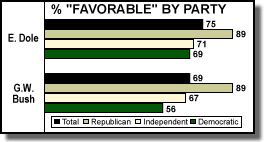
George W. Bush ranks a very close second to Elizabeth Dole in general appeal, with 69% of national adults saying they have a favorable impression of him, 12% unfavorable and 19% expressing no opinion. Both do extremely well among rank and file Republicans, but Dole currently has greater cross-party appeal than Bush, with seven in Democrats viewing in favorably.
Quayle Negatives Persists
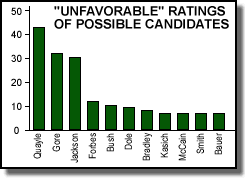
Looking at just their "favorable" scores, Al Gore, Jesse Jackson,
Steve Forbes and Dan Quayle all rank fairly high-each viewed
positively by close to half the American public. Jackson ties Gore
with a 59% favorable rating, while Forbes receives 49% and Quayle
46%. However, when factoring in their unfavorable scores, Dan
Quayle has a bigger image problem than the others. Quayle is viewed
unfavorably by 44% of Americans, Jackson and Gore by about
one-third, and Forbes by only 13%. Forbes' main problem is that a
high number of Americans still have no opinion of him.
While his image today is slightly better today than in 1992, his last year as vice-president, Quayle's unfavorable rating is currently the highest of all possible presidential candidates tested in the poll, Republican or Democratic.
Could Still be Contenders
The remaining names on Gallup's list of possible presidential
candidates-John Kasich, John McCain, Bob Smith, Bill Bradley, Gary
Bauer-are generally not recognized by a majority of the public.
(Massachusetts Senator John Kerry fell into this lesser-known group
on the recent survey, but subsequently announced he will not run.)
The bad news for these candidates is that they rank low on the
basis of their favorable scores. The good news for them is that
their unfavorable ratings are also quite low-generally in the
single digits-thus giving them the opportunity to define themselves
in positive terms as the campaign comes into focus. They may also
take heart from the examples of Bill Clinton in 1992 and George
Bush in 1980-two recent illustrations of candidates virtually
unknown to the American public who rose to prominence in the course
of a presidential campaign.
Impeachment Fallout
Hillary Clinton appears to be the only public relations winner
among the major names associated with the Lewinsky scandal and the
related impeachment trial. While both Bill and Hillary Clinton are
viewed positively today by a majority of Americans, Bill Clinton's
current favorability rating of 55% is slightly lower than before
news of the Lewinsky affair erupted in January of last year.
Hillary Clinton's rating of 65% is substantially higher than where
it stood prior to the scandal. Thus, in contrast with earlier years
in Clinton's presidency when Hillary Clinton received similar or
even lower favorable ratings than her husband, the First Lady has
now outdistanced him.
| Bill Clinton | Hillary Clinton | |
|---|---|---|
| Jan-93 | 65 | 67 |
| Apr-93 | 63 | 61 |
| Jun-93 | 48 | 50 |
| Jul-93 | 51 | 56 |
| Aug-93 | 53 | 57 |
| Sep-93 | 63 | 62 |
| Nov-93 | 54 | 58 |
| Jan-94 | 60 | 57 |
| Mar-94 | 59 | 55 |
| Mar-94 | 56 | 52 |
| Apr-94 | 56 | 56 |
| Jul-94 | 49 | 48 |
| Sep-94 | 47 | 48 |
| Nov-94 | 50 | 50 |
| Jan-95 | 56 | 50 |
| Mar-95 | 51 | 49 |
| Jul-95 | 57 | 50 |
| Jan-96 | 54 | 43 |
| Mar-96 | 58 | 47 |
| Jun-96 | 60 | 46 |
| Aug-96 | 60 | 48 |
| Aug-96 | 57 | 47 |
| Aug-96 | 61 | 51 |
| Oct-96 | 58 | 49 |
| Jan-97 | 65 | 56 |
| Jan-97 | 64 | 55 |
| Feb-97 | 61 | 51 |
| Jun-97 | 59 | 51 |
| Oct-97 | 62 | 61 |
| Dec-97 | 58 | 56 |
| Jan-98 | 57 | 60 |
| Jan-98 | 58 | 61 |
| Jan-98 | 63 | 61 |
| Jan-98 | 65 | 64 |
| Feb-98 | 58 | 60 |
| Aug-98 | 58 | 60 |
| Aug-98 | 60 | 60 |
| Aug-98 | 55 | 64 |
| Aug-98 | 53 | 60 |
| Aug-98 | 55 | 61 |
| Sep-98 | 51 | 61 |
| Oct-98 | 54 | 63 |
| Feb-99 | 55 | 66 |
| Feb-99 | 55 | 65 |
Other prominent figures associated with the Lewinsky scandal have not fared so well. Since the end of January 1998, Monica Lewinsky has been viewed unfavorably by two thirds or more of Americans. Her televised interview this week with Barbara Walters may change matters, but despite rave media reviews for her testimony in the Senate impeachment trial, Lewinsky's favorable-to-unfavorable ratio remains highly negative, at 16%-73%. Her former friend Linda Tripp is perceived even more negatively, with only 11% of Americans saying they have a favorable view of her and 76% unfavorable.
Independent Counsel Ken Starr has never recovered from the unfavorable perceptions that began to emerge in late January 1998. Today, his favorable rating stands at only 31% while his unfavorable rating is 62%.
Ratings for Senator Trent Lott and Representative Henry Hyde-the leading Republicans in the Senate impeachment trial-are mixed. Despite tremendous media attention during the past year, both congressional leaders remain generally unknown to four out of ten Americans. Among those who are familiar with the two men, opinion is closely split. Henry Hyde is viewed favorably by 34%, unfavorably by 30% and is generally unknown to 36% of Americans. Trent Lott's image is 30% favorable and 26% unfavorable, with 44% holding no opinion.
High Favorables No Guarantee of Electibility
Favorability ratings, a staple of Gallup's political polls, are
intended to measure Americans' general reaction to people in the
news. The factors that determine favorability are left up to each
respondent, but analysis suggests they encompass a wide range of
elements, including job performance, political positions and
personal character.
While favorability is a good indicator of "name ID" and electoral potential, it should be noted that favorable ratings are not necessarily a direct predictor of electoral strength. Bob Dole performed extremely well on the favorability dimension throughout the 1996 campaign, at times running very close to Bill Clinton on this measure. Nevertheless, he failed to win the presidency. In 1992, Ross Perot was viewed favorably by close to half of Americans, but earned just 19% of the vote.
Recent Gallup pre-election polling suggests this caveat may apply to the year 2000 candidates. While Elizabeth Dole ties George W. Bush on favorability among Republicans, she currently trails him as the candidate Republican voters would choose as their party's nominee. A similar pattern is seen within the Democratic Party, between Jesse Jackson and Al Gore; both are viewed favorably by four out of five Democrats, but Gore is their undisputed favorite choice for president.
| Favorable | Unfavorable | No opinion/ Not heard of |
|
|---|---|---|---|
| Former Red Cross President Elizabeth Dole | 75% | 10% | 15% |
| TX Governor, George W. Bush | 69 | 12 | 19 |
| Hillary Rodham Clinton | 65 | 30 | 5 |
| Jesse Jackson | 59 | 31 | 10 |
| Al Gore | 59 | 33 | 8 |
| Bill Clinton | 55 | 43 | 2 |
| Businessman Steve Forbes | 49 | 13 | 38 |
| Former Vice-president Dan Quayle | 46 | 44 | 10 |
| Former NJ Senator Bill Bradley | 38 | 9 | 53 |
| House Judiciary Chairman, Henry Hyde | 34 | 30 | 36 |
| Speaker of the House, Dennis Hastert | 31 | 10 | 59 |
| Independent Prosecutor, Kenneth Starr | 31 | 62 | 7 |
| MA Senator John Kerry (*) | 30 | 9 | 61 |
| Senate Republican Leader, Trent Lott | 30 | 26 | 44 |
| AZ Senator, John McCain | 27 | 8 | 65 |
| Ohio Congressman, John Kasich | 16 | 8 | 76 |
| Monica Lewinsky | 16 | 73 | 11 |
| Family Research Council Chairman, Gary Bauer | 14 | 8 | 78 |
| NH Senator Robert Smith | 13 | 8 | 79 |
| Linda Tripp | 11 | 76 | 13 |
(*) Subsequent to Gallup's February 19-21 survey, John Kerry announced he will not be a candidate for president; Pat Buchanan announced is running.