GALLUP NEWS SERVICE
PRINCETON, NJ -- Vermont Senator James Jeffords said last week that he left the Republican Party because it had become too conservative under President Bush. Jeffords was referring to Republicans in Congress, not the rank-and-file citizens who identify with the GOP, and implicitly Americans tended to concur. A one-night CNN/USA Today/Gallup poll conducted immediately after the Vermont senator's decision became known showed that 50% of respondents agreed with his criticism that Republicans have become too conservative, while 42% disagreed.
On the other hand, a review of Gallup polls over the past eight years shows that whatever changes may have taken place among the political leaders in Washington, rank-and-file Republicans -- as well as Democrats -- have remained consistent in their philosophical orientation. The proportion of Americans who identify with each of the two major parties, and the proportion of these party identifiers who consider themselves "conservative," "moderate," or "liberal," are virtually the same today as they were four years ago in the spring of 1997, and eight years ago in the spring of 1993. Still, the review shows that the gender gap between the two major parties has increased over the past eight years, with women moving toward the Democrats and men toward the Republicans.
Today, 30% of Americans consider themselves Republicans, compared with 29% who said that in 1997, and 30% in 1993. In all three years, 34% of Americans identified with the Democratic Party. Thus, despite the surprise Republican victory in gaining majority control of the U.S. House of Representatives in 1994, Bill Clinton's re-election success in 1996, the impeachment controversy in 1998-1999, and George W. Bush's election last year, the basic partisan orientation of the American people has remained about the same.
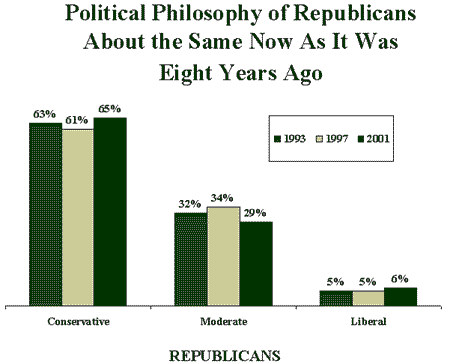
Similarly, for each partisan group, the distribution of party identifiers along the ideological spectrum -- from conservative to liberal -- has remained steady over the past eight years. Today, 65% of Republicans say they are conservative, 29% moderate, and just 6% liberal. Eight years ago, 63% said conservative, 32% moderate, and 5% liberal.
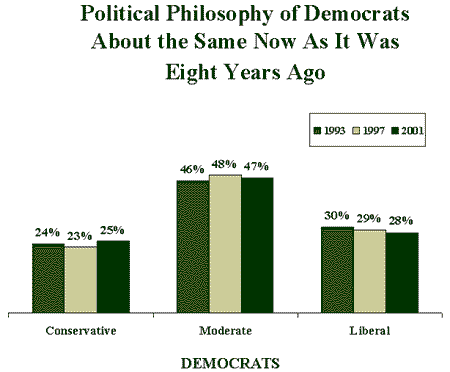
The Democrats show a similar pattern of consistency. Today, 25% say they are conservative, 47% moderate, and 28% liberal. In 1993, the comparable figures were 24% conservative, 46% moderate, and 30% liberal.
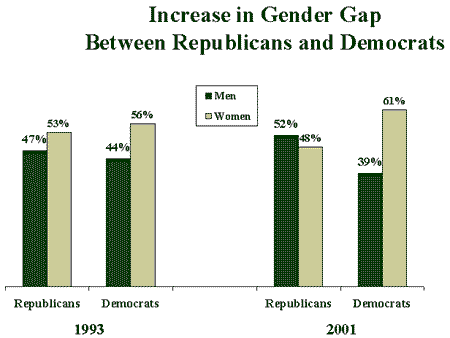
While party identifiers have remained steady in their philosophical orientation, they have changed in other respects. Gallup polls in the spring of 1993, for example, found that 47% of all Republicans were men, while 53% were women. By 1997, the gender composition was split evenly, and today there is a slight margin in favor of men, by 52% to 48%. The trend represents a net 10-point swing toward men over women.
Among Democrats, a mirror trend is found -- a 10-point swing in favor of women. In 1993, women outnumbered men by a 12-point margin, 56% to 44%, but now there is a 22-point advantage for women over men -- 61% to 39%.
Despite these changes, there have been essentially no changes over the past eight years in the composition of the parties by region, age, or race. There are only slight differences between the parties by region, and modest differences by age -- with older Americans somewhat more likely to identify with Democrats, and young people to remain independent.
The differences between the parties by race are much more substantial, though these differences have persisted at a level similar to that of eight years ago. Today, 95% of all Republicans say they are white, 1% black, and 4% some other race. Democrats, by contrast, consist of 74% whites, 20% blacks, and 6% other. These are virtually the same results as those that Gallup found in 1997 and 1993.
SurveyMethods
Results are based on telephone interviews with representative samples of national adults, aged 18+. In each of the years, three polls in the spring were combined, producing sample sizes of about 3,000 each year, with just under 900 self-identified Republicans, and just over 1,000 each of Democrats and independents. For results based on the samples of Republicans each year, one can say with 95% confidence that the margin of sampling error is +/- 4 percentage points. For independents and Democrats, the margin of error is +/- 3 percentage points.
In addition to sampling error, question wording and practical difficulties in conducting surveys can introduce error or bias into the findings of public opinion polls.