GALLUP NEWS SERVICE
PRINCETON, NJ -- Overall investor optimism drifted lower again this month, with the PaineWebber/Gallup Index of Investor Optimism declining nine points to 104, the lowest it has been in more than four years. The current survey of 1,000 investors, jointly sponsored by PaineWebber and The Gallup Organization, was conducted June 1-17. The Index was launched in October 1996, and was standardized at 100. Right after the 1996 presidential election, the Index fell to 95, and declined again the next quarter to 87. But in June 1997, the Index jumped to 119 and eventually peaked at 184 in February 1999. In January 2000, it almost reached that high again when it hit 181, but then it began an uneven decline that continued over the following several months. The Index rebounded in August of last year to 174, but has dropped 70 points since then.
Even more significant is the Index's trend on the strength of the economy, which measures investors' optimism about various aspects of the national economy. For the past five months, it has languished in the 15 to 21 range, far below its initial level of 41 points in October 1996, and its high in January of last year at 75.
| INDEX OF INVESTOR OPTIMISM October 1996 to June 2001 |
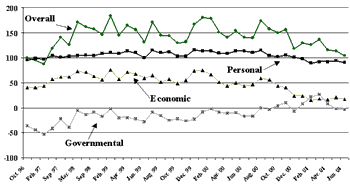 |
In the past three months, as Congress has fought over the tax cut bill and the larger problems in putting together a fiscal year budget, investor optimism about the effect of governmental policies has declined by 33 points, from a net optimism score of 27 in March to -4 today.
Positive Long-Term View of the Stock Market
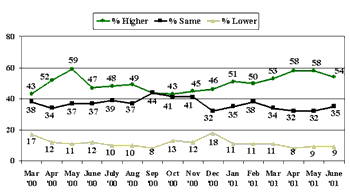
Despite the low level of investor optimism that appears to reflect mostly short-term concerns, investors seem to be bullish about the long-term prospects of the economy and the stock market. On two important measures, investors predict much better performance in the coming year than they did in the past. More than half, 54%, of investors expect the stock market to be higher next year than it is now, while just 9% say lower -- little changed over the past four months. In addition, investors' expectations for return on their investments over the next twelve months is an average of 10.7%. While that is one point lower than the 11.7% recorded last month, it is still much higher than the actual average return of 4.4% reported by investors for the past year.
| Investors' Prediction of Stock Market Next Year Compared with This Year |
 |
Energy Viewed as Serious Problem for Economy
More than eight in 10 investors see the energy situation as a serious problem in the country today -- with 46% saying "very" serious and another 36% saying "moderately" serious. Over half -- 57% -- say the energy situation is having a "major impact" on the economy.
More than three-quarters of investors report this month that, because of rising energy prices, they have felt the need to conserve their use of energy resources -- the same number reporting these efforts last February. In addition, more than half of all investors -- 52% -- say they have had to cut back on personal discretionary spending, up from 45% who reported cutbacks last February.
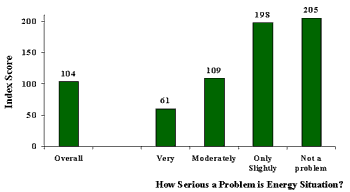
One indication of how much the energy situation is related to investor optimism can be found in a comparison of the Index score with investors' perceptions of the seriousness of the energy problem. As shown in the chart below, while theoverallIndex is at 104, among investors who say the energy situation is "very" important, the Index is only 61. As perceptions of the energy problem become less negative, the Index rises -- at 109 among investors who say the problem is "moderately" serious, 198 among those who say "only slightly serious," and at 205 among those who say it is not a problem. With 82% of investors falling into the first two categories, the Index mostly reflects their views.
| Index of Investor Optimism Compared by Perceptions of Energy Situation |
 |
| June, 2001 |
Survey Methods
The results reported here are based on telephone interviews with a randomly selected national sample of 1,001 adult investors, 18 years and older, with at least $10,000 of investable assets, conducted June 1-17, 2001. For results based on this sample, one can say with 95 percent confidence that the maximum error attributable to sampling and other random effects is plus or minus 3 percentage points. In addition to sampling error, question wording and practical difficulties in conducting surveys can introduce error or bias into the findings of public opinion polls.
INVESTOR ATTITUDES: THE INDEX
|
INDEX OF INVESTOR OPTIMISM |
||||
|
OVERALL |
PERSONAL |
ECONOMIC |
GOVERNMENTAL |
|
|
'01 June |
104 |
91 |
17 |
-4 |
|
'01 May |
113 |
94 |
21 |
-2 |
|
'01 April |
116 |
92 |
16 |
8 |
|
'01 March |
137 |
92 |
18 |
27 |
|
'01 February |
126 |
89 |
15 |
22 |
|
'01 January |
130 |
98 |
24 |
8 |
|
'00 December |
118 |
101 |
24 |
-7 |
|
'00 November |
156 |
105 |
41 |
10 |
|
'00 October |
150 |
102 |
44 |
4 |
|
'00 September |
157 |
104 |
56 |
-3 |
|
'00 August |
174 |
115 |
59 |
* |
|
'00 July |
140 |
111 |
46 |
-17 |
|
'00 June |
141 |
114 |
44 |
-17 |
|
'00 May |
154 |
114 |
50 |
-10 |
|
'00 April |
141 |
108 |
44 |
-11 |
|
'00 March |
151 |
109 |
51 |
-9 |
|
'00 February |
178 |
113 |
67 |
-2 |
|
'00 January |
181 |
114 |
75 |
-8 |
|
'99 December |
167 |
116 |
74 |
-23 |
|
'99 November |
132 |
103 |
55 |
-26 |
|
'99 October |
130 |
103 |
49 |
-22 |
|
'99 September |
144 |
112 |
57 |
-25 |
|
'99 August |
145 |
110 |
51 |
-16 |
|
'99 July |
171 |
115 |
65 |
-9 |
|
'99 June |
131 |
100 |
59 |
-28 |
|
'99 May |
156 |
110 |
68 |
-22 |
|
'99 April |
165 |
114 |
71 |
-20 |
|
'99 March |
145 |
108 |
57 |
-20 |
|
'99 February |
184 |
110 |
76 |
-2 |
|
'98 December |
147 |
108 |
56 |
-17 |
|
'98 September |
158 |
104 |
63 |
-9 |
|
'98 June |
162 |
105 |
71 |
-14 |
|
'98 March |
171 |
104 |
73 |
-6 |
|
'97 December |
126 |
103 |
62 |
- 39 |
|
'97 September |
141 |
101 |
62 |
- 22 |
|
'97 June |
119 |
104 |
57 |
- 42 |
|
'97 February |
87 |
97 |
43 |
- 53 |
|
'96 November |
95 |
99 |
40 |
- 44 |
|
'96 October |
100 |
95 |
41 |
- 36 |
Do you think the energy situation in the country today is a
problem, or not a problem?
|
01 June |
|
|
% |
|
|
A problem |
87 |
|
Not a problem |
12 |
|
Don't know/Refused |
1 |
|
100% |
Do you think the energy problem in the country today is [Rotate: 1)
Very serious, 2) Moderately serious, OR 3) Only slightly serious?]
[BASED ON THOSE WHO THINK THE ENERGY SITUATION IN THE COUNTRY IS A
PROBLEM; n = 870; MARGIN OF ERROR = +/- 4%]
|
Based on Those Who Think Energy Situation is a Problem |
Based on Total Sample |
|
|
% |
% |
|
|
Very serious |
53 |
46 |
|
Moderately serious |
41 |
36 |
|
Only slightly serious |
6 |
5 |
|
Not a problem |
0 |
12 |
|
Don't know/Refused |
* |
1 |
|
100% |
100% |
How much of an impact do you think the country's energy situation is having on the economy - a major impact, a minor impact, or no impact?
|
01 June |
|
|
% |
|
|
Major impact |
57 |
|
Minor impact |
42 |
|
No impact |
1 |
|
Don't know/Refused |
* |
|
100% |
As the cost of gas, electricity and other energy sources rise across the country, have you personally felt the need to do either of the following, or not? How about (read A-B)?
A. Conserve on your use of energy sources
|
01 Feb |
01 June |
|
|
% |
% |
|
|
Yes, felt the need |
77 |
77 |
|
No, not felt the need |
23 |
23 |
|
Don't know/Refused |
0 |
* |
|
100% |
100% |
B. Cut back on any other personal discretionary spending
|
01 Feb |
01 June |
|
|
% |
% |
|
|
Yes, felt the need |
44 |
52 |
|
No, not felt the need |
55 |
48 |
|
Don't know/Refused |
1 |
* |
|
100% |
100% |
Which of the following approaches to solving the nation's energy problems do you think the U.S. should follow right now? [Rotate1-2]
|
01 June |
|
|
% |
|
|
Emphasize exploration and production of more oil, gas and coal supplies |
34 |
|
Emphasize more conservation by consumers of existing energy supplies |
39 |
|
(Both equally) |
21 |
|
(Neither) |
5 |
|
Don't know/Refused |
1 |
|
100% |
*Less than 0.5%