GALLUP NEWS SERVICE
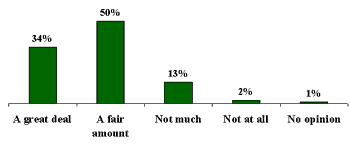
PRINCETON, NJ -- As Washington leaders wrangle over the specifics of the economic stimulus bill currently stalled in Congress, a new Gallup poll suggests that Americans may be wondering what all the fuss is about. Only half of the nation's adults believe that immediate government action is necessary to improve the country's economic woes; the other half see these problems as part of the natural business cycle and says that immediate government action is not needed. Furthermore, only 34% believe Congress and the president can greatly improve the economy by their actions. This is according to a CNN/USA Today/Gallup poll conducted Dec. 14-16.
| How Much can Congress and the President Improve the Economy by Their Actions? |
 |
| Dec 14-16, ‘01 |
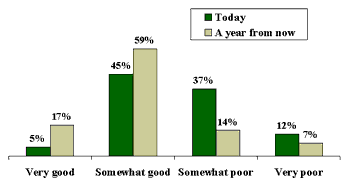
The economic recovery package, initiated by President Bush after the Sept. 11 terrorist attacks, is supposed to infuse the economy with a fresh wave of consumer spending and deliver financial relief to unemployed workers, many of whom lost their jobs in the current recession. However, it appears most Americans believe the economy is already on course for improvement. With characteristic optimism, three-quarters of Americans say that the U.S. economy will be in either very good shape or somewhat good shape a year from now -- more than the 50% who currently think the economy is good.
| Economy Ratings: Today vs. Next Year |
 |
| Dec 14-16, ‘01 |
Republicans Have Slim Public Relations Advantage
The current legislative battle between President Bush and Democratic leaders in Congress over the stimulus bill may be the toughest political fight of Bush's presidency. Both sides are digging in on behalf of their economic approach, and both claim to represent the will of Americans. Although neither side wins the support of a majority of Americans, the new survey indicates that the Republicans have the political edge.
When asked whose approach they prefer in dealing with the country's current economic problems, 44% of Americans choose the Republicans, compared with 35% who choose the Democrats. About one in five say it does not make a difference or have no opinion on the matter. This appears to be a modest change from early October -- at that time, Americans were evenly divided at roughly 45% when asked which party they trusted more to deal with the economy.
Bush Gets Little Blame for Recession
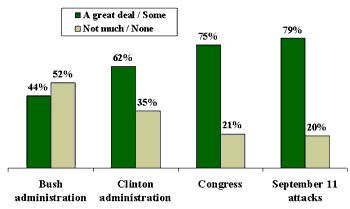
Although it may not impress Bush's opponents in Congress, relatively few Americans see his administration as responsible for the current economic problems. Overall, Americans have not tagged any group or event with responsibility for the current recession, but the Bush administration ranks as the least responsible among those measured. Only 7% of Americans say the present administration deserves a great deal of blame for the recession, compared to 15% who blame Congress, 24% the Clinton administration, and 36% the Sept. 11 terrorist attacks. When factoring in those who assign "some" blame to each factor, the Bush team is the only one that is blamed by less than a majority of Americans.
| Degree of Blame for Current Recession |
 |
| Dec 14-16, ‘01 |
|
Degree of Blame for Current Recession
|
||
|
Great deal/some |
Not much/none |
|
|
Bush administration |
44% |
52 |
|
Clinton administration |
62% |
35 |
|
Congress |
75% |
21 |
|
Sept. 11 terrorist attacks |
79% |
20 |
Not a Simple Picture
The newest results can be compared to a CNN/USA Today/Gallup poll from early October. At that time, a majority of Americans (54%) rated the economy as an "extremely important" issue for the president and Congress. That was up from 34% in January, and on par with the October rating for the importance of foreign affairs, but lower than the rating of terrorism (70%). The same survey found widespread public support for a list of specific elements that could be included in an economic stimulus bill:
- 94% favored extending unemployment insurance and healthcare coverage for workers affected by the terrorist attacks
- 86% favored new tax cuts for low- and moderate-income workers
- 81% supported raising the minimum wage
- 75% favored increased government spending on job training and construction
- 75% supported making the recently passed tax cuts take effect immediately
- 61% favored passing new tax cuts for businesses
These results do not necessarily indicate there has been a major shift in public opinion about the merits of an economic stimulus bill. Rather, they suggest that the specific economic stimulus elements being debated are fairly noncontroversial and that, relative to other government initiatives, economic stimulus ranks as a fairly high public priority. At the same time, as the new poll shows, it appears that Americans are not sold on the idea that the stimulus package is absolutely necessary or that it will be highly effective.
Survey Methods
These results are based on telephone interviews with a randomly selected national sample of 1,019 adults, 18 years and older, conducted Dec. 14-16, 2001. For results based on this sample, one can say with 95 percent confidence that the maximum error attributable to sampling and other random effects is plus or minus 3 percentage points. In addition to sampling error, question wording and practical difficulties in conducting surveys can introduce error or bias into the findings of public opinion polls.
(As you may know, the federal government has announced that the country is currently in a recession and has been since March of this year.) How would you rate economic conditions in this country today – as very good, somewhat good, somewhat poor, or very poor?
|
Very |
Somewhat |
Somewhat |
Very |
No |
|
|
% |
% |
% |
% |
% |
|
|
2001 Dec 14-16 |
5 |
45 |
37 |
12 |
1 |
|
2001 Sep 21-22 |
7 |
50 |
34 |
8 |
1 |
|
2001 Apr 20-22 |
10 |
57 |
25 |
7 |
1 |
|
2001 Feb 9-11 |
16 |
64 |
16 |
3 |
1 |
|
2001 Jan 15-16 |
24 |
58 |
14 |
4 |
* |
|
2000 Jun 6-7 |
39 |
46 |
9 |
5 |
1 |
|
2000 Mar 10-12 |
42 |
44 |
10 |
3 |
1 |
|
1999 Jun 25-27 |
34 |
50 |
10 |
6 |
* |
|
1999 Jan 8-10 |
41 |
48 |
8 |
3 |
* |
|
1998 Jul 7-8 |
29 |
50 |
15 |
5 |
1 |
|
1998 Jan 25-26 |
24 |
57 |
14 |
4 |
1 |
|
1998 Jan 24-25 |
24 |
57 |
13 |
5 |
1 |
|
1998 Jan 23-24 |
24 |
57 |
15 |
4 |
* |
|
1997 Oct 27-29 |
24 |
55 |
15 |
4 |
2 |
|
1997 Aug 22-25 |
17 |
52 |
21 |
9 |
1 |
Now thinking about a year from now, do you expect economic conditions in this country will be -- very good, somewhat good, somewhat poor, or very poor?
|
Very |
Somewhat good |
Somewhat poor |
Very |
No |
|
|
% |
% |
% |
% |
% |
|
|
2001 Dec 14-16 |
17 |
59 |
14 |
7 |
3 |
|
2001 Sep 21-22 |
21 |
56 |
15 |
5 |
3 |
|
2001 Apr 20-24 |
16 |
54 |
18 |
9 |
3 |
|
2001 Feb 9-11 |
18 |
53 |
21 |
6 |
2 |
|
2001 Jan 15-16 |
13 |
55 |
22 |
8 |
2 |
|
2000 Jun 6-7 |
24 |
56 |
10 |
5 |
5 |
|
2000 Mar 10-12 |
24 |
55 |
13 |
4 |
4 |
|
1999 Jun 25-27 |
21 |
55 |
15 |
7 |
2 |
|
1999 Jan 8-10 |
25 |
56 |
12 |
4 |
3 |
|
1998 Jul 7-8 |
19 |
54 |
14 |
7 |
6 |
|
1997 Oct 27-29 |
20 |
55 |
18 |
4 |
3 |
COMBINED RESPONSES (Q.6/Q.7)
|
Good now/ Good next year |
Good now/ Poor next year |
Poor now/ Good next year |
Poor now/ Poor next year |
|
|
|
2001 Dec 14-16 |
43% |
6 |
32 |
16 |
3 |
In general, do you prefer the Republicans' or the Democrats'
approach to deal with the country's current economic
problems?
|
|
|
BOTH |
NEITHER |
No |
|
|
2001 Dec 14-16 |
44% |
35 |
4 |
5 |
12 |
Please tell me whether you think each of the following deserves a great deal of blame, some blame, not much blame, or no blame at all for the country's current economic recession. How about -- [RANDOM ORDER]?
A. The current Bush administration
|
Great deal |
Some |
Not much blame |
No blame |
No |
|
|
2001 Dec 14-16 |
7% |
37 |
24 |
28 |
4 |
B. The Clinton administration
|
Great deal |
Some |
Not much blame |
No blame |
No |
|
|
2001 Dec 14-16 |
24% |
38 |
18 |
17 |
3 |
C. Congress
|
Great deal |
Some |
Not much blame |
No blame |
No |
|
|
2001 Dec 14-16 |
15% |
60 |
13 |
8 |
4 |
|
2001 Dec 14-16 |
Great deal |
Some |
TOTAL |
|
The Clinton administration |
24% |
38 |
62 |
|
Congress |
15% |
60 |
75 |
|
The current Bush administration |
7% |
37 |
44 |
How much of the country's current economic problems are a result of the Sept. 11 terrorist attacks -- a great deal, a moderate amount, not much, or none at all?
|
A great |
A moderate amount |
|
|
No |
|
|
2001 Dec 14-16 |
36% |
43 |
16 |
4 |
1 |
Which of the following comes closer to your view of the U.S.
economy -- [ROTATED: the federal government should take immediate
action to improve the country's current economic problems, (or) the
country's current economic problems are part of the natural
business cycle and immediate government action is not
necessary]?
BASED ON -- 485 -- NATIONAL ADULTS IN FORM A; ±5 PCT. PTS.
|
|
Take immediate |
Immediate action |
No |
|
2001 Dec 14-16 |
47% |
49 |
4 |
How much do you think Congress and the president can improve the economy by their actions -- a great deal, a fair amount, not much, or not at all?
BASED ON -- 534 -- NATIONAL ADULTS IN FORM B; ±5 PCT. PTS.
|
A great |
A fair amount |
|
|
No |
|
|
2001 Dec 14-16 |
34% |
50 |
13 |
2 |
1 |
(vol.) -- Volunteered response
* -- Less than 0.5%
