Many young Americans currently face the daunting prospect of looking for their first full-time jobs during a time of sluggish economic conditions and relatively high unemployment. Analysts say this year's job market is the toughest in years for new college graduates. Recent Gallup polling* finds that roughly two-thirds of all Americans share this negative view of the job market, saying that now is a bad time to find a quality job. Do young Americans, many of whom are now looking for their first full-time jobs, share this pessimism?
Combined data taken from Gallup polls conducted in March through June of this year show 37% of 18- to 24- year-olds think now is a good time to find a quality job, while 62% think it is a bad time. Those figures may not sound especially upbeat, but this is actually the most optimistic of all the age groups surveyed. The next most optimistic consists of 30- to 34-year-olds, among whom 34% think now is a good time to find a job.
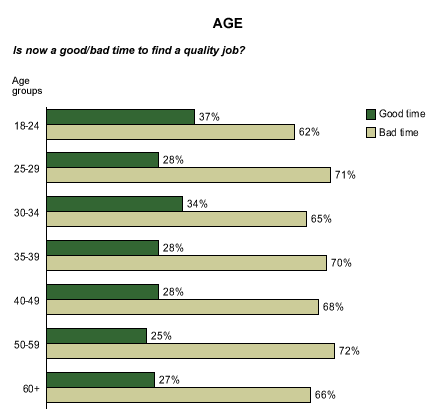
Optimism Differs Among Categories of Young Americans
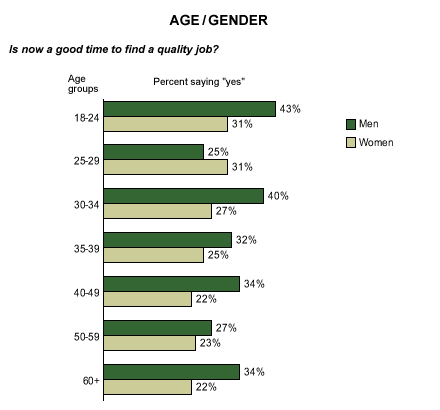
Younger men, among whom 43% think it is a good time to find a quality job, are driving much of this age group's optimism. By comparison, 31% of women aged 18 to 24 think now is a good time for job-hunting, figures more or less in line with the opinion of Americans in general. Men aged 18 to 24 are much more optimistic about the job situation than any other age or gender group, with the exception of 30- to 34-year-old males, 40% of whom think now is a good time to find a job.
Educational differences also are related to one's level of optimism about the job market. Among age groups, there is little difference in job market assessments by college attendance -- with the exception of the 18- to 24-year-old age group. In this group, a majority (51%) of those who have not attended college believe now is a good time to find a quality job, compared to just one-fourth (25%) of those with some college education. This suggests that the job market may be better for those seeking jobs that don't require a college education.
It is possible that many students currently attending college do not identify themselves as college-educated because they have not yet completed college. However, when all students are removed from the 18- to 24- year-old age group, the data change little. Fifty percent of non-students in this age group without any college education say the job market is good, compared to 27% of non-students in that age group who have at least some college education.
Possibly related to the differences by education level is the finding that optimism varies by place of residence. The data show that younger Americans living in rural areas are more optimistic about job prospects (43%) than are urban (36%) or suburban (35%) residents. Among Americans as a whole, there are no differences in assessments of the job market by place of residence.
*These results are based on telephone interviews with randomly selected national samples of 4,031 adults, 18 years and older, conducted in Gallup polls in March, April, May and June 2002. For results based on this sample, one can say with 95% confidence that the maximum error attributable to sampling and other random effects is ±2%. The sample of adults aged 18 to 24 includes 361 respondents and has a margin of error of ±6%. In addition to sampling error, question wording and practical difficulties in conducting surveys can introduce error or bias into the findings of public opinion polls.