The debate over the appropriate size and scope of the federal government's role in American society is perennial. But every U.S. taxpayer would probably agree that, regardless of its size, the government should strive to operate as productively and efficiently as possible. President Bush's management agenda (see Related Sites), released in August 2001, reflects this sentiment in its mandate that the government be "citizen-centered, not bureaucracy-centered." The agenda also laid out five government-wide goals to guide federal agencies toward improving their management and performance, the first of which is "strategic management of human capital."
That's a broad directive, but one aspect of strategic management of human capital is helping government employees become more engaged and productive in their jobs, providing higher and more satisfactory levels of service. The call to be "citizen-centered" requires government organizations to continually assess customer service, and identify those public-sector units who provide model service.
The next logical question is this: Is the degree to which government employees are engaged in their jobs linked to their customers' satisfaction with the services they provide?
The answer could offer insights for customer and employee relationships across the public sector. According to Catherine Maloney, a program expert for the Federal Supply Service (FSS), a branch of the U.S. General Services Administration (GSA), "Finding a correlation between customer satisfaction and employee engagement . . . will convince our managers to focus on more workforce-related strategies to improve engagement, and consequently improve customer service."
In the summer of 2002, FSS commissioned Gallup to analyze customer satisfaction and employee engagement results for its GSA Fleet Program -- a professional, full-service leasing program that oversees the management of one of the largest non-tactical worldwide fleets. Gallup's research pointed to several ways that FSS can leverage employee performance to positively impact its customers.
The Customer Impact Analysis
Prior to this study, FSS had been independently measuring both the satisfaction of GSA Fleet customers and the engagement of its employees, but had no basis for relating the two measurements to one another.
Gallup researchers examined the results of a December 2001 agency-wide Employee Engagement Survey (conducted by Gallup, using its 12-item Q12 instrument) and a July 2001 Customer Satisfaction Survey of GSA Fleet (conducted by another survey firm, using a 20-item customer satisfaction survey). Gallup examined data from 53 work units across 10 regions nationwide. Researchers identified two key outcomes for FSS: satisfaction with overall performance, and loyalty (a willingness to continue to use GSA Fleet services).
Gallup investigated possible relationships between employee engagement and the most highly controllable individual customer satisfaction items. In addition, the study explored the relationship between employee engagement and both the overall customer satisfaction and customer loyalty metrics.
Results and Implications
The resulting data indicated that more engaged work units generally have more satisfied and loyal customers. When quantified into dollars and numbers of customers, GSA Fleet workgroups with higher levels of engagement had, on average, 23 to 26 more highly satisfied and loyal customers, which equated to more than $1 million in revenue.
The findings also suggest that employee engagement is related to the "key drivers" of satisfaction with GSA Fleet's overall performance. In other words, highly engaged work units are more likely than less engaged units to receive high scores on the specific customer survey items that "drive" satisfaction with overall performance. For example, satisfaction with "offering conveniently located maintenance and repair facilities" -- an item that is a key driver of overall satisfaction and also highly controllable by employees -- is significantly higher among work units with Q12 scores in the top quartile (25th percentile) than among units with Q12 scores in the bottom quartile (25th percentile).
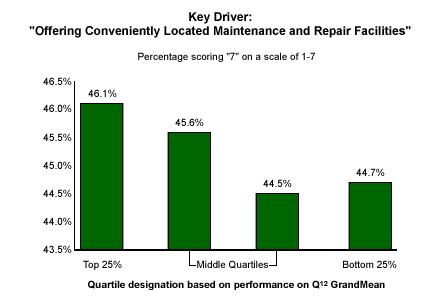
The results imply that those most engaged workgroups at FSS could benefit their agency in two ways. First, these workgroups help customers realize the value of FSS to customers; they translate the goals and missions of FSS through the services they provide. Secondly, these workgroups provide learning opportunities for FSS. They are the "best practices" teams and lead the way in terms of service to their employees and customers.
FSS is hoping that this research, as well as future research on employee engagement and business outcomes, will help shape the way that the agency responds to the goals of the president's management agenda (PMA). Maloney comments, "The PMA zeros in on strategic management of human capital. If more and more business outcomes are positively linked to employee engagement, then that will lead and/or support more initiatives to strategically recruit, retain, and develop employees here (at FSS)."