First in a two-part series on public opinion about healthcare malpractice insurance.
Physicians in West Virginia, Florida, and Mississippi have recently engaged in work stoppages to protest rapidly rising malpractice insurance premiums. Doctors in Pennsylvania threatened to walk off the job earlier this month, and New Jersey doctors have planned a walkout for today. President Bush echoed their concerns by calling for medical liability reform during his State of the Union address last week, saying, "No one has ever been healed by a frivolous lawsuit."
A January 2003 Gallup Poll* asked Americans several questions about malpractice insurance to gauge their level of concern with the issue and their opinions about how it should be handled.
Is Malpractice Insurance in Crisis?
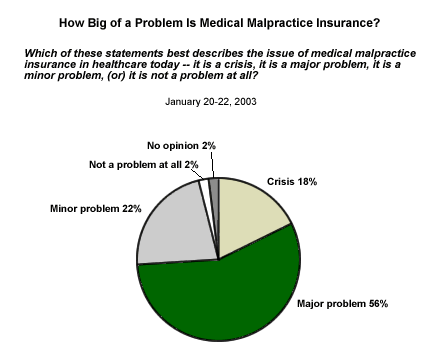
Physicians involved in the current protests may argue that the issue of malpractice insurance has reached crisis proportions, but fewer than one in five Americans (18%) say they would characterize it as a "crisis." That's not to say, however, that the public doesn't recognize it as a problem: 56% of Americans think malpractice insurance is a major problem, while another 22% feel it is a minor problem.
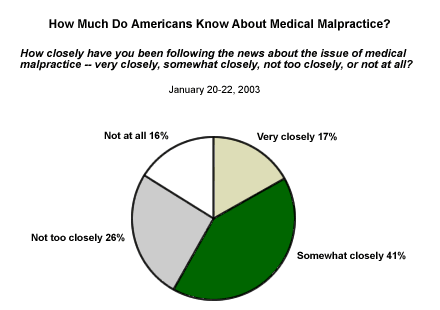
The low percentage of Americans who call the issue a crisis may derive in part from the fact that only 17% of Americans say they are following news on the malpractice issue very closely. Forty-one percent say they are following it "somewhat closely," while 42% report following it "not too closely" or "not at all." Indeed, among those who are following the issue closely, 34% say malpractice is in a state of crisis.
Are There Too Many Lawsuits?
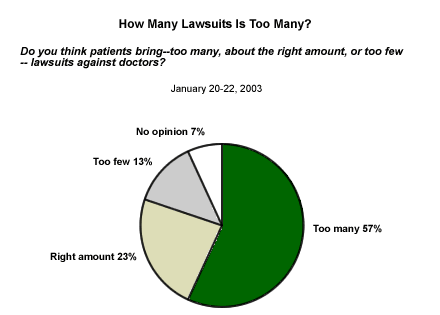
The rapid rise of malpractice insurance premiums is commonly attributed to the idea that doctors are faced with too many lawsuits, many of which are frivolous or otherwise unnecessary. The public tends to support this position: 57% of Americans feel patients bring too many lawsuits against doctors, while 23% say they are bringing the right amount and 13% say too few lawsuits are being filed.
How Should the Problem Be Solved?
Ongoing debate in some state legislatures and at the federal level (now reinforced by Bush's State of the Union appeal) has focused primarily on two possibilities for addressing the medical liability issue: 1) limiting the amount that patients can be awarded for their emotional pain and suffering, and 2) limiting the amount that patients can be awarded as punishment to doctors for negligence and carelessness. While a majority favors both potential solutions, Americans are more likely to say they favor the first option (72%) than the second (64%).
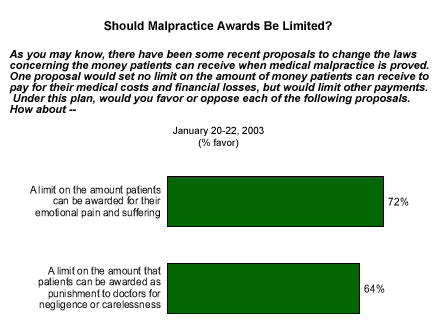
The majority of Americans clearly endorse President Bush's desire to limit malpractice awards. But public support regarding the general idea of limited liability for emotional pain and doctor negligence does not necessarily mean that the road to action will be easy for the president. The current debate in West Virginia reflects the complexity of the issue. The lower body of the West Virginia state legislature has passed physician-friendly legislation, while the upper body is debating more lawyer-friendly legislation, with the major point of debate being the cap amounts. Levels of public support may well drop as broad rhetoric on the need for award limits gives way to debate over specific cap levels proposed throughout the country.
*Results are based on telephone interviews with 1,006 national adults, aged 18 and older, conducted Jan. 20-22, 2003. For results based on the total sample of national adults, one can say with 95% confidence that the maximum margin of sampling error is ±3%.