The Index of Investor Optimism* fell 24 points to 42 in May, offsetting one-third of its 61-point surge in April. During the first half of March and prior to the invasion of Iraq, investor optimism had fallen to 5 -- the lowest point in the Index's six-year history. The record April surge brought it up to its highest point since June 2002, but the May decline returns the Index close to its January level (38). Investor optimism is now at about half of what it was a year ago.
However, the overall decline hides something significant: optimism among substantial investors -- investors with $100,000 or more of investable assets -- increased in May, while optimism among other investors declined. Why are substantial investors more optimistic than their less wealthy counterparts? Do the bigger investors on Wall Street know something that the rest of us don't? Or has their wealth insulated them from economic reality on Main Street?
Optimism Among Substantial Investors Continues to Increase
Optimism among substantial investors increased 12 points in May, after a 50-point surge in April. This brings substantial investor optimism to 62 -- above its January level (57) and close to its December 2002 point (66). Although substantial investor optimism continues to increase, it's still far from the level of 101 it was at a year ago.
In sharp contrast, the Index among "average" investors (those with at least $10,000 in investable assets) fell 46 points to 30 in May, offsetting about two-thirds of its 68-point increase in April. This puts optimism among average investors above its January level (27), but well below its December level (44). Right now, optimism among average investors is at about a third of its level from a year ago (84).
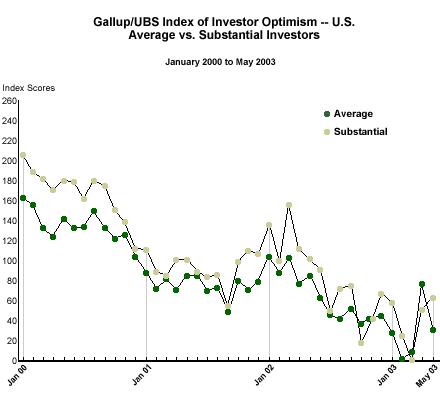
Why Is Substantial Investor Optimism Increasing?
One reason substantial investors are more optimistic than other investors has to do with their personal investment portfolios. Substantial investor optimism increased six points along the Personal Dimension of the Index, from 48 in April to 54 in May. In sharp contrast, the Personal Dimension fell from 62 to 35 among average investors.
Obviously, substantial investors are more optimistic than other investors that they can continue to grow their portfolios in the year ahead. Although the new tax bill had not passed at the time of this survey, it may nevertheless have influenced investors' responses. The tax cuts were widely anticipated on Wall Street and bigger investors stand to benefit more than other investors from changes like the reduction in dividend taxes.
Differing economic outlooks are another reason for the gap in optimism between substantial and average investors. While neither group is particularly optimistic about the economic outlook over the next 12 months, substantial investors are slightly optimistic, with a score of 9 on the Economic Dimension. Other investors are slightly pessimistic about the economic outlook, with a -5 along this dimension of the Index.
Do Big Investors Know Better?
Substantial investors often seem to know more about the investment outlook than other investors do. This is not only an issue of greater access to information, but also a question of degree of interest. Many average investors tend to adopt a buy-and-hold strategy, trusting that their investments will work out over the long term. Many also invest in mutual funds and similar instruments and do not pay a great deal of attention to individual stocks. As a result, average investors don't routinely follow economic fluctuations.
In contrast, many substantial investors spend a great deal of their time studying the markets and their investments. They also tend to pay more attention to the economy for both investment and business reasons. So it's not surprising that econometric analysis suggests the level of optimism among substantial investors may be a slightly better predictor of future economic activity than the overall Index of Investor Optimism.
Still, substantial investors have often been more optimistic about the future than other investors have over the past few years. Unfortunately, the economic stagnation of recent years suggests that such optimism was unwarranted. In this regard, I think today's "jobs recession" and its impact on the average American consumer is much harder for substantial investors to understand. In a real sense, many substantial investors have been somewhat insulated from the lack of job growth, despite the fact that many on Wall Street have lost both their jobs and their bonuses during the past couple of years.
Given the current jobs recession I tend to believe that average investors have a much better feel than wealthy investors for what is happening to the real economy on Main Street. But, I'd certainly love to be proved wrong.
*Results are based on telephone interviews with 1,001 investors, aged 18 and older, conducted May 1-14, 2003. For results based on the total sample of investors, one can say with 95% confidence that the margin of sampling error is ± 3%.