GALLUP NEWS SERVICE
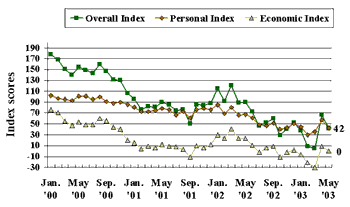
The Index of Investor Optimism -- a joint effort of UBS and The Gallup Organization -- fell 24 points in May. This follows a huge, war-induced surge of 61 points in April. The May decline in investor optimism is certainly understandable, as investor joy over the removal of many war-related uncertainties and the resulting increase in economic clarity gave way to a renewed focus on current economic conditions and the prospects for real economic improvement in the months ahead.
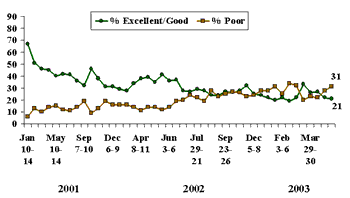
Unfortunately, Gallup's latest consumer confidence data -- like many other economic measures -- are not very encouraging as far as the public's assessment of current economic conditions is concerned. New Gallup Poll data (May 19-21) show that 31% of the public rates current economic conditions as "poor," compared to only 21% who rate them as "good" or "excellent." This negative assessment of the economy suggests that the nation's consumers have yet to see any real improvement in economic activity. Until they do, investors have good reason to be less optimistic about the nation's near-term economic prospects.
Investor Optimism Declines in May
During the first half of March and prior to the invasion of Iraq, investor optimism had fallen to 5 -- the lowest point in the Index's six-year history. While the record April surge in the Index brought it to 66, its highest point since June 2002 (72), the May decline to 42 means the Index is again close to its January 2003 (38) and November 2002 (41) levels. Overall investor optimism is now at about half of last May's level (90).
The Personal Dimension of the Index fell 15 points in May, offsetting two-thirds of this dimension's 22-point April increase, and now stands at 42. This places investor assessments of their personal situations back at their January (44) and November 2002 (43) levels. Still, investors are more optimistic overall about their personal financial situations than they were in March (35), prior to the start of the war with Iraq, but substantially less optimistic than they were in April (57) or last May (67).
The Economic Dimension of the Index also declined in May, falling from April's slightly optimistic level of 9 to a totally neutral position of 0. This suggests that investors have lost a little of their postwar enthusiasm about the economic outlook for the next 12 months. In March, before the war began, investors were decidedly negative about the economy, with the Economic Dimension of the Index at –30 -- its lowest level ever.
| Index of Investor Optimism – U.S. January 2000 – May 2003 |
 |
Consumers Assess the Economy at Prewar Lows
The differential between the percentage of consumers rating current economic conditions as "good/excellent" and the percentage rating them as "poor" is now –10 percentage points. This puts the American consumer's assessment of current economic conditions back at its prewar, March level. At that time, 32% of the public rated conditions as "poor" and 22% rated them as "good/excellent," for the same differential of –10 percentage points.
Of course, consumer assessment of the economy did surge after the war began, with 33% of the public rating economic conditions as "good/excellent" and 20% rating them as "poor," for a differential of +13 percentage points in Gallup's March 24-25 poll. The differential declined to +5 percentage points as Baghdad fell in early April, before declining further to –6 percentage points in early May. Obviously, the latest poll shows that all of the earlier war-related increases in consumer perceptions of the economy have now dissipated.
| Rating of Current Economic Conditions |
 |
More Consumers Say the Economy Is Getting Worse, Rather Than Better
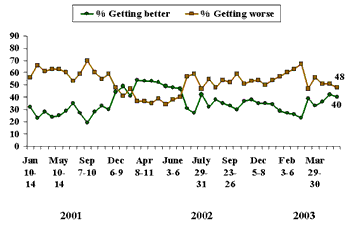
Nearly half the public (48%) continues to say economic conditions in the country are getting worse, rather than better. This is nearly the same percentage (51%) who held this view in early April and early May. However, it is substantially below the two out of three Americans (67%) who thought things were getting worse just prior to the war's outbreak in early March.
Although more consumers still say economic conditions are getting worse as opposed to better (48% vs. 40%, respectively), the degree of difference has shown a pronounced decline. The differential between those saying economic conditions are getting better and those saying they are getting worse is now only –8 percentage points -- much improved over the prewar differential of –44 percentage points in the March 3-5 poll. It is this improvement in consumer expectations for the future that has some observers arguing that consumer confidence has increased significantly following the war.
| Economic Conditions Getting Better or Getting Worse? |
 |
Will the Surge in Investor Optimism Also Dissipate?
At this point, the cessation of hostilities in Iraq does not appear to be generating the strong "rally effect" in investor and consumer confidence that many had anticipated. The sharp improvement in how consumers assess the economy has dissipated. Consumer expectations for the future have improved but have not continued to gain momentum, and remain weak. And investor optimism is declining, rather than gaining positive momentum.
In this context, it is hard to see how investor optimism and consumer confidence are going to maintain their current levels -- let alone increase -- unless consumers and investors see some real economic improvements in the months ahead. Declining energy costs may help. So might the tax cuts just adopted by the Congress, although this is the subject of much debate. What no longer seems debatable, however, is the notion that the war-related "rally-effect" will jump-start the economy -- this is not happening.
Survey Methods
Results for the "Index of Investor Optimism -- U.S." are based on telephone interviews with a randomly selected U.S. sample of 1,001 adult investors, 18 years and older, with at least $10,000 of investable assets, conducted May 1-14, 2003. Results for the Gallup Poll of May 19-21, 2003 are based on random telephone interviews with 1,014 national adults, aged 18+. For results based on these samples, one can say with 95 percent confidence that the maximum error attributable to sampling and other random effects is ±3 percentage points. In addition to sampling error, question wording and practical difficulties in conducting surveys can introduce error or bias into the findings of public opinion polls.