GALLUP NEWS SERVICE
PRINCETON, NJ -- The Washington Post on Monday sparked a modest media frenzy with its front-page story contending that Secretary of State Colin Powell was planning to step down from his position in the eventuality of a second Bush administration. White House spokesman Scott McClellan immediately denied the speculation that conversations about Powell's future had taken place, and Powell himself called the story "gossip" and "nonsense" in a radio interview on Monday.
There have been some complaints about Powell from conservatives who argue that he is not hard-line enough in his policies, and there have been a number of continuing stories of fighting between the State Department and the Department of Defense and its very public leader, Donald Rumsfeld. Indeed, some of the discussion on Monday immediately jumped to conjecture about possible replacements for Powell, including such hard-liners as Deputy Secretary of Defense Paul Wolfowitz and former Speaker of the House Newt Gingrich.
Gallup Poll data strongly suggest that a Powell departure would be a significant loss for the Bush administration. Powell remains one of the most popular political figures in Gallup Poll history, and his current 83% favorable rating is some 18 points higher than the favorable rating of his boss, George W. Bush. Powell's image appears relatively impervious to damage; his favorable rating has remained high despite his public and visible connection with the administration's assertions earlier this year (still unproven) that Iraq possessed weapons of mass destruction.
Here is the trend graph on Powell's favorable ratings:
| Opinion of Secretary of State Colin Powell |
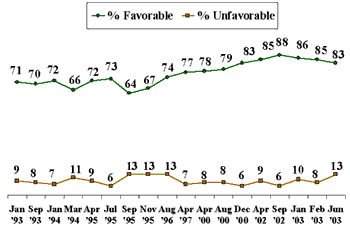 |
As noted, one remarkable thing about Powell's favorable rating is its relative constancy. Powell is at least as popular now as he has been in times past.
Unlike most Republicans who serve in the Bush administration (and of course, Bush himself), Powell's popularity extends across party lines. In June, his favorable rating among Republicans was 94%, among independents 78%, and among Democrats 82%. There is very little difference in Powell's ratings across ideological lines; liberals, moderates, and conservatives all give Powell equally high favorable ratings. Even some 69% of Americans who disapprove of the way President Bush is handling his job as president say they have a favorable opinion of Powell.
Vice President Dick Cheney
Rumors about a changing of the guard when a president moves into a second term are nothing new. Twelve years ago, speculation about administration departures focused not on the senior President Bush's Secretary of State (James Baker), but rather on the possibility that Vice President Dan Quayle would be replaced on the 1992 Republican ticket.
Although the current vice president, Dick Cheney, has been -- famously -- less than highly visible in the first years of the Bush administration (including his sojourns in "undisclosed locations" during times of terrorist threats), he has come nowhere near engendering the controversy associated with Quayle. Quayle was so controversial, in fact, that Gallup began asking Americans in 1990 if they felt then-President Bush should replace Quayle as his nominee in Bush's 1992 re-election bid -- and continued asking that question up to the summer of 1992, when Quayle was eventually renominated.
In general, each time the question was asked, about half of Americans said they felt Quayle should be replaced. The low point for Quayle came in November 1990, when 55% of Americans said Bush should replace him on the 1992 Republican ticket. The high points for Quayle were in the summer and fall of 1991, when the number of Americans who wanted him replaced was slightly lower, at 46%.
Republicans were generally much less inclined to jump on board a "dump Quayle" movement, but the polling never suggested a robust vote of confidence in the elder Bush's vice president. At one point, in November 1990, 48% of Republicans themselves said Quayle should be replaced. That number came down some as the months went on, and by November 1991, just 32% of Republicans said he should go. By July 1992, on the eve of the Republican convention, however, 39% of Republicans said Quayle should be replaced.
The current vice president, Dick Cheney, appears to be much more secure in his position. There has been no speculation about his possible departure -- Bush has announced that he wants Cheney to remain as vice president, Cheney has agreed, and visitors to the Bush re-election Web site are greeted by the headline, "Bush/Cheney '04."
For comparison purposes, our July 18-20 Gallup Poll included the same "should Bush keep" question about Cheney that had been asked about Quayle. The results clearly show that Cheney is in significantly better perceptual shape than was Quayle. Thirty-nine percent of all Americans say that Cheney should be replaced, a number well below any of the comparable measures obtained about Quayle:
If President Bush runs for re-election in 2004, do you think he should keep Dick Cheney as his vice-presidential running mate, or choose someone new?
|
Cheney |
Someone new |
No opinion |
|
|
% |
% |
% |
|
|
National Adults |
|||
|
2003 Jul 18-20 |
53 |
39 |
8 |
|
Republicans |
|||
|
2003 Jul 18-20 |
72 |
24 |
4 |
Trends for Comparison: Dan Quayle
|
Quayle |
Someone new |
No opinion |
|
|
National Adults |
% |
% |
% |
|
1992 Jul 24-26 |
37 |
50 |
13 |
|
1991 Nov 14-17 |
43 |
46 |
11 |
|
1991 Aug 8-11 |
50 |
46 |
4 |
|
1991 May 23-26 |
39 |
52 |
9 |
|
1991 May 6-7 |
39 |
51 |
10 |
|
1991 Feb 14-16 |
38 |
53 |
9 |
|
1990 Nov 8-11 |
36 |
55 |
9 |
|
1990 Mar 8-11 |
35 |
49 |
16 |
|
Republicans |
|||
|
1992 Jul 24-26 |
54 |
39 |
7 |
|
1991 Nov 14-17 |
61 |
32 |
7 |
|
1991 Aug 8-11 |
52 |
43 |
5 |
|
1991 May 23-26 |
56 |
38 |
7 |
|
1991 May 6-7 |
46 |
46 |
8 |
|
1991 Feb 14-16 |
52 |
42 |
7 |
|
1990 Nov 8-11 |
46 |
48 |
5 |
|
1990 Mar 8-11 |
49 |
37 |
14 |
Sentiment to replace Cheney is stronger among Democrats than Republicans, as can be seen in the chart below. But even Democrats show no strong push to get rid of Cheney, as they are about evenly divided on the matter. Independents are similarly torn.
More than 7 out of 10 Republicans say Cheney should remain, leaving a small, but not insignificant 24% of Republicans who say he should be replaced. This 24% figure is lower than the comparable Republican figure for Quayle across any of the eight measures obtained in 1990 through 1992.
|
Keep Dick Cheney as Bush's Running Mate or Choose Someone New? (July 2003) |
|||
|
Keep Cheney on Ticket |
Replace Cheney on Ticket with Someone Else |
Don't Know |
|
|
TOTAL SAMPLE |
53% |
39 |
8 |
|
Republicans |
72% |
24 |
4 |
|
Independents |
46% |
43 |
11 |
|
Democrats |
45% |
47 |
8 |
More on Cheney
Cheney's current favorable rating is 54%, with an unfavorable rating of 34%. That, as would be expected, is a substantially less positive image than Colin Powell's, but it is also somewhat below the favorable rating of George W. Bush, whose favorable/unfavorable numbers in June were 65% and 34%, respectively. (Cheney's lower favorable rating may partly result from the fact that 12% of Americans say they don't know enough about Cheney to be able to rate him.)
|
Opinion About George W. Bush, Colin Powell, Dick Cheney (June 2003) |
|||
|
Favorable |
Unfavorable |
Don't Know |
|
|
George W. Bush |
65% |
34 |
1 |
|
Colin Powell |
83% |
13 |
4 |
|
Dick Cheney |
54% |
34 |
12 |
Unlike Powell, Cheney has a very typical partisan skew in his ratings: Seventy-nine percent of Republicans have a favorable opinion of Cheney, compared with only 39% of Democrats.
Survey Methods
The most recent results are based on telephone interviews with 1,003 national adults, aged 18+, conducted July 18-20, 2003. For results based on the total sample of national adults, one can say with 95% confidence that the margin of sampling error is ±3 percentage points.
In addition to sampling error, question wording and practical difficulties in conducting surveys can introduce error or bias into the findings of public opinion polls.