Effective instruction often relies on strong supplemental materials to reinforce verbal directions -- just ask the flight attendants who stand in the aisles at the outset of every flight to hold up sample seat belts and air masks for passengers.
This principle applies equally well in an inpatient hospital setting, when patients and their families learn about the patient's treatment. Good educational materials ensure that patients and family members understand the reasons for the treatment, promote recovery and future healthy behavior, and reduce stress for patients and their families.
Patient Satisfaction With Educational and Informational Materials
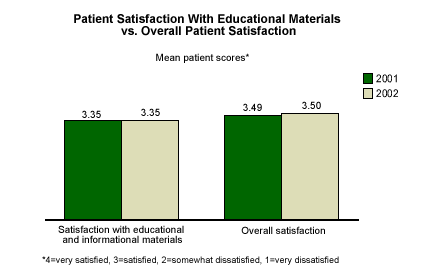
To assess this crucial component of patient care, Gallup asks patients about their level of satisfaction with the educational and informational materials provided regarding their hospital stay and treatment. Gallup's inpatient satisfaction and loyalty database figures indicate that in 2002, patients were significantly less satisfied with the educational and informational materials they received than they were with their overall hospital experience.
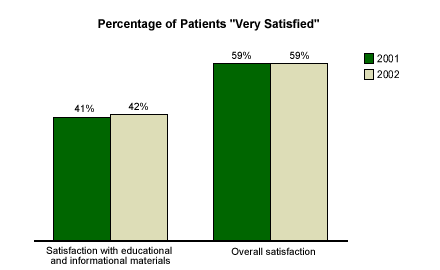
On a scale of 1 to 4, the mean satisfaction score for educational and informational materials was 3.35, compared to 3.50 for overall satisfaction -- numbers similar to those seen in 2001. Further, just 42% of inpatients were "very satisfied" with their educational and informational materials (rating them "4" on a scale of 1 to 4), compared to 59% who were very satisfied overall with their hospital stay.
Improving Educational Materials
Effective patient and family education is not optional for hospitals -- it is a patient right. The second item on the American Hospital Association's Patient Bill of Rights states, "The patient has the right to, and is encouraged to, obtain from physicians and other direct caregivers relevant, current and understandable information concerning diagnosis, treatment and prognosis." There are several simple tips that hospitals can follow to encourage the use of patient education materials and improve satisfaction in this area:
- In an inpatient setting, delivering this information is usually a key responsibility of the doctors and nurses. While supporting educational and informational materials cannot replace effective verbal communication from doctors and nurses, they do provide critical teaching aids and reference material.
- Effective materials have a pleasing layout, emphasizing visual as well as textual elements. Visual examples are often easier to comprehend than text, and video is more efficient than print. Obviously, all written material should be presented in layman's terms, taking into consideration patients' diverse education levels, age, and cultural backgrounds.
- If these materials are going to be consistently used, they must be conveniently accessible to the medical and nursing employees who are supposed to use them, and in adequate supply for distribution to patients and their families.
- Presentation of educational materials to the patient and family members should be documented in the patient's record after the education takes place, and should be subject to quality audits.
Bottom Line
Hospitals looking to reduce their budgets should think twice before cutting patient education programs. Successful patient outcomes are often heavily influenced by patient compliance with instructions during the treatment process. If patients fail to comply with the instructions they are given, it could be because poor patient education led to a lack of understanding. Patient scores on this item in Gallup's database indicate that for many hospitals, there is significant room for improvement in the area of patient education.