When Federal Reserve Board Chairman Alan Greenspan gives his economic outlook to the Joint Economic Committee on Wednesday, interest rates are likely to draw even more attention than usual. Over the past several weeks, long-term interest rates have moved upward from their 46-year lows. As a result, mortgage rates are at their highest levels since December. In addition, there is talk in the markets that the Fed will need to raise interest rates sooner than expected.
Of course, most Americans have long expected inflation to increase and interest rates to do likewise. Will the current uptick in inflation continue to be significant enough to keep interest rates increasing? If so, what impact might higher rates have on consumer perceptions and the overall economy?
Consumers Expect Higher Prices
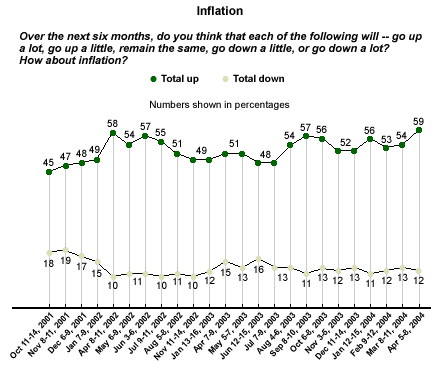
The April 5-8 Gallup Poll* shows that nearly 6 in 10 Americans (59%) expect inflation to go up over the next six months. This is the highest percentage of consumers saying they expect inflation to increase since Gallup began tracking expectations in October 2001. Roughly 1 in 10 consumers (12%) expect inflation to decline over the next six months.
They Also Expect Higher Interest Rates
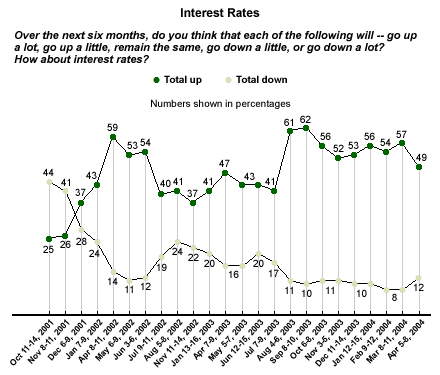
Nearly half of the nation's consumers expect interest rates to increase over the next six months. This percentage is down eight points from March, but almost double the percentage of Americans with this expectation in October 2001.
Higher Rates Could Do Damage
Today's strong economic growth, a booming housing market, better-than-expected March retail sales, and promising new job numbers combine to present a good case for higher interest rates. And while the University of Michigan preliminary consumer sentiment index is purported to have shown a marginal decline in early April, Gallup's consumer confidence numbers show just the opposite -- a slight increase.
The specter of higher interest rates in the months ahead would bring a whole new set of potential economic issues to the fore. For example, higher mortgage rates will not only bring the refinancing boom to a halt, but also could impact the new housing market. A lack of mortgage refinancing activity could reduce consumer spending because this has been a significant source of spending resources for households. Higher interest rates could also affect consumer borrowing, hurting auto sales, and increase business investment costs, reducing their magnitude.
Bottom Line
Given that the economy is growing at nearly a 5% rate, the deceleration caused by modestly higher interest rates wouldn't normally be much of a problem. It is important that the Fed maintain price stability, and sometimes this means that inflationary pressures associated with rapid economic growth need to be moderated.
But these are not normal times for the U.S. economy. It is not at all clear that the job market has actually started to create a significant number of new jobs. In fact, the past month's upturn in long-term rates may be offsetting the modest job gains currently taking place. With any luck, the Fed chairman will make it clear this week that the recent surge in inflationary expectations is premature, at least as far as the Fed's ability to influence interest rates is concerned.
*Results are based on telephone interviews with 1,014 national adults, aged 18 and older, conducted April 5-8, 2004. For results based on the total sample of national adults, one can say with 95% confidence that the margin of sampling error is ±3 percentage points.