Most observers expect the Federal Open Market Committee (FOMC) to leave interest rates unchanged when it meets Tuesday, but also to use its public statement to set the stage for a possible increase in rates later this summer or fall. Surging gas prices and last week's U.S. Department of Commerce report that inflation increased more than expected during the first quarter seem to support this expectation.
On the other hand, the Commerce Department also reported that the economy grew at only a 4.2% annual rate in the first quarter -- slower than expected and matching the growth of the fourth quarter of 2003 (4.1%). In addition, the University of Michigan reported that its Consumer Sentiment Index fell in April, further confirming the continued decline in the UBS/Gallup Index of Investor Optimism* reported earlier last week.
As the nation's defender of price stability, should the FOMC encourage higher interest rates? Is the economy expanding so rapidly that it is creating inflationary pressures and thus needs to slow? How the members of the FOMC answer these questions depends on whose perceptions of the current economic expansion they feel are most important.
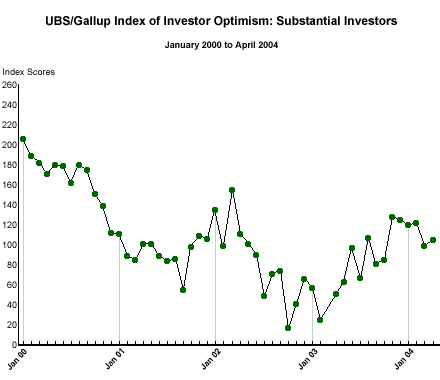
Substantial Investors Are Slightly More Optimistic
Although the overall UBS/Gallup Index of Investor Optimism fell 12 points in April, the Index actually increased slightly among "substantial" investors -- those with $100,000 or more of investable assets. Among substantial investors, the Index rose six points in April to 104 -- 31 points higher than the Index score for investors overall (73). Among substantial investors, the Index is now more than twice as high as it was a year ago (50).
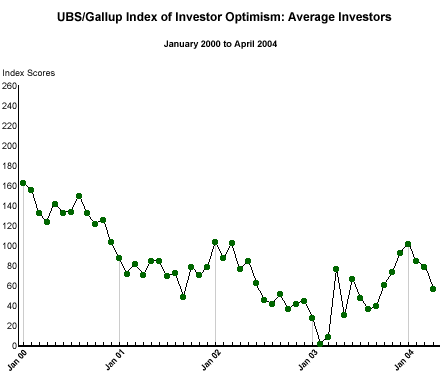
Average Investors Are Less Optimistic
In sharp contrast to the increase in optimism among substantial investors, among average investors -- those with between $10,000 and $100,000 in investable assets -- optimism fell 22 points. The Index among average investors now stands at 56 -- 17 points below the overall Index and 20 points below its April 2003 level of 76. Among average investors, optimism is currently about half that of substantial investors'.
Two Perspectives on the Economy
If the FOMC adopts an economic view similar to that of substantial investors, then higher interest rates make sense. The economy continues to expand at a good pace; growth will probably be revised upward from the initial Commerce Department report. The equity and housing markets are doing well, and rising commodity prices are driving up the inflation rate.
On the other hand, average investors and other consumers see different economy. Even after the strong March jobs report, they fear for their jobs. They don't see their incomes increasing significantly, and the prices of essentials are going up. The real purchasing power of these middle-income Americans is being squeezed. From the average investor's perspective, higher interest rates do not make much sense.
Bottom Line
My guess is that as the FOMC members study the economic numbers, they will tend to see the same economy as substantial investors and most economists currently do -- particularly if they anticipate another good jobs report this Friday. In turn, they will see inflation as a growing danger, if not a greater threat than slower economic growth. However, increasing interest rates in the current economic environment could end up producing stagflation (minimal growth with higher inflation and unemployment) -- one of the worst possible economic outcomes.
*Results for the Index of Investor Optimism -- U.S. are based on telephone interviews with a randomly selected U.S. sample of 802 adult investors, aged 18 and older, with at least $10,000 of investable assets, conducted April 1-18, 2004. For results based on these samples, one can say with 95% confidence that the maximum error attributable to sampling and other random effects is ±4 percentage points. In addition to sampling error, question wording and practical difficulties in conducting surveys can introduce error or bias into the findings of public opinion polls.