GALLUP NEWS SERVICE
PRINCETON, NJ -- Democratic presidential candidate John Kerry recommended last week that the 9/11 Commission, the bipartisan panel charged with investigating the Sept. 11 terrorist attacks, be extended for 18 months while its recommendations are reviewed and implemented. Kerry said the extension would enable the commission to deliver periodic status reports on the implementation of its recommendations. The most recent CNN/USA Today/Gallup poll finds that a majority of Americans endorse extending the commission's work. In a week when the Senate and House are conducting hearings on the commission's recommendations, the poll finds that Americans also say that the government should take the time necessary to adequately review the commission's findings before implementing changes.
Americans are confident that both Kerry and President George W. Bush can protect citizens from future terrorist attacks, but when given the choice between the two candidates, most say Bush would better handle terrorism. Recent polling also shows a slight increase in the number of Americans saying terrorist attacks are likely in the near future, and less optimism about the war against terrorism.
Public Endorses Extension of the 9/11 Commission
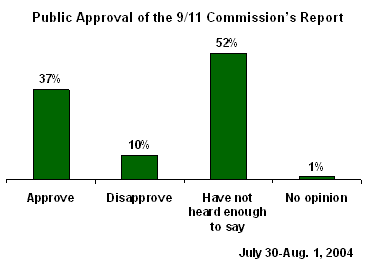
The poll, conducted July 30-Aug. 1, finds that a slight majority of Americans, 52%, say they have not heard enough about the 9/11 report to be able to evaluate it. Among those who do have an opinion, many more Americans approve (37%) of the recent report than disapprove of it (10%).
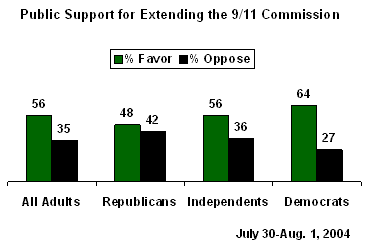
After the release of the commission's report, Kerry (among others) voiced support for extending the commission's work for another 18 months. When asked about the possibility of extending the commission's work, 56% of Americans support the idea, while 35% oppose it.
There are definite partisan differences on this question, perhaps because Bush has yet to endorse the extension of the commission. More than 6 in 10 Democrats (64%) support the extension, while 27% oppose it. Republicans are more divided: 48% support the extension and 42% oppose it.
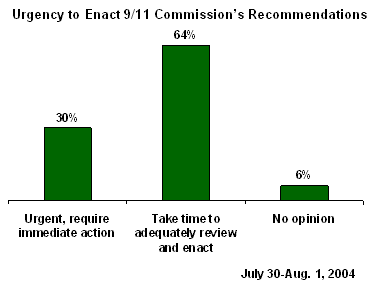
Despite the evident sense of urgency with which Congress is considering the commission's recommendations, the American public appears to be somewhat more cautious about speedy implementation. Sixty-four percent of Americans say the recommendations are "important, but Congress and the president should take the time they feel they need to adequately review and enact them," while 30% say the recommendations "require urgent action and Congress and the president should enact them immediately."
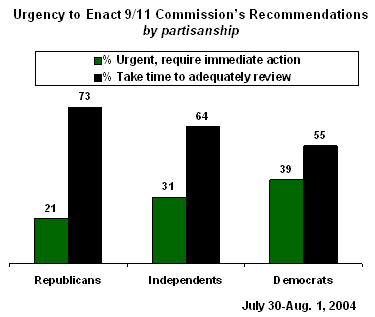
Republicans tend to be somewhat more cautious than Democrats are on the timetable for implementing the commission's proposals. More than 7 in 10 Republicans, 73%, say the president and Congress should take the time necessary to adequately review the recommendations, while 21% say immediate action is necessary. Among Democrats, 55% prefer time to adequately review the commission's proposals, while 39% say the government should take immediate action.
Public Confident in Bush, Kerry to Protect Americans From Terrorism
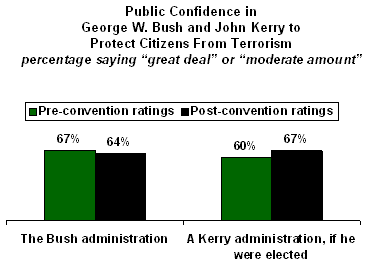
Americans tell Gallup that they are confident in both the Bush administration and a hypothetical Kerry administration to protect citizens from future acts of terrorism. Sixty-four percent of Americans say they have a great deal (31%) or a moderate amount (33%) of confidence in the Bush administration to protect the nation from terrorism. This is little changed from mid-July.
Nearly the same percentage of Americans, 67%, express a great deal (30%) or a moderate amount (37%) of confidence in a theoretical Kerry administration to protect U.S. citizens from terrorism. Confidence in Kerry on terrorism increased slightly after the Democratic convention; 60% of Americans said they were confident before the convention.
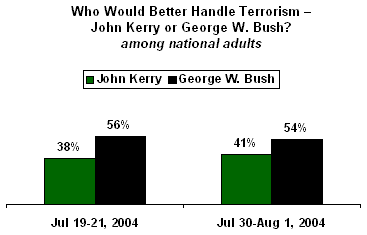
While the public is confident that both candidates would protect citizens from terrorism, when given a choice between the two candidates on who would do the better job of handling terrorism, Americans pick Bush over Kerry by 54% to 41%. The current results show little substantial change on this measure throughout 2004; this has generally been Bush's most significant perceived strength since the Sept. 11 terrorist attacks.
Among Americans, Likelihood of Attacks Up, Optimism for Fight Against Terror Down
Prior to the recent government alerts that terrorists may be targeting several financial institutions in New York, New Jersey, and Washington, D.C., Gallup asked Americans several questions about the war on terrorism. The results generally show that the majority of Americans say that it is at least somewhat likely that terrorist attacks will occur in the near future, and they have become less optimistic about the progress being made in the fight against terrorism.
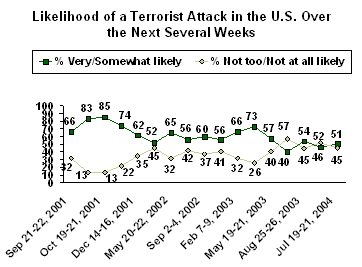
The results, taken from a July 19-21 survey, show that a slim majority of Americans, 51%, say it is at least somewhat likely that a terrorist attack will occur over the next several weeks, while 45% say it is not too or not at all likely. These results show a five-point increase in the percentage saying very or somewhat likely since January, when 46% felt this way. The results on this question, based on a year-by-year average, show that this year's ratings are lower than they have been in the nearly three years since the Sept. 11 terrorist attacks. In 2001, 74% of Americans, on average, said a terrorist attack was very or somewhat likely to occur, while in 2002 and 2003, an average of 58% said it was likely.
When asked about the likelihood of a terrorist attack around November's presidential election, more Americans think an attack is likely then than think one will occur in the next few weeks. About 6 in 10 Americans say it is very (14%) or somewhat (44%) likely that there will be "a major terrorist attack in the United States before the presidential election or on Election Day itself." Thirty-seven percent say a major attack around the election is not too (28%) or not at all (9%) likely.
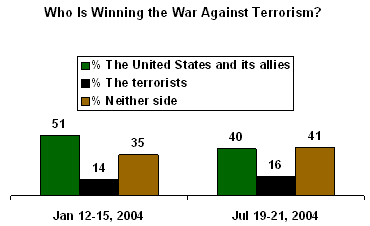
The July 19-21 poll also shows Americans are somewhat less optimistic than they were in January about who is winning the war on terrorism. Now, 40% say the United States and its allies are winning, while 16% say the terrorists and 41% say neither side. In January, a slim majority (51%) said the United States and its allies were winning, while 14% said the terrorists and 35% said neither side.
That poll also found that 55% of Americans are at least somewhat satisfied with the way things are going for the United States in the war against terrorism, while 44% are not too or not at all satisfied. These results represent a decline in satisfaction since September 2003, when a similar poll found 66% of Americans satisfied with the progress of the war against terrorism, and only 33% dissatisfied.
Survey Methods
These results are based on telephone interviews with a randomly selected national sample of 1,518 adults, aged 18 and older, conducted July 30-Aug. 1, 2004. For results based on this sample, one can say with 95% confidence that the maximum error attributable to sampling and other random effects is ±3 percentage points. In addition to sampling error, question wording and practical difficulties in conducting surveys can introduce error or bias into the findings of public opinion polls.