GALLUP NEWS SERVICE
PRINCETON, NJ -- Three years ago, terrorist hijackers brought down the World Trade Center towers, crashed into the Pentagon, and would have directed a fourth airplane at a target in Washington, D.C., if not for the plane's heroic passengers. These attacks did much more than damage buildings and end thousands of lives; they shocked Americans into consciousness of terrorism as a real and present danger to their personal safety.
In an immediate reaction poll conducted the same night of the terrorist attacks, Gallup found a high level of Americans -- 58% -- saying they were worried that they or someone in their families would become victims of terrorism. Other polling around that period recorded profound sadness among the public, even symptoms of depression, as people grappled with the horror of the attacks. Concern about flying on commercial airlines ran high.
One thing the attacks did not do was convince Americans that their way of life was irreversibly changed. On the night of Sept. 11, only half the public expected that events that day would permanently alter the way Americans live. Six months later, in March 2002, only 55% perceived that the American way of life had indeed changed; 44% disagreed. Even fewer Americans -- just 25% -- said that they personally had changed the way they live because of the attacks.
Those figures are similar today. According to the latest CNN/USA Today/Gallup poll, conducted Sept. 3-5, Americans are about evenly divided over whether their fellow citizens have permanently changed the way they live: 52% say they have, while 46% say they have not. Only 23% report that they, personally, have changed their lifestyles as a result.
Fear Levels Down, but Not Back to "Normal"
In the three years since 9/11, Gallup polling has documented a general return to normalcy in the public's mood, including a decline in public fear about terrorism. However, fear of terrorism has not completely reverted to the pre-9/11 level.
Public fear of terrorism quickly fell over the first two months after 9/11, dropping from 59% in October 2001 to 35% by late November. However, since then, this fear has tended to fluctuate a great deal, with the percentage worried ranging from 28% to 48%. The current 43%, recorded Sept. 3-5, is on the high side of the post-9/11 range of concern. Indeed, fear rose significantly just in the past month, climbing from 34% in mid-August.
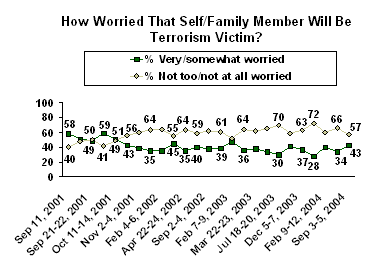
At no time over the past three years, however, has public fear of terrorism been as low as it was in the last survey on this topic that Gallup conducted before 9/11. That survey, conducted in April 2000, found just 24% of Americans very or somewhat worried about becoming a victim of terrorism similar to the 1995 Oklahoma City bombing. The peak level of public concern about this form of terrorism was recorded shortly after that bombing, when 42% were worried. (In fact, most of Gallup's poll questions on terrorism from 1995-2000 were asked in the context of that domestic terrorist event.)
A possible explanation for the recent increase in public concern about terrorism is the heavy attention given to the issue at the Republican National Convention in late August. However, the rise in concern between the mid-August and early September polls was seen evenly across Republicans, independents, and Democrats. Given this, a more likely reason for the spike in concern is the terrorist hostage crisis at a school in southern Russia, which ended in horrific bloodshed on the same day the September poll began.
Rating the War on Terrorism
Despite the United States' failure, thus far, to capture the
architect of the 9/11 attacks, al Qaeda leader Osama bin Laden,
Americans today are generally positive when asked about the
likelihood that he will be captured, and about the success of the
war on terrorism more generally.
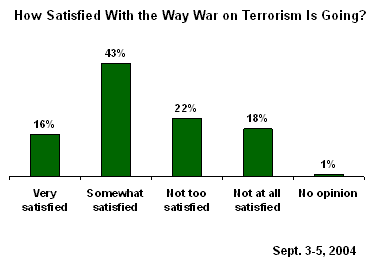
While few people are willing to say they are " very satisfied" with how things are going for the United States in the war on terrorism, the majority (59%) are at least somewhat satisfied. Only 40% are generally not satisfied. This attitude has been largely stable over the past year and a half.
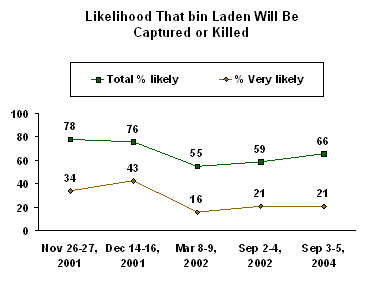
Americans also remain optimistic that bin Laden will eventually be captured or killed. While only one in five believe this is very likely, another 45% consider it somewhat likely. Only 31% perceive it as unlikely. Americans were initially much more optimistic about capturing bin Laden -- particularly after the United States successfully removed the Taliban regime from power in Afghanistan in December 2001. However, after declining in 2002, expectations about capturing bin Laden have since rebounded somewhat.
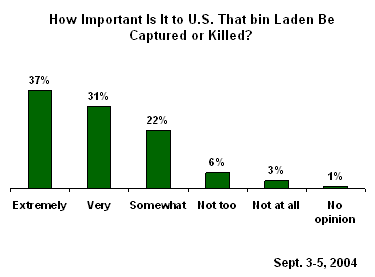
A new question in the latest poll finds Americans highly mixed on the importance of capturing bin Laden. Nearly 4 in 10 believe his capture is extremely important; about a third say it is very important, while about a quarter say it is only somewhat important. Another 9% attach little or no importance to his capture.
Partisanship of Attitudes
Satisfaction with the war on terrorism is highly related to the political party with which one identifies. The vast majority of Republicans (87%) say they are satisfied with the way things are going in the war on terrorism. This contrasts with 55% of independents and just 33% of Democrats.
Predictions about the likelihood that bin Laden will be captured are less partisan. A solid majority of all three political groups believes this is at least somewhat likely. Majorities of each group also say it is important that this be accomplished -- although Republicans (48%) are more likely than independents (25%) and Democrats (36%) to say it is extremely important.
Survey Methods
These results are based on telephone interviews with a randomly selected national sample of 1,018 adults, aged 18 and older, conducted Sept. 3-5, 2004. For results based on this sample, one can say with 95% confidence that the maximum error attributable to sampling and other random effects is ±3 percentage points. In addition to sampling error, question wording and practical difficulties in conducting surveys can introduce error or bias into the findings of public opinion polls.
20. Turning to something else, how worried are you that you or someone in your family will become a victim of terrorism -- very worried, somewhat worried, not too worried, or not worried at all?
BASED ON –488—NATIONAL ADULTS IN FORM A
|
|
|
Some-what worried |
|
Not |
KNOW A VICTIM (vol.) |
|
|
|
|
% |
% |
% |
% |
% |
% |
|
|
2004 Sep 3-5 ^ |
11 |
32 |
36 |
21 |
-- |
* |
|
|
|
|
|
|
|
|
|
|
|
2004 Aug 9-11 ^ |
8 |
26 |
36 |
30 |
-- |
* |
|
|
2004 Feb 9-12 |
10 |
30 |
36 |
24 |
* |
* |
|
|
2004 Jan 2-5 |
5 |
23 |
42 |
30 |
* |
* |
|
|
2003 Dec 5-7 |
9 |
28 |
38 |
25 |
* |
* |
|
|
2003 Aug 25-26 |
11 |
30 |
33 |
26 |
* |
-- |
|
|
2003 Jul 18-20 ^ |
6 |
24 |
38 |
32 |
* |
* |
|
|
2003 Apr 22-23 ^ |
8 |
26 |
39 |
26 |
* |
1 |
|
|
2003 Mar 22-23 |
8 |
30 |
38 |
24 |
-- |
* |
|
|
2003 Feb 17-19 |
8 |
28 |
33 |
31 |
* |
-- |
|
|
2003 Feb 7-9 ^ |
13 |
35 |
34 |
18 |
* |
* |
|
|
2003 Jan 23-25 |
8 |
31 |
36 |
25 |
-- |
* |
|
|
2002 Sep 2-4 |
8 |
30 |
37 |
25 |
* |
* |
|
|
2002 May 28-29 |
9 |
31 |
37 |
22 |
1 |
* |
|
|
2002 Apr 22-24 |
8 |
27 |
39 |
25 |
1 |
* |
|
|
2002 Mar 4-7 |
12 |
33 |
32 |
23 |
* |
* |
|
|
2002 Feb 4-6 ^ |
8 |
27 |
39 |
25 |
-- |
1 |
|
|
2001 Nov 26-27 |
8 |
27 |
34 |
30 |
1 |
* |
|
|
2001 Nov 2-4 |
11 |
28 |
34 |
26 |
-- |
1 |
|
|
2001 Oct 19-21 † |
13 |
30 |
33 |
23 |
* |
1 |
|
|
2001 Oct 11-14 † |
18 |
33 |
35 |
14 |
* |
* |
|
|
2001 Oct 5-6 † |
24 |
35 |
27 |
14 |
* |
* |
|
|
2001 Sep 21-22 † |
14 |
35 |
32 |
18 |
* |
1 |
|
|
2001 Sep 14-15 † |
18 |
33 |
35 |
13 |
* |
1 |
|
|
2001 Sep 11 † ‡ |
23 |
35 |
24 |
16 |
1 |
1 |
|
|
2000 Apr 7-9 ^♣ |
4 |
20 |
41 |
34 |
-- |
1 |
|
|
1998 Aug 20 ‡ |
10 |
22 |
38 |
29 |
-- |
1 |
|
|
1996 Jul 20-21 ‡♠ |
13 |
26 |
34 |
27 |
-- |
* |
|
|
1996 Apr 9-10 ♣ |
13 |
22 |
33 |
32 |
-- |
* |
|
|
1995 Apr 21-23 ♣ |
14 |
28 |
33 |
24 |
-- |
1 |
|
|
|
|
|
|
|
|
|
|
|
^ |
Asked of a half sample. |
||||||
|
† |
WORDING: How worried are you that you or someone in your family will become a victim of a terrorist attack -- very worried, somewhat worried, not too worried, or not worried at all? |
||||||
|
‡ |
Based on one night poll of national adults with a margin of error of ±4 pct. pts. |
||||||
|
♠ |
WORDING: How worried are you that someone in your family will become a victim of a terrorist attack -- very worried, somewhat worried, not too worried, or not worried at all? |
||||||
|
♣ |
WORDING: How worried are you that you or someone in your family will become a victim of a terrorist attack similar to the bombing in Oklahoma City? |
||||||
21. How satisfied are you with the way things are going for the U.S. in the war on terrorism -- very satisfied, somewhat satisfied, not too satisfied, or not at all satisfied?
BASED ON –530—NATIONAL ADULTS IN FORM B
|
|
Very |
Somewhat |
Not too |
Not at all |
No |
|
|
|
% |
% |
% |
% |
% |
|
|
2004 Sep 3-5 ^ |
16 |
43 |
22 |
18 |
1 |
|
|
|
|
|
|
|
|
|
|
2004 Aug 9-11 ^ |
14 |
42 |
24 |
19 |
1 |
|
|
2004 Jul 19-21 ^ |
15 |
40 |
21 |
23 |
1 |
|
|
2003 Sep 8-10 |
14 |
52 |
21 |
12 |
1 |
|
|
2003 Jan 31-Feb 2 ^ |
18 |
45 |
21 |
15 |
1 |
|
|
2002 Sep 2-4 |
14 |
61 |
18 |
6 |
1 |
|
|
|
||||||
|
^ |
Asked of a half sample. |
|||||
22. As a result of the September 11th terrorist attacks, do you think Americans have permanently changed the way they live, or not?
BASED ON –488—NATIONAL ADULTS IN FORM A
|
|
Yes, changed |
No, have not |
No opinion |
|
|
|
% |
% |
% |
|
|
2004 Sep 3-5 |
52 |
46 |
2 |
|
|
|
|
|
|
|
|
2002 Sep 2-4 |
54 |
45 |
1 |
|
|
2002 Mar 8-9 |
55 |
44 |
1 |
|
|
2001 Sep 11 ^ |
49 |
45 |
6 |
|
|
|
|
|
|
|
|
^ |
WORDING: As a result of today's attacks, do you think Americans will permanently change the way they live, or not? |
|||
23. As a result of the September 11th terrorist attacks, have you permanently changed the way you live, or not?
BASED ON –530—NATIONAL ADULTS IN FORM B
|
|
Yes, changed |
No, have not |
No opinion |
|
|
% |
% |
% |
|
2004 Sep 3-5 |
23 |
77 |
* |
|
|
|
|
|
|
2002 Sep 2-4 |
18 |
82 |
* |
|
2002 Mar 8-9 |
25 |
75 |
0 |
24. Thinking about the likelihood of terrorist attacks against the U.S., do you think – [ROTATED: the chances of terrorist attacks will be less if John Kerry is elected president, the chances of terrorist attacks will be less if George W. Bush is re-elected president] or the outcome of the presidential election this year will not have any effect on the chances of additional terrorist attacks in the next four years?
|
|
|
|
Election outcome have no effect |
|
|
|
|
|
|
|
|
|
|
2004 Sep 3-5 |
16% |
31 |
49 |
4 |
|
|
|
|
|
|
|
|
|
2004 Aug 23-25 ^ |
20% |
23 |
53 |
4 |
|
|
|
|
|
|
|
|
|
^ |
Asked of a half sample. |
||||
Q.25-26 SPLIT SAMPLED
25. How likely is it that the U.S. will be able to capture or kill Osama bin Laden-- very likely, somewhat likely, not too likely, or not at all likely?
BASED ON –488—NATIONAL ADULTS IN FORM A
|
|
|
Some-what |
|
|
ALREADY DEAD (vol.) |
|
|
|
|
% |
% |
% |
% |
% |
% |
|
|
2004 Sep 3-5 ^ |
21 |
45 |
20 |
11 |
1 |
2 |
|
|
|
|
|
|
|
|
|
|
|
2002 Sep 2-4 |
21 |
38 |
26 |
10 |
2 |
3 |
|
|
2002 Mar 8-9 |
16 |
39 |
29 |
13 |
-- |
3 |
|
|
2001 Dec 14-16 |
43 |
33 |
16 |
6 |
-- |
2 |
|
|
2001 Nov 26-27 |
34 |
44 |
15 |
6 |
-- |
1 |
|
|
|
|
|
|
|
|
|
|
|
^ |
Asked of a half sample. |
||||||
26. How important do you think it is to the U.S. that Osama bin Laden be captured or killed – extremely important, very important, somewhat important, not too important, or not at all important?
BASED ON –530—NATIONAL ADULTS IN FORM B
|
|
|
|
Some-what |
Not |
Not |
No |
|
|
|
|
|
|
|
|
|
2004 Sep 3-5 |
37% |
31 |
22 |
6 |
3 |
1 |