As the most popular month for weddings draws to a close, many newlyweds may be facing some hefty bills as they return from their honeymoons and settle into everyday life together. A survey released last month by the Fairchild Bridal Group indicates the average cost of a wedding in the United States has ballooned to more than $26,000 (a 73% increase from 15 years ago), and significantly more couples than 15 years ago are personally footing the bill for their weddings.
A recent Gallup Poll Panel survey* asked Americans to weigh in on the amount of money pouring into the wedding industry, and the consensus is clear -- 87% of respondents said they feel people generally spend too much on weddings. Just 12% said people tend to spend the right amount of money on their weddings, and a scant 1% said not enough money is spent.

How much is too much? Christina Clemente, a 30-year-old bride-to-be from New Jersey who is planning a wedding for nearly 400 guests, can answer that question all too easily. "We're spending far, far too much money [on our wedding]," she says, "My fiancé and I are $40,000 above our budget." When all is said and done, Clemente estimates her family will spend a staggering $100,000 on her wedding in August.
Most People Think They Spent the "Right Amount"
Spending tens of thousands of dollars on one day may seem unthinkable to some, but Clemente isn't alone. Twenty-six-year-old Tanya Canup tied the knot in front of 105 guests on April 2 in New Orleans to the tune of $60,500. Nevertheless, Canup says her parents spent the right amount of money. "I was able to incorporate everything I wanted into the wedding."
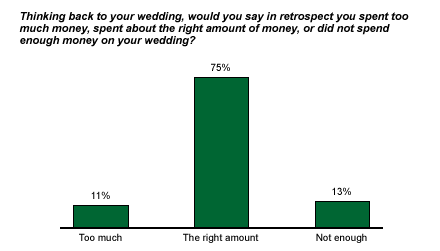
Despite the high percentage who said most people spend too much, 75% of respondents who have been married** said they, themselves, spent about the right amount on their own weddings. Eleven percent said they spent too much and 13% said they didn't shell out enough. The data suggest younger people are more likely than older people to feel they spent too much on their weddings, which reinforces the Fairchild Bridal Group finding that wedding costs have increased significantly in recent years.
Emily Smith, 26, who was married at her parents' home in North Carolina last September, feels she and her family spent the right amount of money on her wedding -- about $14,000. "We looked for ways to make smart choices and spent money where we thought it was important (photography, etc.)," says Smith. In general, Smith feels other people spend "way too much money" on weddings.
Tracey Hanson, 32, agrees. She paid $9,000 for her 75-guest wedding in Wisconsin last August. "I agree that you want the day to be special and meaningful but that doesn't mean going into debt," Hanson says. She and her husband paid for their wedding themselves in cash, and she feels they "did not go overboard."
What Size Wedding to Have?
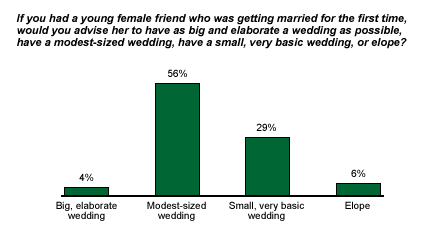
The terms "big wedding" or "small wedding" mean different things to different people; some might consider 100 guests to be "small" or "modest," while others might see this as a large wedding. Gallup asked panel respondents what size wedding they would recommend if they had a young female friend preparing to get married. The majority (56%) would suggest a "modest-sized" wedding, while 29% would recommend a "small, very basic" wedding. Only 4% favor a "big, elaborate" wedding, and 6% would advise their friend to escape the hubbub altogether and elope.
Bottom Line
What advice would recent brides give to those planning a wedding? The same theme recurs: Remember the wedding day is far less important than the marriage. "Keep in mind that you're planning a marriage, not a wedding -- and those are two very different things," Smith says. "Worried about whether your chair covers match the napkins? It doesn't matter … Oh, and you don't need nearly as much cake as the caterer tells you."
*These results are based on telephone interviews with a randomly selected national sample of 1,000 adults in the Gallup Poll Panel of households, aged 18 and older, conducted March 1 to March 22, 2005. For results based on this sample, one can say with 95% confidence that the maximum error attributable to sampling and other random effects is ±3 percentage points. In addition to sampling error, question wording and practical difficulties in conducting surveys can introduce error or bias into the findings of public opinion polls.
**These results are based on telephone interviews with 827 adults in the Gallup Poll Panel of households who have been married, conducted March 1 to March 22, 2005. For results based on this sample, one can say with 95% confidence that the maximum error attributable to sampling and other random effects is ±4 percentage points.