GALLUP NEWS SERVICE
PRINCETON, NJ -- Gallup's late October economic update shows little change in Americans' expressed worry about their families' financial situations. The three biggest money problems bedeviling the public at this point are energy costs, healthcare costs, and simply not having enough money. Americans' estimates of how much they are going to spend on clothing and dining out are lower now than they have been at previous points this year, suggesting at least the possibility of a pullback in discretionary spending in the face of higher gas prices.
Worried About Your Family's Finances?
About 4 in 10 Americans say they are worried about their families' personal financial situations.
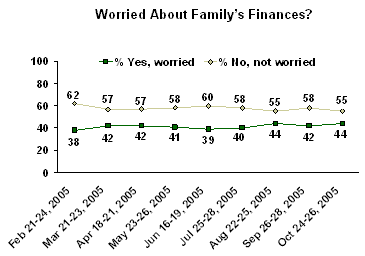
Expressed personal concern about family finances has remained remarkably stable so far this year. The average from February to October this year is 41%, with no one month's reading more than three percentage points above or below that average.
Over the last three months, the percentage expressing concern has averaged 43%, which is slightly higher than the year's average, but it is too soon to tell whether that represents any sort of trend toward more concern.
Those who say they are worried about their family finances are asked whether they are very worried or somewhat worried.
At this time, would you say you are worried about your family's finances, or not?
Are you very worried, or just somewhat worried?
COMBINED RESPONSES
|
Very |
Somewhat |
Not |
No |
|
|
% |
% |
% |
% |
|
|
2005 Oct 24-26 |
19 |
25 |
55 |
1 |
|
|
|
|
|
|
|
2005 Sep 26-28 |
18 |
24 |
58 |
* |
|
2005 Aug 22-25 |
17 |
27 |
55 |
1 |
|
2005 Jul 25-28 |
15 |
25 |
58 |
2 |
|
2005 Jun 16-19 |
14 |
25 |
60 |
1 |
|
2005 May 23-26 |
15 |
26 |
58 |
1 |
|
2005 Apr 18-21 |
18 |
24 |
57 |
1 |
|
2005 Mar 21-23 |
18 |
24 |
57 |
1 |
|
2005 Feb 21-24 |
17 |
21 |
62 |
* |
We do not detect any increase in the percentage of Americans saying they are "very worried" this year. The percentage "very worried" was slightly lower in May through July (averaging 15%), but over the past three months it is at a point very similar to where it was in February through April (averaging 18%).
This absence of any significant increase in expressed concern about family finances contrasts with changes in real economic conditions over the past nine months, including in particular the rapid increase in gas prices in August that lasted into September.
Family Financial Problems
Each month, Gallup asks Americans in an open-ended format to detail their families' most pressing financial problems.
What is the most important financial problem facing your family today? [OPEN-ENDED]
Recent Trend:
|
Oct |
Sep |
Aug |
Jul |
Jun |
May |
|
|
% |
% |
% |
% |
% |
% |
|
|
Energy costs/Oil and gas prices |
17 |
17 |
20 |
8 |
7 |
5 |
|
Healthcare costs |
12 |
11 |
10 |
13 |
17 |
18 |
|
Lack of money/Low wages |
11 |
10 |
11 |
11 |
12 |
12 |
|
Too much debt/Not enough money to pay debts |
7 |
8 |
6 |
7 |
6 |
8 |
|
Unemployment/Loss of job |
6 |
6 |
7 |
8 |
7 |
8 |
|
High cost of living/Inflation |
6 |
7 |
6 |
6 |
8 |
5 |
|
College expenses |
6 |
7 |
6 |
7 |
7 |
8 |
|
Cost of owning/renting a home |
5 |
5 |
3 |
4 |
6 |
6 |
|
Retirement savings |
4 |
3 |
5 |
6 |
6 |
9 |
|
Taxes |
4 |
4 |
3 |
4 |
3 |
3 |
|
State of the economy |
2 |
1 |
* |
1 |
1 |
-- |
|
Transportation/Commuting costs |
1 |
1 |
1 |
1 |
2 |
-- |
|
Social Security |
1 |
1 |
2 |
1 |
2 |
2 |
|
Stock market/Investments |
1 |
* |
1 |
1 |
1 |
-- |
|
Interest rates |
1 |
1 |
1 |
1 |
1 |
1 |
|
Lack of savings |
1 |
1 |
1 |
1 |
2 |
-- |
|
Controlling spending |
* |
* |
1 |
1 |
1 |
-- |
|
|
|
|
|
|
|
|
|
Other |
3 |
4 |
4 |
4 |
6 |
4 |
|
None |
16 |
18 |
16 |
17 |
16 |
16 |
|
No opinion |
3 |
4 |
5 |
5 |
3 |
4 |
|
Percentages add to more than 100% due to multiple responses. |
|
|
|
|||
|
Contact Gallup for full trend. |
|
|
|
|||
The big change in the responses to this question throughout this year has been the uptick in expressed worry about energy costs, which occurred in August and continued through October. Energy costs have been the top problem for the last three months.
Other concerns have remained relatively stable. Sizable percentages of Americans continue to worry about healthcare costs (12%) and simply not having enough money (11%). These are the second- and third-most frequently occurring responses, followed by a variety of problems in the 5% to 7% range, including too much debt, unemployment, inflation, college expenses, and the cost of owning or renting a home.
The graph presents the trend of family financial worry and the trend in the top-of-mind mention of energy costs as the top family concern.
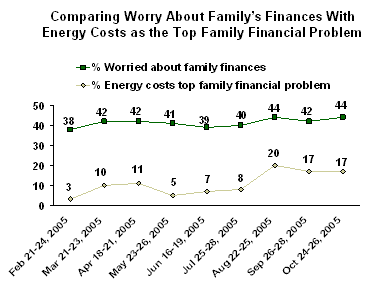
There is little evidence that the increase in concern about gas prices caused a concomitant jump in worry about one's personal family financial situation.
Estimated Spending
Gallup also asks Americans to estimate how much they and their families are going to spend "this month" in each of four categories: groceries, clothing, eating dinner at a restaurant, and entertainment/vacation travel/recreational activities.
There is some fluctuation in these estimates by month, but the differences between many months are not statistically significant. Nevertheless, there has been a slight drop off in estimated spending in two discretionary categories for the last month or two, suggesting the possibility that the toll being taken by higher energy costs may be reflected in slightly lower spending in other areas of the family budget.
Groceries
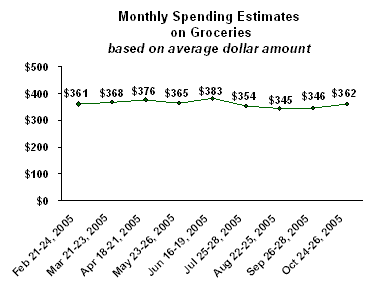
The average American family estimates spending $362 on groceries in October, little changed from the average estimates on grocery spending found in each month going back to February this year.
Although the actual dollar amount varies from survey to survey, there has been no systematic trend showing that planned spending on groceries is steadily getting larger, or smaller.
The lowest estimate of the year so far came in August ($345), while the highest was in June ($383).
Clothing
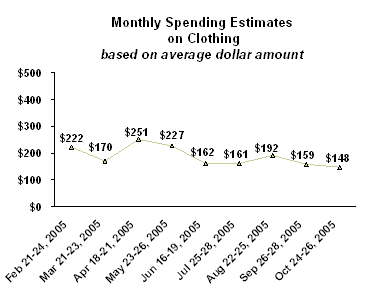
Spending on clothing might be considered somewhat more discretionary than other family expenditures and perhaps as a result Gallup surveys have measured more variation in these estimates from month to month this year.
Americans indicated in October that they would be spending $148 on average on clothing in the month. That is the lowest such estimate this year. The previous low points were three measures in and around $160 found in September, July, and June. The highest estimates for clothing spending came earlier this year, including an estimate of $251 in April.
Does this indicate a slowdown in spending on this key retail category going forward? It's difficult to know at this point, but these data suggest that some consideration be given to this hypothesis.
Eating Dinner Out at a Restaurant
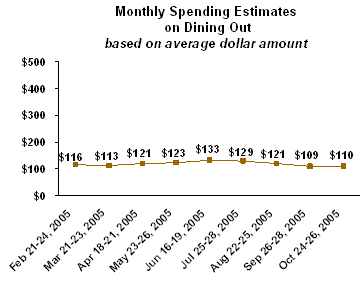
Estimates of monthly expenditures at restaurants have ranged from $109 to $133 this year.
The last two months have marked the lowest estimates measured so far this year: $109 in September and $110 in late October. The differences in these estimates by month are not great, and one should be appropriately hesitant to read too much into the slightly lower estimates.
Nevertheless, as was the case for the clothing estimates, the fact that the estimates have gone down suggests at least the possibility of some increased financial concern on the part of consumers, perhaps in the face of rising energy costs.
Entertainment, Vacation Travel, Recreational Activities
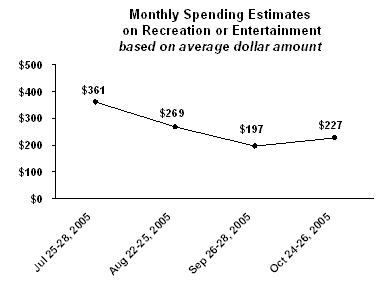
Gallup started measuring in this category in July, so there is only a four-month trend at this point.
The data show a significant drop in September ($197), with a slight recovery in October ($227) -- compared with the two summer months of July ($361) and August ($269). This is entirely predictable given the assumption that recreational and vacation spending should be higher in the summer months.
These results are based on telephone interviews with a randomly selected national sample of 840 U.S. adults, aged 18 and older, conducted Oct. 24-26, 2005. For results based on this sample, one can say with 95% confidence that the maximum error attributable to sampling and other random effects is ±4 percentage points. In addition to sampling error, question wording and practical difficulties in conducting surveys can introduce error or bias into the findings of public opinion polls.
