GALLUP NEWS SERVICE
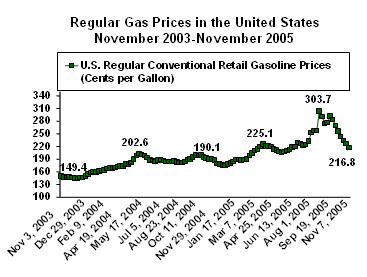
PRINCETON, NJ -- The price of a gallon of regular gas nationwide has dropped by $0.60, or about 20%, over the past two months. Also, in mid-November, Gallup's jobs measure reached its best level since measurement began in August 2001.
Still, while investor optimism is up from its post-Katrina low, it remains at very modest levels according to the November UBS/Gallup Index of Investor Optimism poll. Similarly, Gallup's measure of consumer confidence is up from its lows of the past two months, but remains weak.
Why aren't investors and consumers more optimistic given plunging gas prices and an improved jobs outlook? Are we simply seeing a response lag on the part of investors and consumers to recent improvements in their economic environment or are there other factors at play?
Gas Prices Are Plunging
A year ago, the average price of a gallon of regular gas across the United States was $1.90 according to the Energy Information Administration (EIA). Pump prices peaked at $3.04 in early September. Since then, prices have plunged $0.87 and now stand at $2.17 per gallon. Although the price of a gallon of gas is down about 20% in the last two months, it remains 25% higher than a year ago.
The Job Market Is Improving
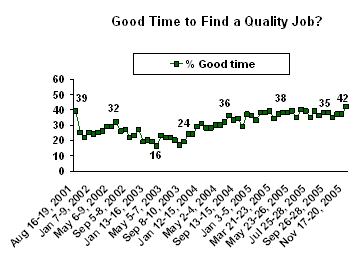
Gallup's Nov. 17-20 poll shows the percentage of Americans saying now is a good time to find a quality job reaching a new high of 42%. This is up from 35% in mid-October and 37% in late October and early November. Gallup began tracking job market conditions using this measure in August 2001.
Investor Optimism Is Up but Remains Weak
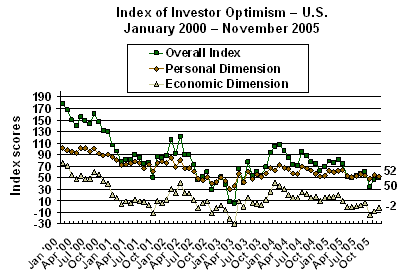
Despite plunging gas prices and improving job market conditions, investor optimism as measured by the UBS/Gallup Index remains essentially unchanged at 50 in November -- up only three points from October. This represents an improvement from the 34 registered in September, but remains below the August level of 61 and the year-ago level of 69.
The Personal Dimension is at 52 -- down from 55 in October and not much above the 48 of September. The Economic Dimension has improved over the past two months going from -14 in September to -8 in October, and -2 in November. This indicates that investors as a whole are no longer pessimistic about the economic outlook having become essentially neutral over the past two months.
Consumers Say Economic Conditions Are Better but Remain Weak
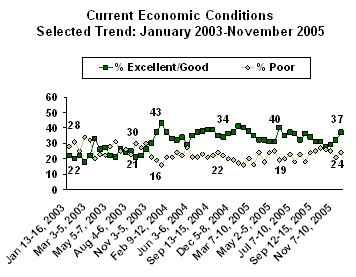
In Gallup's Nov. 17-20 poll of the general public, 37% of American consumers say current economic conditions are "good" or "excellent" while 24% say they are "poor." This positive difference of 13 percentage points is essentially the same as in early November's difference of 11 percentage points, but considerably better than the positive difference of only 4 percentage points in late October and 2 percentage points earlier that month. Still, it remains far below the positive 24-point difference of January.
More Consumers Still Say the Economy Is Getting Worse
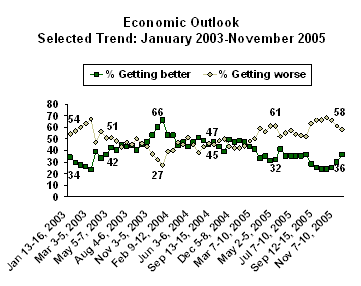
Only 36% of American consumers say economic conditions in the country as a whole are "getting better" right now compared with 58% who say they are "getting worse." This negative difference of 22 percentage points is an improvement over the negative 31-point difference of early November and the negative 41 to 42 points of September and October. Still, it is far below the positive difference of 6 percentage points in January of this year and November 2004.
The Majority of Investors Say the Economy Is in a Slowdown/Recession
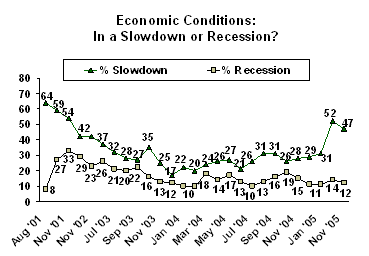
The UBS/Gallup poll shows more than half of U.S. investors say the current economy is in a slowdown (47%) or a recession (12%). On the other hand, only 40% say the economy is in a recovery (23%) or sustained expansion (17%). This is an improvement over October when 33% of investors said the economy was in a recovery or expansion, but far below the 57% in January who said the economy was in a recovery (42%) or sustained expansion (15%).
Uncertainty May Be Moderating Investor/Consumer Optimism
Even as gas prices plunge, 71% of investors say energy prices are hurting the investment climate a lot. This is down from 80% last month, but still on top of the list of 11 potential worries included in the most recent UBS/Gallup survey of investors.
One possible explanation for this comparatively modest drop in investor concerns relative to the plunge in gas prices is that the drop in pump prices has occurred so quickly that most investors have not fully adjusted to the magnitude of the gas price declines. And, even after these major price declines, gas prices at the pump remain significantly higher than they were a year ago. Another explanation might be that consumers continue to worry about and experience much higher natural gas and heating oil prices. For many consumers, these cost increases may more than offset the drop in gas prices as the pump -- particularly if we have a colder than normal winter.
The most likely explanation, however, may involve the volatility associated with gas prices at the pump over the past year. Gas prices surged past $3.00 a gallon in September, surprising everyone. Now, they have fallen much more than most observers expected over the past couple of months. What assurance do consumers have that a severe cold spell for several weeks or some other unexpected disruption to gas supplies won't occur in the next couple of months sending gas prices soaring once more?
Some may argue that such an uncertainty may be good if consumers continue to make decisions aimed at conserving existing gas supplies. Obviously, increased conservation is a plus for the current economy.
On the other hand, uncertainty and/or volatility often have a significant economic cost associated with it, particularly when it affects a consumer essential like energy. For example, data from the ShopperTrak, which monitors retail sales, reports that Black Friday (the day after Thanksgiving and traditionally the day retailers get into the black financially) sales were essentially flat compared to last year. This is consistent with Gallup's recent polls and the results of the latest UBS/Gallup investors poll. We may hear a lot more about the cost associated with energy price uncertainty in the months ahead if retailer sales and/or profits suffer significantly this holiday season.
Survey Methods
Results for the Index of Investor Optimism poll are based on telephone interviews with 801 investors, aged 18 and older, conducted Nov. 1-20, 2005. For results based on the total sample of investors, one can say with 95% confidence that the maximum margin of sampling error is ±4 percentage points.