GALLUP NEWS SERVICE
PRINCETON, NJ -- The American public is closely divided about whether it was right or wrong for the Bush administration to wiretap telephone conversations between Americans living the United States and suspected terrorists living abroad without obtaining a court order. Slightly more Americans side with the administration.
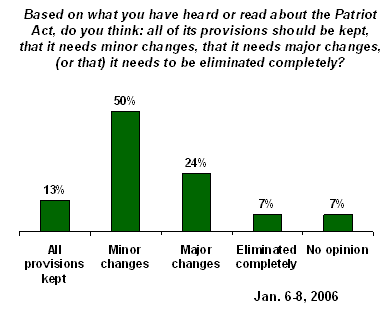
More generally, about 6 in 10 Americans seem comfortable with the current level of government intrusion on civil liberties as part of the war on terrorism. While only 13% of Americans think all provisions of the Patriot Act should be renewed, the strong majority of Americans believe the law needs only minor changes, at best. Slightly less than one-third would make major changes or eliminate the law completely. Fifty-nine percent of Americans say the administration has been about right or has not gone far enough in restricting people's civil liberties in order to combat terrorism. However, there has been a steady increase since 2002 in the percentage saying the administration has gone too far in this regard, now at a high of 38%.
Wiretapping Scandal
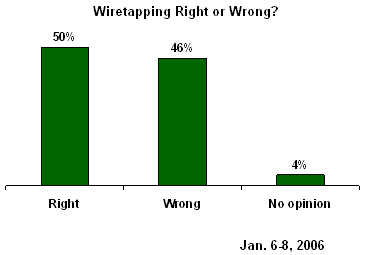
A CNN/USA Today/Gallup poll, conducted Jan. 6-8, finds that 50% of Americans say the Bush administration was right to wiretap telephone conversations without first obtaining a court order, while 46% say it was wrong to do so.
Nearly 3 in 10 Americans say they are following the wiretapping story very closely, and 46% say they are following it somewhat closely. Americans report paying more attention to this story than to the current Senate confirmation hearings for Supreme Court nominee Samuel Alito or to the current scandal involving lobbyist Jack Abramoff. But they are not paying as much attention to the wiretapping story as they did to the aftermath of Hurricane Katrina in 2005, the tsunami that struck parts of Asia in late 2004, or the beginning of the war in Iraq in 2003.
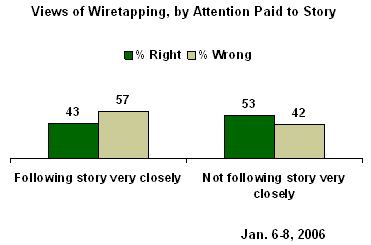
Public opinion about the way the Bush administration handled the wiretapping incidents is related to how closely people are following the story. Among those following the story very closely, 43% say the administration was right, while the majority, 57%, say it was wrong. Those not following the story that closely are more inclined to say the Bush administration was right, by a 53% to 42% margin.
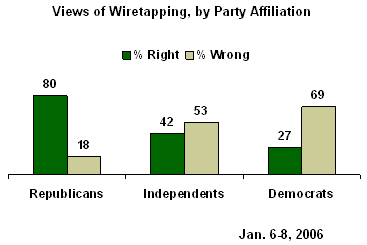
Partisanship also shapes views on this matter, with the vast majority of Republicans, 80%, saying the Bush administration was right to wiretap these conversations, and just 27% of Democrats sharing this point of view.
Bush Administration's Policies About Restricting Civil Liberties
The poll also asked Americans to assess whether the Bush administration has gone too far, has been about right, or has not gone far enough in restricting people's civil liberties in order to fight terrorism. Forty percent of Americans say the administration has been about right, while 38% say it has gone too far and 19% say it has not gone far enough.
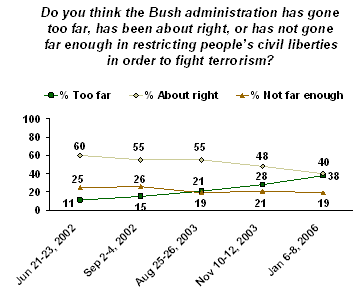
In June 2002, only 11% of Americans said the administration had gone too far in restricting civil liberties. By November 2003, this percentage had risen to 28%, and it is now 10 percentage points higher than that.
Republicans, perhaps not surprisingly, are less critical than are Democrats of the Bush administration's policy of restricting civil liberties to fight terrorism.
|
Bush Administration Policies in Restricting Civil Liberties to Fight Terrorism |
|||
|
Too far |
About right |
Not far enough |
|
|
% |
% |
% |
|
|
Republicans |
10 |
64 |
22 |
|
Independents |
43 |
34 |
19 |
|
Democrats |
64 |
19 |
14 |
Only 10% of Republicans say the Bush administration has gone too far in restricting civil liberties, while the majority (64%) say it has been about right and 22% say it has not gone far enough. This compares with nearly two in three Democrats (64%) who say the administration has gone too far, 19% who say about right, and 14% who say not far enough.
Patriot Act
The Patriot Act is set to expire in early February, unless Congress once again extends it. But what do Americans think should happen to the Patriot Act? The current poll finds that fewer than one in six Americans, 13%, say all of the provisions of the Patriot Act should be kept, and an additional 50% say the act needs minor revisions. Just under a third of Americans are more critical of the Patriot Act, with 24% saying it needs major changes and 7% saying it should be eliminated completely.
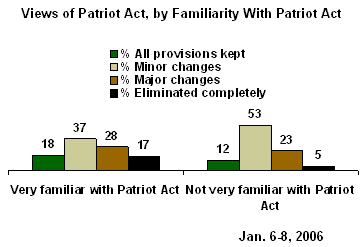
Americans who describe themselves as "very familiar" with the Patriot Act tend to be more likely than those who are not that familiar with it to say it needs major changes or should be eliminated completely, although both groups tend to favor minor changes, if any.
Among those very familiar with the law, 55% say the law should be kept intact or needs only minor changes, while 45% believe it needs major changes or should be eliminated completely. Among those who are not as familiar with the act, 65% say it should be kept in its present form or with minor changes, and just 28% say it needs major changes or should be eliminated altogether.
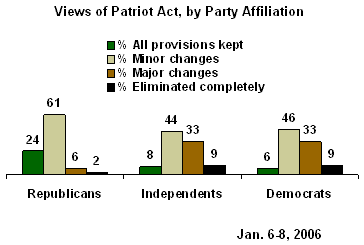
Republicans are much more positive than Democrats in their responses to this question. More than 8 in 10 Republicans say the Patriot Act should be renewed as it is or with only minor changes, while 8% say it needs major changes or should be eliminated altogether. This compares with a slight majority of Democrats, 52%, who say the law should be kept intact or with minor changes, and 42% who say it needs major changes or should be eliminated completely.
Survey Methods
Results are based on telephone interviews with 1,003 national adults, aged 18 and older, conducted Jan. 6-8, 2006. For results based on the total sample of national adults, one can say with 95% confidence that the margin of sampling error is ±3 percentage points. In addition to sampling error, question wording and practical difficulties in conducting surveys can introduce error or bias into the findings of public opinion polls.
11. Do you think the Bush administration -- [ROTATED: has gone too far, has been about right, or has not gone far enough] -- in restricting people's civil liberties in order to fight terrorism]?
|
|
Too far |
About |
Not |
No |
|
% |
% |
% |
% |
|
|
2006 Jan 6-8 |
38 |
40 |
19 |
3 |
|
|
|
|
|
|
|
2003 Nov 10-12 ^ |
28 |
48 |
21 |
3 |
|
2003 Aug 25-26 ^ |
21 |
55 |
19 |
5 |
|
2002 Sep 2-4 ^ |
15 |
55 |
26 |
4 |
|
2002 Jun 21-23 ^ |
11 |
60 |
25 |
4 |
|
|
|
|
|
|
|
^Asked of a half sample |
||||
27. As you may know, shortly after the terrorist attacks on September 11, 2001, a law called the Patriot Act was passed, which makes it easier for the federal government to get information on suspected terrorists through court-ordered wiretaps and searches. How familiar are you with the Patriot Act -- very familiar, somewhat familiar, not too familiar, or not at all familiar?
|
Very |
Somewhat |
Not too |
Not at all |
No |
|
|
% |
% |
% |
% |
% |
|
|
2006 Jan 6-8 |
17 |
59 |
18 |
6 |
* |
|
|
|
|
|
|
|
|
2004 Feb 16-17 |
13 |
46 |
27 |
14 |
* |
|
2003 Nov 10-12 ^ |
12 |
41 |
25 |
22 |
* |
|
2003 Aug 25-26 ^ |
10 |
40 |
25 |
25 |
-- |
|
|
|||||
|
^Asked of a half sample |
|||||
28. Based on what you have heard or read about the Patriot Act, do you think -- [ROTATED: all of its provisions should be kept, that it needs minor changes, that it needs major changes, (or that) it needs to be eliminated completely]?
|
Keep |
Minor |
Major |
Eliminated |
No |
|
|
|
|
|
|
|
|
|
2006 Jan 6-8 |
13% |
50 |
24 |
7 |
7 |
29. As you may know, the Bush administration has been wiretapping telephone conversations between U.S. citizens living in the United States and suspected terrorists living in other countries without getting a court order allowing it to do so. How closely have you been following the news about this -- very closely, somewhat closely, not too closely, or not at all?
|
|
Very |
Somewhat |
Not too |
Not |
No |
|
|
|
|
|
|
|
|
2006 Jan 6-8 |
29% |
46 |
16 |
9 |
* |
30. Do you think the Bush administration was right or wrong in wiretapping these conversations without obtaining a court order?
|
Right |
Wrong |
No |
|
|
|
|
|
|
|
2006 Jan 6-8 |
50% |
46 |
4 |