PRINCETON, NJ -- While geopolitical concerns about Iraq, Iran, and terrorism appear to hold center stage in the national news media, they do not top the investor agenda for 2006. Instead, investors point to energy prices and healthcare costs as the most important issues for the year ahead, according to the January UBS/Gallup Index of Investor Optimism poll.
Despite these domestic economic concerns, investor optimism continued to surge during the first half of January, reaching its highest level in 19 months. Substantial investors -- those having $100,000 or more in investable assets -- have been the driving force behind the increase in investor optimism over the past year. This growing optimism on the part of substantial investors stems not only from their increased confidence about their own portfolios, but also from their more positive view of the economy's prospects overall.
Given oil prices in the high $60-per-barrel range, increasing gas prices at the pump, and earnings reports over the past week that have been less robust than many expected, it is not surprising that the stock market seems to have lost its upward momentum. The question is whether the same can be said for the U.S. economy as a whole.
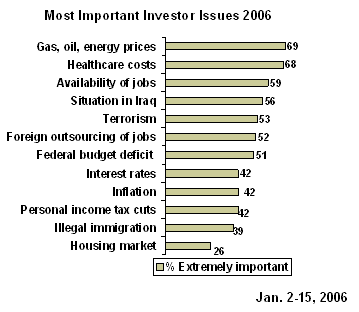
Most Important Investor Issues in 2006
Two in three investors say energy prices (69%) and healthcare costs (68%) will be extremely important for investors in 2006. Third is the availability of jobs (59%), followed by Iraq (56%), terrorism (53%), the outsourcing of jobs to foreign countries (52%), and the federal budget deficit (51%). Among the bottom 5 of the 12 issues included in the poll are tax cuts on personal income, interest rates, and inflation -- all at 42%. Illegal immigration follows at 39%, and conditions in the housing market come in last at 26%.
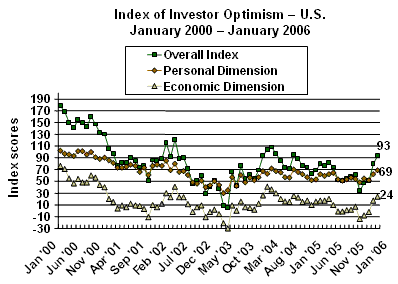
Investor Optimism Continues to Surge in January
The Index of Investor Optimism increased by 14 points in January 2006, on top of its 29-point increase in December, and now stands at 93 -- its highest level since June 2004, when it was at 95. This is the fourth consecutive increase in the Index since September 2005, when it stood at 34.
The Personal Dimension increased 7 points in January, reaching 69. The Economic Dimension also increased 7 points, to 24, indicating that investors as a whole are now optimistic about the economy. This contrasts sharply with their pessimistic views last September (-14), as both the Gulf Coast and the U.S. economy felt the impact of Hurricane Katrina.
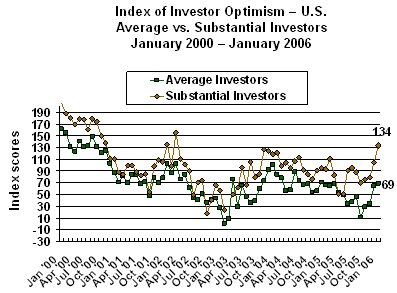
Substantial Investors Driving Optimism Upward
In April 2005, substantial and average investors (the latter are those having at least $10,000 but less than $100,000 in investable assets) were essentially equally optimistic about the investment climate, with the substantial investor Index at 51 and the average investor Index at 53. Since that time, the substantial investor Index has more than doubled, and now stands at 134. In sharp contrast, the average investor Index has increased by only 16 points over that same period, and now stands at 69 -- about half the level of the substantial investor Index.
Time to Refocus on Domestic Issues
Over the past 12 months, consumer prices have increased by 3.4%. As a result, inflation-adjusted weekly earnings actually declined by 0.4% last year -- the third annual decline in a row. Given this context, it is not surprising that consumer spending slowed to a 10-year low as 2005 came to an end.
According to a Bloomberg survey conducted among economists between Dec. 23 and Jan. 9, growth in consumer spending is expected to accelerate to a 3.5% annual rate during the first quarter of 2006. While consumer spending has remained surprisingly strong during some difficult economic times of the recent past, it appears unlikely that such an acceleration in consumer spending growth will happen, in the face of surging energy prices and no real earnings growth -- particularly if consumers reduce their use of home equity loans and lines as a way of maintaining their spending.
Still, market expectations are that the Federal Open Market Committee will increase interest rates at its Jan. 31 meeting and probably will do so again in March. Although interest-rate increases may be coming to an end after that, surging energy prices remain a significant inflationary threat.
Regardless, Gallup's recent investors' poll suggests that Washington policymakers would be well advised to shift some of their attention from the global arena to today's more mundane domestic concerns. In this regard, recent indications that the president will make some major new healthcare proposals during his State of the Union speech on Jan. 31 are fully consistent with investor priorities.
While international issues and Washington scandals may draw the headlines in the months ahead, the stealth issue for 2006 may be consumers' real disposable incomes. As investor priorities imply, if energy and healthcare costs continue to soar during a time of stagnant wages, they will endanger not only consumer spending but the overall economy as well as political incumbents in 2006.
Survey Methods
Results for the Index of Investor Optimism poll are based on telephone interviews with 801 investors, aged 18 and older, conducted Jan. 2-15, 2006. For results based on the total sample of investors, one can say with 95% confidence that the maximum margin of sampling error is ± 4 percentage points. In addition to sampling error, question wording and practical difficulties in conducting surveys can introduce error or bias into the findings of public opinion polls.
