GALLUP NEWS SERVICE
PRINCETON, NJ -- As Americans listen to President George W. Bush's State of the Union address Tuesday night, they will do so with a mostly negative frame of mind about the overall direction of the country and broad dissatisfaction with numerous domestic issues, but with tremendous national pride and continued confidence in the American Dream.
The latest Gallup polling finds only 35% of Americans satisfied with the way things are going in the United States generally; only 30% hold positive views about the economy. At the same time, 85% are proud to be American, most are content with the overall quality of life in the country (81% are satisfied), most are satisfied with the position of women (70%), with the opportunity for people to get ahead by working hard (66%), and with the position of blacks and other minorities (53%).
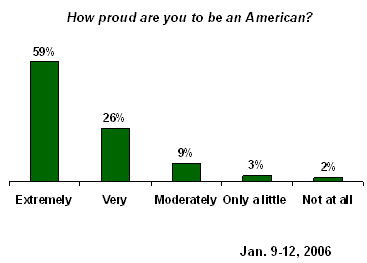
Taken together, the data seem to call for a sober State of the Union speech -- one that addresses the many serious issues facing the country -- but within an upbeat framework.
Issues Balance Sheet Tends to Be Negative
Gallup asked Americans how satisfied they were with 28 specific issues in the annual Gallup Mood of the Nation poll, conducted Jan. 9-12. Of the full list, the public is more satisfied than dissatisfied with 9, and more dissatisfied than satisfied with 11.
Americans tend to be positive about the general principles of American society and democracy -- the opportunity to get ahead by working hard, our system of government, the overall quality of life, the position of women and minorities, race relations, and the influence of religion. They are also mostly satisfied with the nation's military strength, and security from terrorism.
|
Positive Issue Ratings |
|||
|
Total Satisfied |
Total Dissatisfied |
Net |
|
|
% |
% |
|
|
|
1. The overall quality of life |
81 |
18 |
+63 |
|
2. The position of women in the nation |
70 |
26 |
+44 |
|
3. The nation's military strength and preparedness |
67 |
28 |
+39 |
|
4. The opportunity for a person to get ahead by working hard |
66 |
33 |
+33 |
|
5. The nation's security from terrorism |
58 |
39 |
+19 |
|
6. Our system of government and how well it works |
59 |
41 |
+18 |
|
7. The position of blacks and other racial minorities in the nation |
53 |
35 |
+18 |
|
8. The influence of organized religion |
55 |
41 |
+14 |
|
9. The state of race relations |
52 |
40 |
+12 |
Americans are closely divided in their assessment of seven areas, ranging from environmental quality, the nation's gun laws, the nation's economy, and abortion policies. These are areas where fewer than 10 percentage points separate the number who are satisfied vs. those who are dissatisfied.
|
Closely Divided Issue Ratings |
|||
|
Total Satisfied |
Total Dissatisfied |
Net |
|
|
% |
% |
|
|
|
1. The quality of the environment in the nation |
52 |
45 |
+7 |
|
1. The nation's laws or policies on guns |
48 |
43 |
+5 |
|
2. The nation's policies to reduce or control crime |
48 |
47 |
+1 |
|
3 The state of the nation's economy |
47 |
50 |
-3 |
|
4. The quality of medical care in the nation |
47 |
51 |
-4 |
|
5. The size and power of the federal government |
46 |
52 |
-6 |
|
6. The role the U.S. plays in world affairs |
44 |
51 |
-7 |
|
7. The nation's policies regarding the abortion issue |
40 |
48 |
-8 |
Where Americans are mostly dissatisfied spans a wide variety of domestic issues.
|
Negative Issue Ratings |
|||
|
|
Total Satisfied |
Total Dissatisfied |
Net |
|
|
% |
% |
|
|
1. The quality of public education in the nation |
42 |
56 |
-14 |
|
2. The amount Americans pay in federal taxes |
38 |
61 |
-23 |
|
3. The Social Security and Medicare systems |
35 |
58 |
-23 |
|
4. The nation's energy policies |
29 |
55 |
-26 |
|
5. The size and influence of major corporations |
35 |
62 |
-27 |
|
6. The acceptance of homosexuality in the nation |
32 |
59 |
-27 |
|
7. The nation's campaign finance laws |
21 |
53 |
-32 |
|
8. The moral and ethical climate |
33 |
66 |
-33 |
|
9. The level of immigration into the country today |
27 |
65 |
-38 |
|
10. The nation's efforts to deal with poverty and homelessness |
26 |
70 |
-44 |
|
11. The availability of affordable healthcare |
26 |
72 |
-46 |
National Security the Priority
A separate measure from Gallup's Jan. 20-22 survey finds terrorism and the situation in Iraq ranking high as issues Americans would like to see Congress and Bush address in the coming year. A majority says each of these is extremely important for the government to deal with.
Healthcare, the economy, and government corruption emerge as a second tier of priorities, while post-Katrina recovery and immigration rank lower.
|
How Important for the President and Congress to Deal With? |
||
|
Extremely |
Extremely/Very |
|
|
% |
% |
|
|
The situation in Iraq |
58 |
92 |
|
Terrorism |
57 |
89 |
|
Healthcare policy |
47 |
86 |
|
The economy |
46 |
87 |
|
Corruption in government |
45 |
82 |
|
The problems caused by Hurricane Katrina |
35 |
71 |
|
Immigration |
31 |
64 |
Healthcare Concerns Loom Large
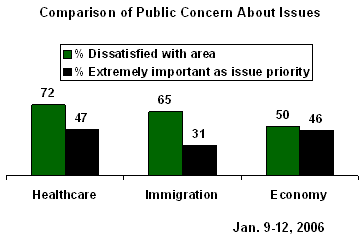
Healthcare stands out as one of most troubling domestic issue for Americans. Not only are the vast majority of Americans dissatisfied with healthcare, but healthcare ranks fairly high as an issue Americans want Congress and Bush to deal with in the coming year.
Like healthcare, immigration ranks high as a public concern for Americans (65% are dissatisfied with immigration, compared with 72% for healthcare). However, Americans are much less likely to say immigration should be a priority for governmental action than say this about healthcare: (31% vs. 47%).
Like healthcare, Americans rank the economy high as a governmental priority (46% call the economy "extremely important" vs. 47% for healthcare). At the same time, Americans are less dissatisfied with the economy than they are with healthcare (50% vs. 72%).
As a result, healthcare has little competition for the distinction of being Americans' number one domestic concern in Gallup's early January poll. (Public satisfaction with Iraq and anti-terrorism policies was not rated, and thus cannot be directly compared to healthcare).
Trend Highlights
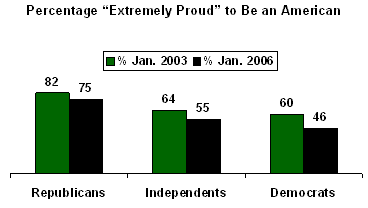
Although 6 out of 10 Americans still say they are "extremely proud" to be an American and another 26% are "very proud," national pride has declined some in recent years, particularly among Democrats.
There have been no significant changes over the past year in public satisfaction with most of the 28 issues rated each January, but the percentage satisfied has declined on four:
- Satisfaction with the nation's energy policies fell 10 points, from 39% in January 2005 to 29% in January 2006.
- Satisfaction with polices to reduce crime fell from 57% to 48%.
- Satisfaction with the U.S. role in world affairs fell from 52% to 44%.
- The percentage satisfied with the moral and ethical climate fell from 40% to 33%.
Additionally, the percentage saying it is extremely or very important for Congress to deal with immigration rose slightly over the past year, from 57% to 64%. At the same time, there was no change in the percentages saying they are satisfied or dissatisfied with immigration.
Parsing Complex Issues
The meaning of public dissatisfaction is fairly clear for most issues where dissatisfaction runs high. For instance, it is safe to assume that those dissatisfied with "the quality of public education in the nation" want the quality of education to be better. Similarly, it is clear that those dissatisfied with the nation's energy policies want better policies. But for a few issues (such as abortion policies, acceptance of homosexuality, and level of immigration) the policy implication associated with dissatisfaction is not self-evident. Therefore, for these issues, Gallup asks specific policy questions that resolve the ambiguity.
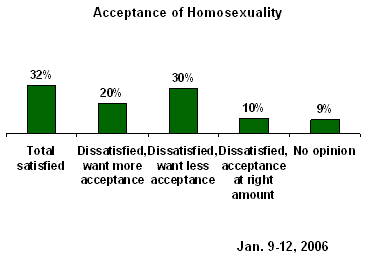
On gay rights, the 59% of Americans who are dissatisfied are largely divided between those who want more acceptance for gays and those who want less. As a result, the dissatisfied public on gay rights is not one Bush can satisfy with policy changes. Overall, one in five Americans seek more acceptance for gays, about a third are satisfied with current acceptance, and close to another third want less acceptance.
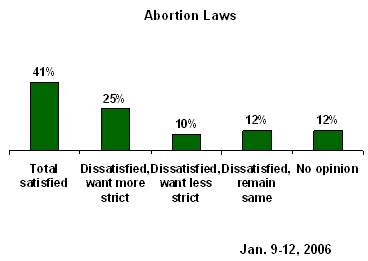
On abortion, there is also no consensus that can easily direct Bush on how to satisfy the dissatisfied public. Many of those who are dissatisfied want the laws to be more strict, though a large number feel the opposite, wanting them to be less strict. The net result is a that 25% of Americans are dissatisfied and want the laws to be more strict, 10% are dissatisfied and want the laws to be less strict, 12% say they are dissatisfied but want the laws to remain the same, and 41% are satisfied with current laws.
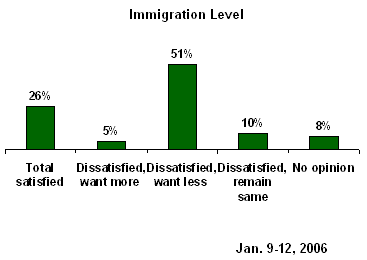
Immigration follows a different pattern, as most of those who are dissatisfied think that immigration should be reduced. The net result is that 51% of Americans are dissatisfied with the level of immigration and want it reduced; only 5% are dissatisfied and want it increased. Here, the guidance for Bush is much clearer.
Summary
All in all, the data reviewed suggest there are 12 specific problem areas for the country that Bush would be wise to touch on.
Americans are largely dissatisfied with conditions in 10 specific issue areas: healthcare (72% are dissatisfied), poverty (70%), the moral climate (66%), immigration (65%), corporate power (62%), taxes (61%), Social Security (58%), public education (56%) energy policies, (55%), and campaign finance laws (53%).
Additionally, Iraq and terrorism rank high as areas the public is anxious to see Congress and Bush address in the coming year.
Survey Methods
These results are based on telephone interviews with a randomly selected national sample of 1,003 adults, aged 18 and older, conducted Jan. 9-12, 2006 and a separate survey of 1,006 adults, aged 18 and older, conducted Jan. 20-22, 2006. For results based on surveys of these sizes, one can say with 95% confidence that the maximum error attributable to sampling and other random effects is ±3 percentage points. In addition to sampling error, question wording and practical difficulties in conducting surveys can introduce error or bias into the findings of public opinion polls.